ADX Calculation for Gold: Step-by-Step Guide
ADX Calculation for Gold: Step-by-Step Guide
The Average Directional Index (ADX) helps traders measure the strength of gold price trends without indicating direction. It’s especially useful in volatile markets like gold, where trends can shift sharply. ADX values range from 0 to 100, with higher values signaling stronger trends. To calculate ADX, you’ll need accurate gold price data, including high, low, and closing prices, over a consistent timeframe (typically 14 periods). The process involves these key steps:
- True Range (TR): Measure daily price volatility by comparing the current high, low, and previous close.
- Average True Range (ATR): Smooth TR values over 14 periods to assess average volatility.
- Directional Movement (+DM and -DM): Identify whether price movement is upward or downward.
- Directional Indicators (+DI and -DI): Turn smoothed +DM and -DM values into percentages relative to ATR.
- Directional Index (DX) and ADX: Calculate DX from +DI and -DI, then smooth it to derive ADX.
Accurate, real-time data is essential for reliable ADX calculations. Tools like OilpriceAPI streamline this by providing consistent gold price data, ensuring your analysis stays aligned with current market conditions. ADX is most effective when combined with other indicators, helping traders confirm trends and refine strategies.
How to Use the ADX Indicator to Profit in Trading - Discover this Effective Method
What You Need Before Calculating ADX
Before diving into ADX calculations for gold, it’s crucial to start with accurate and reliable data.
Required Data for ADX Calculation
To analyze ADX effectively, you’ll need specific price data for each trading period: high, low, and closing prices in USD per troy ounce. Stick to a consistent timeframe - typically 14 periods - and ensure timestamps align with your chosen interval.
You can adjust the standard 14-period window to match your trading strategy. For instance, shorter periods (like 7 days) can provide more responsive signals, while longer ones (such as 21 days) result in smoother, less volatile trends.
The type of data interval you use - daily, hourly, or even minute-by-minute - depends on your trading style. Day traders might lean toward 15-minute or hourly intervals, while long-term investors often rely on daily closing prices. Whatever you choose, consistency in time intervals is critical for accurate calculations.
Why Accurate Gold Price Data Matters
Precision matters when it comes to ADX calculations. Even small errors in your price data can lead to misleading results, as the formula relies on exact differences between consecutive price periods. Inaccuracies can distort key components like directional movements and true range values, potentially throwing off your analysis.
To avoid this, stick to a single, reliable data source. Errors or delays in price feeds can significantly impact your trading decisions, especially if you’re working with real-time market conditions. Outdated or inconsistent data might not reflect current trends, undermining your strategy.
Using a service like OilpriceAPI can simplify this process. It provides both real-time and historical gold price data in standardized formats, making it easy to integrate with your calculation tools or trading platforms. This eliminates the hassle of cleaning or reformatting data from multiple sources and ensures you’re working with dependable information.
With accurate data at your fingertips, you’re ready to move on to the actual ADX calculation process.
How to Calculate ADX for Gold: Step-by-Step Process
Calculating the Average Directional Index (ADX) for gold involves five sequential steps. Each builds on the previous to arrive at the final ADX value. Here's a clear breakdown of the process.
Step 1: Calculate True Range (TR)
The True Range (TR) measures gold price volatility by comparing three price relationships for each trading day. For every period, calculate the following:
- Current High - Current Low: The difference between the day's highest and lowest prices.
- |Current High - Previous Close|: The absolute difference between today’s high and yesterday’s closing price.
- |Current Low - Previous Close|: The absolute difference between today’s low and yesterday’s closing price.
From these, select the largest value as the True Range for the day. For instance, if the high is $21.95, the low is $20.22, and the previous close is $21.51:
- (H-L) = $21.95 - $20.22 = $1.73
- |H-Cp| = |$21.95 - $21.51| = $0.44
- |L-Cp| = |$20.22 - $21.51| = $1.29
The True Range for Day 1 is $1.73, as it’s the largest value.
Step 2: Calculate Average True Range (ATR)
The Average True Range (ATR) smooths out daily TR values over a specific period, typically 14 days, to provide a clearer picture of average volatility.
- For the initial ATR, sum the TR values from the first 14 periods and divide by 14.
- For subsequent ATRs, use this formula:
Current ATR = [(Prior ATR × (n-1)) + Current TR] / n, where 'n' is the period length (usually 14).
For example, if the first 14 TR values total $16.65, the initial ATR is $16.65 ÷ 14 = $1.18. Using a prior ATR of $1.18 and today’s TR of $1.18, the new ATR becomes:
[(1.18 × 13 + 1.18) ÷ 14 = $16.52 ÷ 14 = $1.18].
Step 3: Find +DM and -DM Values
Now, determine the Directional Movement (DM), which shows whether gold prices are trending upward or downward.
-
+DM (Positive Directional Movement):
Calculate Current High - Previous High. If this value is positive and greater than |Current Low - Previous Low|, then +DM equals this value. Otherwise, +DM = 0. -
-DM (Negative Directional Movement):
Calculate Previous Low - Current Low. If this value is positive and greater than |Current High - Previous High|, then -DM equals this value. Otherwise, -DM = 0.
Each period will have either a +DM or -DM value, depending on the stronger directional movement.
Step 4: Calculate +DI and -DI
The Directional Indicators (+DI and -DI) turn the smoothed +DM and -DM values into percentages relative to the ATR, allowing for standardized comparisons.
- +DI = (Smoothed +DM ÷ ATR) × 100
- -DI = (Smoothed -DM ÷ ATR) × 100
To calculate these, first smooth the +DM and -DM values using the same 14-period formula as the ATR. Then divide each smoothed value by the ATR and multiply by 100. These percentages reflect the strength of upward (+DI) or downward (-DI) movements.
Step 5: Calculate DX and Get Final ADX
Finally, combine the directional indicators to calculate the Directional Index (DX) and, ultimately, the ADX.
- DX = (|+DI - -DI| ÷ (+DI + -DI)) × 100
The ADX is then derived by smoothing the DX values:
- First ADX: The average of the first 14 DX values.
- Subsequent ADX: Use the formula:
Current ADX = [(Prior ADX × 13) + Current DX] / 14.
The ADX score ranges from 0 to 100. Higher values indicate stronger trends (regardless of direction), while lower values suggest weaker or sideways market movement.
sbb-itb-a92d0a3
How to Read ADX Results for Gold Trading
Understanding ADX values can help you make better decisions when trading gold. The ADX measures the strength of a trend, giving you a clearer picture of market movements. By interpreting these values, you can turn technical data into actionable strategies.
What ADX Numbers Mean
The ADX scale ranges from 0 to 100, and each range reveals something different about gold's price behavior. As Welles Wilder, the creator of the ADX, explained:
A trend shows the most strength when the Average Directional Index is above 25... and a trend is weak or the price is considered trendless if the ADX reaches below 20.
| ADX Value Range | Trend Strength | Market Condition | Trading Implication |
|---|---|---|---|
| Below 20 | Weak or No Trend | Stable or Sideways | Avoid new trades; the market lacks a clear direction |
| 20 – 40 | Developing/Moderate | Gradual Movement | Align trades with the emerging trend direction |
| Above 40 | Strong Trend | Clear, Robust Direction | Indicates a strong trend, but very high readings could signal exhaustion |
- ADX below 20: This suggests a sideways or consolidating market where trends are weak, and breakouts are hard to predict.
- ADX between 20 and 40: A trend is forming, making it a good range for trend-following strategies.
- ADX above 40: This confirms a strong trend, but be cautious - extremely high values might indicate the trend is overextended.
Using Real-Time Data for Better ADX Calculations
To get accurate ADX readings, you need up-to-the-minute gold price data. In a fast-paced market like gold, even a slight delay in data can lead to outdated calculations, leaving you with insights that no longer reflect actual market conditions.
Why Real-Time Data Matters for ADX Analysis
Gold prices can shift dramatically within minutes, especially during major economic events or geopolitical developments. Using real-time data is essential for precise market analysis in volatile commodity markets like gold (XAUUSD). If your data lags, your ADX calculations will be off, making your trading decisions less effective.
Here’s why this happens: ADX relies on directional movement and true range values. Any delay in price data creates a domino effect, leading to trend strength readings that may show a strong trend when the market has already reversed. In contrast, low-latency data keeps your analysis aligned with current market momentum, enabling quicker, more informed trading decisions. Real-time data ensures your ADX values reflect what’s happening now - not what happened minutes ago.
In today’s lightning-fast trading environment, having up-to-date data isn’t just helpful; it’s critical. Seamless data flow lets you integrate accurate ADX metrics into your trading strategy, helping you respond to market shifts as they happen.
How OilpriceAPI Simplifies Data Access
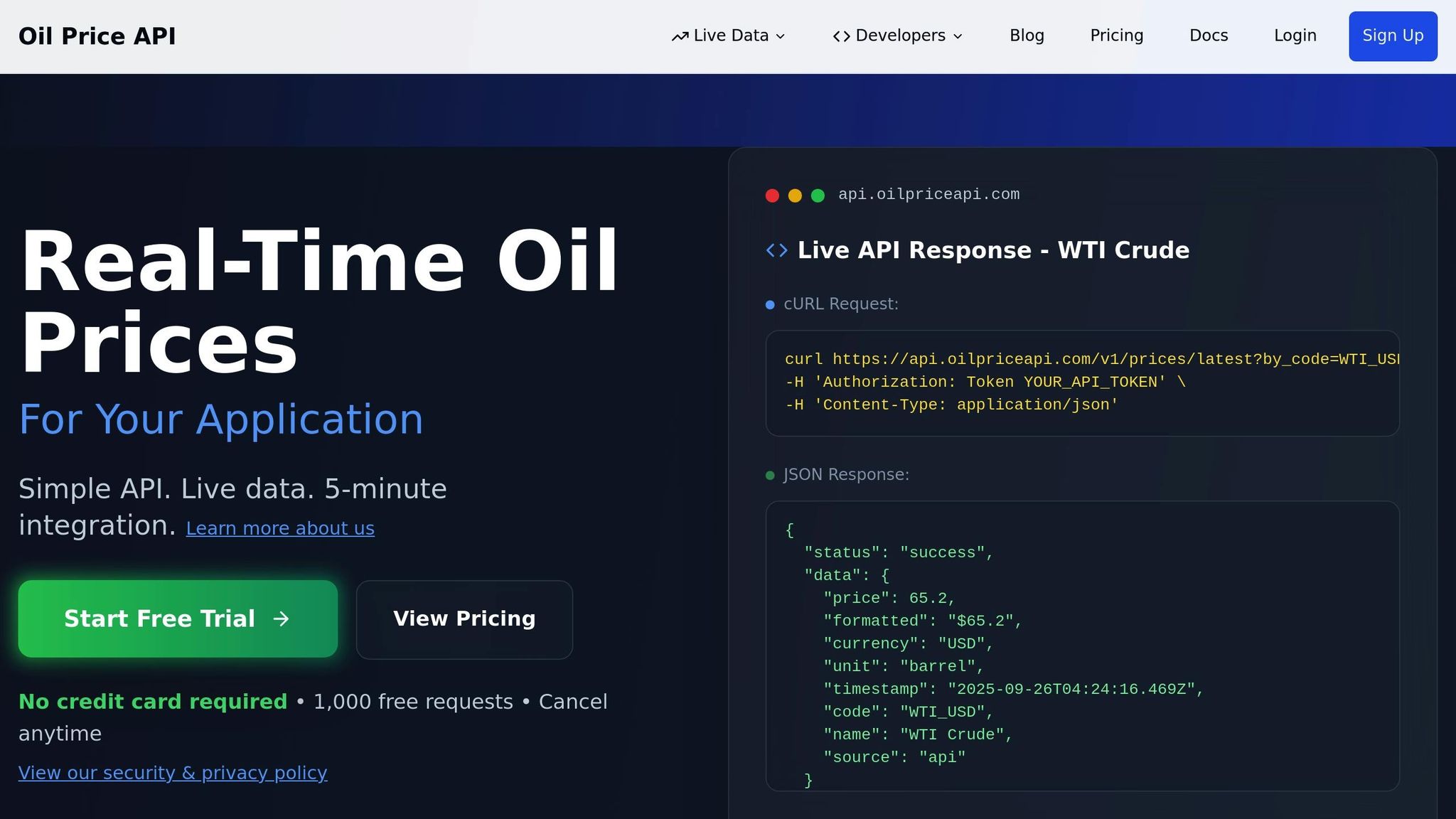
OilpriceAPI makes accessing real-time data easy and efficient. The platform provides both real-time and historical gold price data through a straightforward JSON REST API. This automation means you can bypass the tedious process of manually updating spreadsheets or charts.
Whether you need ADX calculations once a day or continuous updates during trading hours, OilpriceAPI offers flexible data frequency options to suit your strategy. What sets it apart is the consistency of its data format. Instead of juggling multiple data sources with varying formats or update schedules, you get reliable gold price information that integrates directly into your ADX calculations. This eliminates the errors that often arise when transferring data manually across platforms.
Manual vs. API-Based ADX Calculations
Switching from manual to API-driven ADX calculations can save you time and improve accuracy. Here’s how the two approaches compare:
| Aspect | Manual Calculations | API-Based Calculations |
|---|---|---|
| Time Required | 15-30 minutes per calculation | Automated, completed in seconds |
| Data Accuracy | Prone to errors and delays | Real-time and consistent |
| Update Frequency | Limited by manual effort | Continuous or scheduled updates |
| Scalability | Difficult to manage multiple timeframes | Easy to monitor various periods simultaneously |
| Error Risk | High due to manual data entry | Minimal, thanks to automation |
| Cost | Time-intensive but no direct costs | Subscription fees but significant time savings |
Manual calculations involve copying high, low, and close prices for 14-day periods, which leaves plenty of room for errors. A single mistake can throw off your entire analysis. On the other hand, API-based calculations automate these steps. Your system can pull the latest gold prices and recalculate ADX values automatically, ensuring your trend strength readings are always up-to-date - without the manual workload.
Modern tools like OilpriceAPI provide the real-time data you need for effective analysis and execution. In volatile markets, this advantage can make all the difference when it comes to spotting trend changes quickly and acting decisively.
Summary and Next Steps
The Average Directional Index (ADX) helps measure trend strength, offering valuable insights for gold trading. By understanding and following its systematic calculation process, you can better assess market momentum and refine your trading strategies.
Recap of ADX Calculation Steps
Calculating ADX for gold involves a step-by-step approach that builds on itself to deliver accurate trend strength readings:
-
Step 1: Determine the True Range (TR)
Identify the highest value among three price relationships to calculate TR. -
Step 2: Calculate the Average True Range (ATR)
Smooth the TR values over a 14-period span to establish the ATR. -
Step 3: Find Directional Movement (+DM and -DM)
Compare the current highs and lows with those of previous periods to determine directional movement values. -
Step 4: Compute Directional Indicators (+DI and -DI)
Divide the smoothed directional movements by the ATR, then multiply by 100 to calculate +DI and -DI. -
Step 5: Derive the DX and ADX Values
Use the relationship between +DI and -DI to calculate the DX, then smooth it over 14 periods to get the final ADX reading.
Accurate inputs and consistent timeframes are critical for reliable results. ADX values range from 0 to 100, with readings above 25 indicating a strong trend. This structured process ensures clarity and precision in your analysis.
The Importance of Quality Data
Accurate and real-time gold price data is essential for effective trend analysis. Using poor or delayed data can lead to skewed ADX readings, especially during volatile market conditions when gold prices fluctuate rapidly. Reliable data sources, such as OilpriceAPI, ensure your ADX calculations align with current market momentum, allowing you to make informed trading decisions. Consistent access to quality data strengthens your ability to act confidently and capitalize on trading opportunities.
Integrating ADX into Your Gold Trading Strategy
Now that you understand how to calculate ADX and the importance of reliable data, it’s time to incorporate these insights into your trading approach. ADX is most effective when used alongside other tools, rather than as a standalone indicator. Pair ADX readings with +DI and -DI values to gauge both trend strength and direction. This combination offers a more comprehensive view, helping you identify not just whether a trend is strong but also the direction it’s moving.
ADX can also serve as a filter for other trading signals. For instance, when ADX indicates strong trend conditions (above 25), it may increase the likelihood of success for directional trades. Conversely, when ADX shows weak trends (below 20), you might shift your focus to range-bound strategies or wait for clearer signals before acting.
It’s important to remember that ADX confirms trends rather than predicts them. Use it to validate price action and assess whether current trends have the strength to continue. Before fully implementing ADX strategies, consider paper trading to refine your approach and build confidence.
Given the gold market's inherent volatility, analyzing trend strength with ADX can be particularly useful. By mastering ADX calculations and relying on dependable data, you’ll have a powerful tool to navigate the complexities of gold trading with greater accuracy and confidence.
FAQs
How does the ADX indicator help traders analyze gold market trends?
The ADX (Average Directional Index) is a handy tool for traders looking to measure the strength of trends in the gold market. When the ADX is above 25, it usually points to a strong trend, signaling that trend-following strategies could work well. On the flip side, an ADX reading below 25 suggests a weaker or sideways market, where different tactics might be more suitable.
By incorporating the ADX into their analysis, traders can fine-tune their entry and exit points, adapt strategies to current market conditions, and manage risks more effectively. It’s a key indicator for making smarter decisions in gold trading.
What mistakes should I avoid when calculating ADX for gold, and how can they impact trading results?
When analyzing gold with the ADX (Average Directional Index), one common pitfall is relying solely on the indicator for making trade decisions. While ADX is a valuable tool, it performs best in trending markets. Using it in range-bound conditions often results in false signals or delayed reactions, which can lead to poorly timed entries or exits - and potentially increase losses.
Another frequent mistake involves incorrect ADX period settings. Short periods tend to generate excessive noise, making it harder to identify meaningful trends. On the other hand, overly long periods may smooth out key signals, causing traders to miss potential opportunities. Additionally, the accuracy of your data inputs is critical. Even minor errors in the data can compromise the indicator's reliability. By addressing these issues, you can use ADX more effectively and approach trading decisions with greater confidence.
Why is using real-time data essential for ADX calculations in the gold market, and how can delays affect trading decisions?
Real-time data plays a crucial role in calculating the ADX (Average Directional Index) for the gold market. It allows traders to evaluate the strength of price trends as they unfold, ensuring their decisions are based on the most current market conditions. Given how unpredictable gold prices can be, even a slight delay in data can lead to outdated signals, resulting in missed opportunities or poor trading choices.
Relying on delayed data increases the risk of acting on trends that are no longer relevant, which can amplify the chances of encountering false signals. By using real-time data from dependable sources like OilpriceAPI, traders can react more quickly and make well-informed decisions, staying ahead in the ever-changing gold market.