Designing for Data-Driven Financial Apps
Designing for Data-Driven Financial Apps
Real-time data is the backbone of financial apps. Whether you're monitoring commodity prices or managing multi-asset portfolios, the right API can make or break your application. Here's what you need to know:
- OilpriceAPI: Best for apps focused on commodities like oil, gas, and gold. It offers fast updates (every 5 minutes), simple integration, and reliable security.
- Generic Financial Data APIs: Ideal for broader financial needs (stocks, currencies, bonds). They provide diverse data but require more setup and customization.
Quick Comparison
| Criteria | OilpriceAPI | Generic Financial Data APIs |
|---|---|---|
| Data Focus | Commodities (oil, gas, gold) | Broad financial instruments |
| Update Frequency | Every 5 minutes | Varies by provider |
| Integration Complexity | Simple JSON endpoints | Requires additional filtering |
| Request Volume | 1.5M+ monthly requests | Varies |
| Customization | Tailored commodity data feeds | Standardized feeds with customization |
| Security | Token-based, 24/7 monitoring | Multi-layered encryption and compliance |
Key takeaway: Choose OilpriceAPI for energy-focused apps needing speed and simplicity. Opt for generic APIs for multi-asset platforms, but be prepared for more complex integration.
Designing a Finance App From Scratch in Figma

1. OilpriceAPI
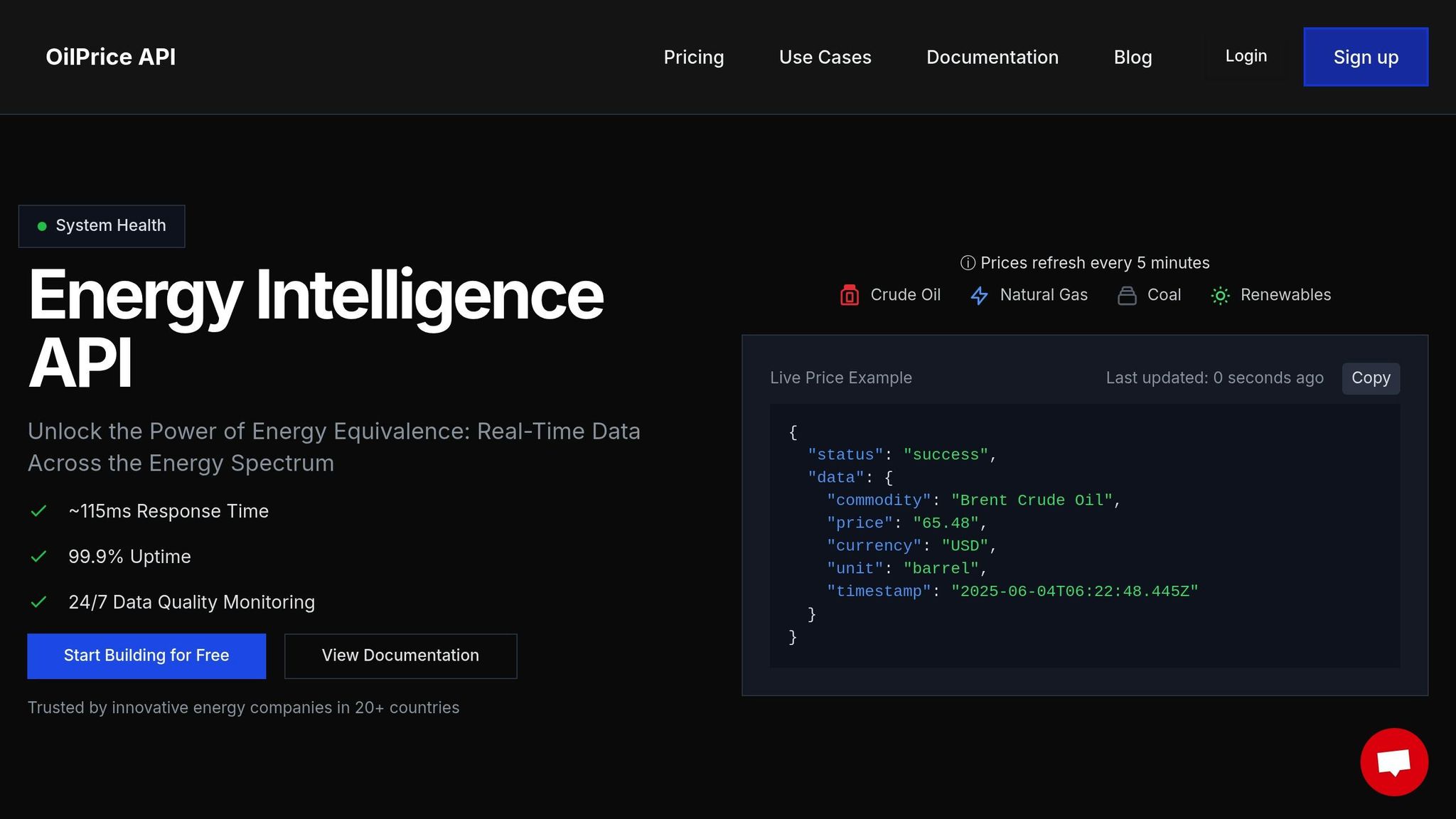
OilpriceAPI is tailored for financial applications that require dependable, real-time, and historical data for key commodities like Brent Crude, WTI, Natural Gas, and Gold. This JSON REST API delivers the essential data needed for informed decision-making in the financial world.
Real-Time Data Capabilities
OilpriceAPI stands out with its impressive performance metrics: 99.9% uptime, response times averaging 115 milliseconds, and commodity price updates every 5 minutes. These features strike a great balance between data accuracy and system efficiency, making it well-suited for quick trading decisions. The platform's ability to handle millions of monthly requests while serving users across 20+ countries further highlights its reliability and scalability.
Ease of Integration
OilpriceAPI is designed with developers in mind, offering a simple REST API paired with detailed documentation. This makes it straightforward to work with, even for those who might not be API experts.
"Oilprice API simplifies the process of obtaining accurate real-time updates and historical data for major commodities."
The platform uses token-based security for authentication, eliminating the need for complex OAuth setups. This streamlined approach allows developers to integrate the API quickly, reducing development time and enabling them to focus on creating user-friendly interfaces while leveraging reliable data.
Security Features
In financial applications, data security and accuracy are essential. OilpriceAPI addresses this with 24/7 data quality monitoring, ensuring the information remains dependable. By sourcing data from trusted market sources, the platform builds confidence in the reliability of the data it provides, meeting the high standards required for financial tools.
2. Generic Financial Data API
While platforms like OilpriceAPI focus on specific commodities, generic financial data APIs offer a broader view of the market. These APIs provide standardized access to a wide range of financial instruments, including stocks, bonds, and currencies, across multiple markets.
Real-Time Data Capabilities
Generic financial data APIs deliver real-time market updates, enabling users to respond quickly to market shifts. This speed and accuracy are particularly vital for algorithmic trading systems, which rely on precise data feeds to minimize risks and maximize returns.
Leading APIs showcase impressive performance metrics. For example, some handle over 700 million API requests daily, with peak loads reaching 1,000,000 requests per minute. Using WebSocket connections, these platforms achieve ultra-low latency data streaming, with average response times of approximately 170 milliseconds across all instruments.
These capabilities are a game-changer for high-frequency trading, where milliseconds can influence outcomes. Portfolio managers also leverage real-time data by integrating sentiment analysis from news and social media with traditional metrics to anticipate short-term market trends. Such robust performance ensures seamless integration into financial applications.
Ease of Integration
How easily an API integrates can significantly impact the development process for financial applications. Generic financial data APIs follow predetermined standards that streamline the integration process, saving time and effort by aligning various development phases.
However, challenges remain. A striking 97% of companies report difficulties in implementing successful API strategies. RESTful APIs are often preferred for mobile app development due to their efficient bandwidth usage and faster processing compared to SOAP, which requires more complex and costly technologies. These APIs can enhance applications with features like payment processing, data analytics, and portfolio management, eliminating the need for developers to build these functions from scratch.
Customization Options
Customization is another strength of generic financial data APIs. They allow users to tailor data feeds with specific information, services, and formatting, making it easier to integrate them into existing workflows. This flexibility enables businesses to analyze customer financial data and offer personalized products, services, and recommendations.
The shift from batch processing to real-time API calls marks a major improvement. APIs now allow users to request data in a predefined format in real time, replacing the older, slower batch processing methods traditionally used in financial institutions.
One notable example is a European investment bank that implemented real-time balance APIs. This move gave them near-instant visibility into payment activities, significantly reducing decision-making times across their operations.
Security Features
Security is crucial when dealing with financial data, particularly as data breaches become more common. Generic financial data APIs address this with multi-layered security measures, including encrypted data transmission, secure authentication protocols, and strict compliance with financial regulations.
Choosing an API with strong security, compliance, and infrastructure ensures data integrity while minimizing latency. By combining traditional metrics with alternative inputs, these APIs offer a broader view of market dynamics, unlocking new possibilities for predictive modeling and risk assessment. Emerging technologies like edge computing and blockchain are poised to further enhance data processing speed and transparency in the financial sector.
sbb-itb-a92d0a3
Comparison Summary
Building real-time financial apps means carefully deciding between OilpriceAPI and more general financial APIs, depending on your specific requirements. Each option has its strengths and challenges, which can impact both user experience and development timelines.
OilpriceAPI stands out for its precision and focus. Handling over 1.5 million requests monthly, it offers real-time data on Brent Crude, WTI, Natural Gas, and Gold. This makes it a go-to choice for energy-focused apps, as it minimizes the need to filter irrelevant data, saving both time and development costs.
On the other hand, generic financial data APIs are designed for versatility. They provide a broad range of financial data, including stocks, bonds, currencies, and commodities. While they cater to diverse application needs, they often require additional data filtering and setup to handle the wide array of information they offer. Here's a quick comparison of key differences:
| Criteria | OilpriceAPI | Generic Financial Data API |
|---|---|---|
| Data Focus | Specialized in oil, gas, and gold prices | Broad coverage of multiple financial instruments |
| Update Frequency | Every 1–2 minutes | Varies |
| Integration Complexity | Simple JSON endpoints, fast setup | May require extra data filtering |
| Request Volume | Over 1.5M monthly requests | Varies with provider |
| Development Cost | Lower for energy-focused apps | Higher initial setup for diverse data needs |
| Customization | Tailored commodity data feeds | Standardized feeds needing extra customization |
| Historical Data | Limited in free tiers | Depends on subscription level |
Both options prioritize secure data transmission and authentication. However, OilpriceAPI's specialized focus allows it to implement security features tailored to commodity trading. It’s worth noting that OilpriceAPI’s free tier has limits on requests and historical data, while generic APIs often require premium plans to match its level of real-time precision.
The global API management market, projected to hit $21 billion by 2028, highlights the importance of choosing the right integration. If your app revolves around energy trading, commodity analysis, or sector-specific dashboards, OilpriceAPI’s targeted data and ease of use make it an excellent fit. On the flip side, if you’re building a platform that manages multi-asset portfolios or offers a broader financial overview, generic APIs deliver the comprehensive data you’ll need - though at the cost of more complex integration.
Conclusion
Choosing between OilpriceAPI and general financial data APIs ultimately depends on your app's goals and audience. If you're developing an energy-focused application, OilpriceAPI offers tailored data and straightforward integration. This allows your team to focus on crafting a seamless user experience rather than dealing with complex data handling. On the other hand, generic APIs provide a broader range of data but may require more effort to integrate and maintain.
When it comes to historical data, OilpriceAPI delivers key pricing information for oil, gas, and gold. In contrast, generic APIs often offer larger datasets that span multiple asset classes. For organizations prioritizing efficiency, adopting specialized APIs like OilpriceAPI can lead to a 35% faster time-to-market and a 42% reduction in development costs compared to competitors. Financial institutions using specialized APIs have also reported a 31% boost in customer acquisition and a 27% drop in onboarding costs. Additionally, OilpriceAPI's precise data delivery results in faster dashboard loading times and more responsive interfaces, which directly improve user satisfaction and engagement.
Generic APIs, however, are ideal for multi-asset platforms that demand diverse market data. They support a variety of visualizations, from stock performance graphs to currency correlation heatmaps. But this flexibility often comes with greater integration challenges and potentially higher development expenses.
Both API types uphold strong security standards. The real difference lies in ease of implementation and ongoing maintenance. OilpriceAPI's specialized focus means fewer breaking changes and more predictable updates, while generic APIs, due to their broader scope, may require more frequent adjustments.
Ultimately, the right choice depends on your app's focus. If you're building a commodity-specific application and value simplicity and speed, OilpriceAPI is the way to go. For broader, multi-asset platforms, generic APIs offer the versatility you need, albeit with added complexity.
FAQs
What should I consider when deciding if OilpriceAPI is the right fit for my financial app?
When deciding if OilpriceAPI is a good fit for your financial app, there are a few important things to weigh. Start by asking yourself if your app needs real-time or historical pricing data for commodities like Brent Crude, WTI, Natural Gas, or Gold. OilpriceAPI delivers this data through a JSON REST API, which makes integration straightforward and hassle-free.
Also, consider how critical data accuracy and reliability are for your users. If your app depends on up-to-the-minute commodity prices to help users make decisions, OilpriceAPI's commitment to precise and timely data could be a valuable asset. Take a moment to review how the API's features line up with your app's objectives, whether that's simplifying price analysis or empowering users to make informed choices.
By aligning OilpriceAPI's strengths with your app's specific requirements, you can create a smoother user experience and ensure dependable data performance.
How easy is it to integrate OilpriceAPI compared to other financial data APIs, and how could this affect development timelines?
OilpriceAPI is built to make integration straightforward, delivering quick response times and dependable performance with an impressive 99.9% uptime. Unlike many financial data APIs that often involve dealing with complicated data formats and normalization, OilpriceAPI takes a more simplified approach.
This streamlined setup can save developers valuable time, enabling them to concentrate on building intuitive, data-rich financial apps instead of getting bogged down with integration headaches.
How can OilpriceAPI improve the user experience of energy-focused financial apps compared to general financial data APIs?
OilpriceAPI transforms how energy-focused financial apps operate by providing real-time, dependable data with an impressive 99.9% uptime. This ensures users always have access to the most current market updates. Unlike broader financial data APIs, OilpriceAPI zeroes in on energy commodities like Brent Crude, WTI, Natural Gas, and Gold, delivering precise insights tailored specifically to this sector.
With its ability to streamline price analysis and supply both real-time and historical data, OilpriceAPI enables users to make well-informed decisions with speed and confidence. This specialized approach allows financial apps to differentiate themselves by delivering accurate, timely information that’s essential for managing price risks and conducting detailed market evaluations.