APIs are transforming commodity risk management by providing real-time data and automating complex processes. Here's how they help:
- Real-Time Data Access: APIs deliver instant updates on commodity prices, enabling quick decisions and minimizing risks during volatile market conditions.
- Automation: They eliminate manual tasks like data entry, trade reconciliation, and compliance reporting, reducing errors and saving time.
- Historical Data for Analysis: APIs provide years of historical data for backtesting strategies and identifying trends.
- Multi-Commodity Support: Manage diverse portfolios with data on oil, gold, natural gas, and more - all from a single source.
- Custom Alerts: Set up notifications for price thresholds, volume changes, or market events to stay ahead.
With APIs, businesses can make faster, data-driven decisions, automate workflows, and improve compliance, all while reducing costs and errors.
An introduction to commodities risk management
How APIs Deliver Real-Time Commodity Market Data
APIs act as the bridge between commodity markets and financial systems, delivering the kind of data that drives informed decisions. By collecting, processing, and sharing price information almost instantly, they ensure market players stay ahead of the curve.
Key Features of Commodity APIs
Commodity APIs come packed with features that are essential for managing risk effectively. One of the most critical is real-time updates - some APIs can deliver price changes with delays as short as 170 milliseconds. This near-instant speed ensures that users are always working with the latest market data.
Another vital feature is access to historical data, which adds depth to market analysis. With years of past information at their fingertips, analysts can identify trends, measure volatility, and develop predictive models. Combining real-time updates with historical insights offers a comprehensive view of market dynamics.
Multi-commodity support is another standout feature. Top-tier APIs cover a wide range of commodities, including Brent Crude, WTI, Natural Gas, and Gold. This eliminates the hassle of juggling multiple data providers, streamlining portfolio monitoring and reducing system complexity.
Accuracy is non-negotiable in financial markets, and data precision is a hallmark of professional-grade APIs. These tools maintain accuracy down to two decimal places and boast uptime rates as high as 99.99% over a year. Such reliability ensures traders and analysts can trust the data they’re using to make critical decisions.
Together, these features make it easier to integrate and rely on commodity APIs for seamless and secure data management.
How APIs Simplify Data Integration
The integration process for commodity APIs is designed to be straightforward, thanks to their JSON REST structure. This widely-used protocol provides a standardized format that is easy to parse and incorporate into existing systems. Gone are the days of tedious manual data entry - APIs do the heavy lifting.
With HTTP requests using GET and POST methods, users can fetch specific data points or request tailored information. Security is ensured through authentication methods like API keys or OAuth tokens, safeguarding access to sensitive data.
Once integrated, APIs automate data updates and cleaning. This means systems are constantly refreshed with the latest information - whether it’s price movements, bid-ask spreads, or trading volumes - without human intervention. APIs also handle raw data inconsistencies, delivering clean, ready-to-use information that fits seamlessly into analytical tools.
This automation and real-time processing are what make APIs indispensable for modern commodity trading and risk management.
Example: Real-Time Price Updates with OilpriceAPI
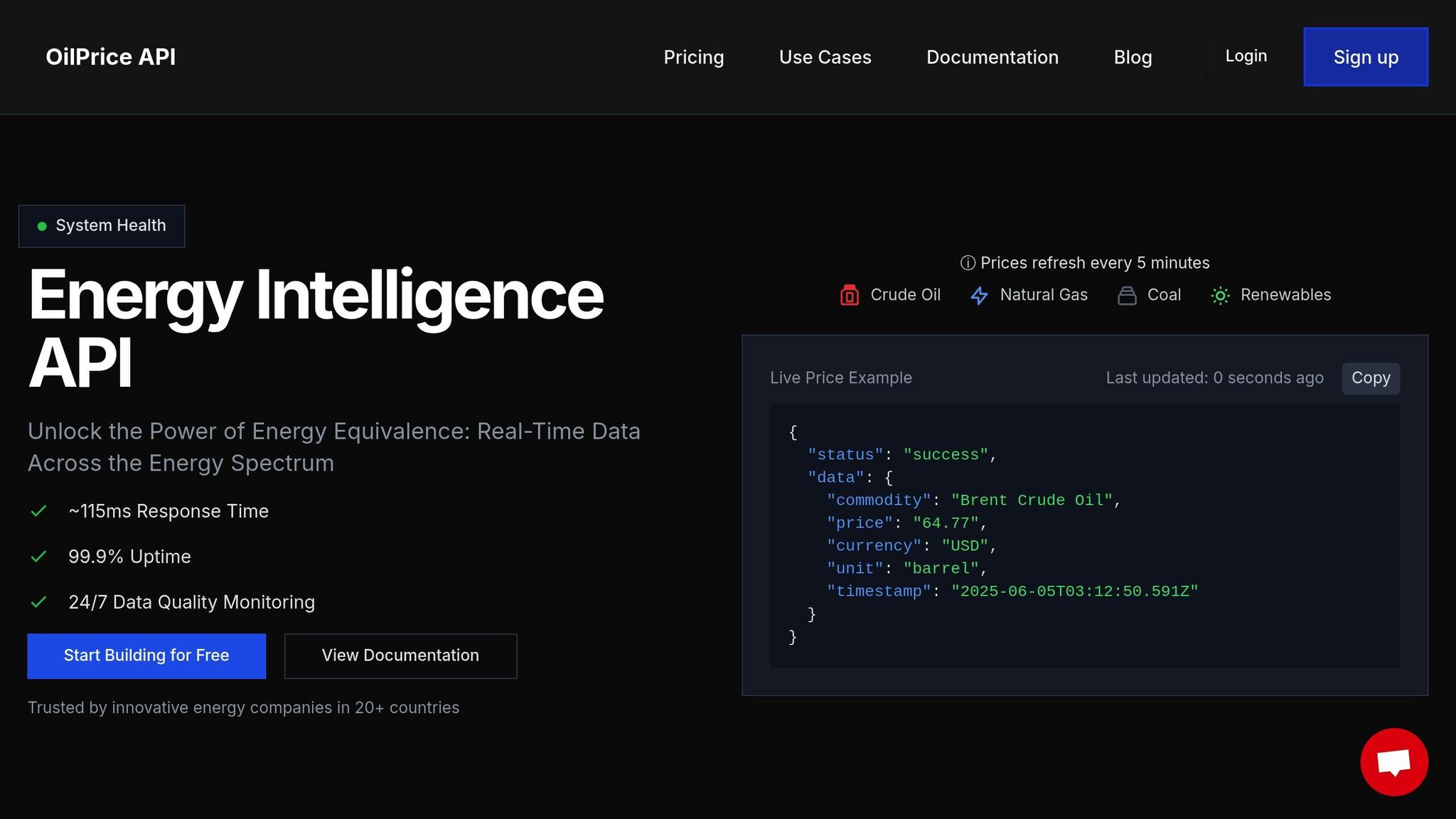
OilpriceAPI is a prime example of how commodity APIs translate technical capabilities into real-world value. It provides both real-time and historical pricing data for key commodities like Brent Crude, WTI, Natural Gas, and Gold through a JSON REST API that integrates effortlessly with financial systems.
Its real-time functionality is especially useful for responding to market fluctuations. For instance, when crude oil prices shift due to geopolitical events or changes in inventory reports, users receive updated pricing data within seconds. This speed is critical for energy companies managing exposure to volatile oil prices or financial institutions handling commodity-linked derivatives.
The historical data offered by OilpriceAPI is equally valuable. Risk managers can backtest strategies or analyze how portfolios would have performed during past market shocks, such as the oil price crash in March 2020 or the natural gas volatility seen in the winter of 2021-2022.
The API’s structured JSON format makes integration with financial software and custom trading platforms a breeze. Users can extract specific data points, set automated alerts, or feed the information directly into risk management dashboards. This flexibility allows businesses to tailor their data usage to meet specific needs.
Automating Risk Management with APIs
APIs have revolutionized risk management by harnessing real-time data feeds to automate complex workflows that used to take hours. By directly integrating market data with risk management systems, APIs not only cut down on manual errors but also streamline processes that were previously cumbersome.
The numbers speak for themselves - automation can reduce compliance costs by 40% and cut routine risk assessment time in half. These efficiencies bring greater precision and reliability to managing exposure in volatile commodity markets.
This technology also transforms areas like hedging and position monitoring, introducing real-time alerts and seamless ledger integrations that redefine how risk management is approached.
Automated Hedging and Position Monitoring
With APIs, hedging becomes a proactive, data-driven process. By continuously feeding real-time market data into risk systems, APIs enable automated tasks like mark-to-market accounting, scenario analysis, and settlement processes. This eliminates the need for manual intervention, ensuring positions are constantly evaluated against current market conditions.
Threshold alerts are another game-changer. APIs can monitor position exposure in real time and send notifications the moment risk levels exceed predetermined thresholds. For example, if exposure crosses a set limit, the system can instantly alert risk managers, enabling swift action.
APIs also handle automatic updates to valuations and ledger entries, removing the need for manual record-keeping. This means hedge effectiveness testing can occur seamlessly, without human intervention.
"Kyriba launched Commodities Risk to support hedging programs, simplify buying and price setting processes and to deliver a more complete liquidity picture." - Bob Stark, Global Head of Market Strategy at Kyriba
Additionally, APIs simplify the creation of subaccounts and the management of commodity futures orders. Considering that commodity prices can fluctuate by as much as 30% over a 90-day period, automation of these tasks is crucial.
What’s more, APIs enable the transfer of large volumes of data to and from client databases, allowing users to analyze, report, and model data with their preferred tools. This creates a self-service environment where risk managers can generate custom reports and visualizations without needing IT assistance.
Streamlining Regulatory Compliance
APIs also excel in automating regulatory compliance, a critical aspect of commodity trading that involves extensive documentation, reporting, and audit trails. By automating these traditionally manual processes, APIs save time and reduce the risk of errors that could lead to compliance violations.
For instance, APIs simplify compliance reporting, making it faster and more accurate. They also integrate seamlessly with regulatory databases and compliance management systems, automating identity verification and ensuring adherence to laws. This consistency minimizes the risk of penalties while maintaining robust compliance protocols.
Real-time monitoring is another advantage. APIs can detect and block unauthorized access as it happens, safeguarding the integrity of financial data and transactions. This capability is essential for creating the audit trails required by regulators.
APIs also enable secure data sharing while protecting customer privacy, a key requirement in compliance frameworks. By 2022, 75% of the top 100 banks worldwide had adopted public APIs, highlighting the trust in API-driven compliance solutions.
The adaptability of APIs is especially valuable for businesses operating across multiple jurisdictions. AI-powered systems can scan regulatory databases and news sources for updates, allowing companies to quickly align with new compliance requirements in different markets. This automated monitoring ensures that compliance protocols remain up to date without constant manual input.
Finally, automation improves resource allocation, with risk management teams seeing up to a 30% boost in efficiency. This allows compliance teams to focus on strategic initiatives instead of routine tasks, resulting in a dynamic compliance framework that evolves with regulatory demands while maintaining accuracy and thoroughness.
sbb-itb-a92d0a3
Advanced Use Cases: Using APIs for Data-Driven Insights
APIs are no longer just tools for automated hedging and compliance - they've evolved into powerful resources for advanced analytics, offering real-time and historical data to help businesses create precise risk frameworks. By leveraging these capabilities, companies can perform tailored risk assessments, which can lead to an average savings of 9% in annual revenue. APIs also process massive datasets and integrate seamlessly with analytical tools, enabling finance teams to design custom solutions aligned with their unique risk profiles. One standout application is backtesting, where the ability to validate strategies directly impacts decision-making.
Backtesting and Scenario Analysis
APIs have transformed backtesting by providing access to extensive historical commodity data, enabling finance professionals to validate strategies with a depth and accuracy that was previously unattainable. With historical records dating back to the 1870s, traders and risk managers can test strategies across various market cycles - whether bull markets, bear markets, or rare disruptive events. APIs also allow simulation of execution dynamics like slippage and latency, adding another layer of realism to these tests.
Custom backtesting frameworks are now within reach, tailored to specific commodities and risk management strategies. For example, a trader could use APIs to test a moving-average crossover strategy with five years of historical data, assessing its performance under diverse market conditions. These frameworks often integrate with backtesting engines that simulate order execution at bid/ask prices, track positions, calculate profit and loss, and evaluate critical risk metrics.
However, the quality of historical data is crucial for accurate results. Risk managers must clean and normalize data obtained through APIs to eliminate anomalies, gaps, and inconsistencies that could skew outcomes. The level of data granularity - such as tick data for precise timing strategies or OHLCV data for candle-based approaches - should align with the strategy's specific needs. Providers like OilpriceAPI enhance these efforts by offering detailed historical pricing for key commodities like Brent Crude, WTI, Natural Gas, and Gold, enabling robust strategy validation in different market conditions.
Correlations and Multi-Asset Monitoring
APIs shine when it comes to uncovering complex relationships between commodities and other asset classes. They provide insights that go beyond single-asset analysis, revealing how commodities interact with broader economic indicators like inflation, interest rates, and economic cycles. Analysts can also use APIs to identify correlations between commodity performance and equity markets, insights that can inform hedging strategies and portfolio decisions.
Multi-asset monitoring is another area where APIs prove invaluable. By offering a comprehensive view of cross-asset relationships, they help manage volatility and protect against market fluctuations. These insights enhance forecasting models and support better anticipation of market movements. For instance, the Instrument Analytics API provides access to factor model data and analytics across Equity, Fixed Income, and Multi-Asset Class models, aiding in research, portfolio construction, and risk management. This versatility makes APIs indispensable for analysts, economists, and portfolio managers aiming to navigate complex market interdependencies and refine their risk strategies.
Custom Alerts and Notifications
APIs aren't just about analysis - they also enable proactive management through custom alerts. Modern commodity APIs go beyond basic price notifications, allowing finance professionals to set up alerts based on specific criteria like price thresholds, volume changes, or significant market events. These instant alerts ensure timely responses to shifting market conditions.
The delivery of these alerts is highly flexible. Notifications can be sent via email or integrated into collaboration platforms like Slack, ensuring they reach the right people through their preferred channels. Some systems even extend alerting to include market news. For example, ICIS offers detailed alerts on individual commodities, covering both price changes and events that might influence pricing assessments. Additionally, advanced tools like Alert Manager can trigger notifications based on order activity, positions, or algorithmic behavior, delivering messages directly to desktops or mobile devices for immediate action.
This level of sophistication in alerting systems allows finance professionals to move from reactive risk management to proactive strategy execution, ensuring they stay ahead of market changes.
Conclusion: How APIs Simplify Commodity Risk Management
APIs have reshaped the way commodity risk is managed by eliminating delays and reducing manual errors - 78% of users now make decisions based on real-time data. This shift brings greater precision and boosts confidence in navigating the unpredictable nature of commodity markets.
With instant access to market data, risk managers are better equipped to handle challenges like price swings, supply chain disruptions, and geopolitical shifts. Unlike older systems that rely on delayed or batch-processed information, APIs deliver real-time updates, allowing for quicker and more informed responses to market changes.
Automation is another game-changer. APIs handle tasks like trade ingestion, reconciliation, and reporting, cutting down on errors and reducing costs. They also integrate effortlessly with ERP and treasury systems, freeing up finance teams to focus on strategic initiatives. These efficiencies open the door to advanced analytics that were once out of reach for many organizations.
With API-driven insights, finance teams can now perform high-level analyses like backtesting strategies, tracking multi-asset correlations, and setting up custom alerts. This capability has led to 85% of users reporting better data quality and faster decision-making.
APIs like OilpriceAPI are at the heart of modern commodity risk management systems. By providing both real-time and historical data for key commodities - such as Brent Crude, WTI, Natural Gas, and Gold - these tools enable a shift from reactive approaches to proactive strategies. The result is a more agile and effective way to navigate the complexities of today’s markets.
FAQs
How do APIs improve data accuracy and reliability for managing commodity price risks?
APIs are a game-changer for improving data accuracy and reliability in managing commodity price risks. They provide real-time, validated data directly to finance professionals, ensuring they always have the latest and most precise information to make well-informed decisions.
By automating the integration of data from multiple sources, APIs eliminate the need for manual entry, significantly reducing the chances of human error or inconsistencies. With real-time updates, businesses can quickly adapt to market changes, staying ahead of price fluctuations and managing risks more efficiently.
Take OilpriceAPI, for instance. It offers instant access to both real-time and historical price data for key commodities like Brent Crude, WTI, Natural Gas, and Gold. This enables users to gain accurate insights, refine their strategies, and navigate the uncertainties of volatile markets with greater confidence.
How do APIs streamline processes and reduce errors in commodity trading?
APIs are transforming commodity trading by streamlining essential tasks like data collection, trade execution, and reporting. By tapping into real-time data, they cut out the need for manual data entry, minimizing errors and boosting accuracy across the board.
This level of automation doesn’t just save time - it makes workflows like trade settlements and price analysis run smoother and faster. For finance professionals, APIs free up time to focus on strategic decision-making, enabling quicker responses to market shifts and more efficient risk management.
How can businesses use APIs to set up custom alerts for better risk management?
APIs give businesses the ability to set up custom alerts that help them manage risks more effectively by using real-time data feeds to track key metrics. These alerts can be customized to send notifications when certain conditions arise, such as shifts in commodity prices, unusual operational patterns, or security issues.
For instance, an API can alert a company when Brent Crude oil prices exceed $90 per barrel or if there are major swings in natural gas prices. This enables businesses to act quickly, make well-informed decisions, and address potential risks before they escalate. By tailoring alerts to align with a company’s specific risk levels and operational priorities, APIs improve decision-making and simplify the risk management process.