How Real-Time Data Improves Diversification Decisions
How Real-Time Data Improves Diversification Decisions
Real-time data is changing how investments are managed. It helps investors make faster, smarter decisions, especially in volatile markets. Here's why it matters:
- Dynamic Portfolio Adjustments: Real-time data enables continuous rebalancing, avoiding delays from outdated strategies.
- Improved Risk Management: Tools analyze market shifts instantly, reducing risks from sudden changes.
- Better Asset Allocation: Real-time insights reveal evolving correlations, like stocks and bonds moving together during stress periods.
- Commodity Focus: Commodities like gold and oil benefit from real-time monitoring, offering inflation hedges and stability during crises.
For example, in 2025, gold demand surged 40%, with prices rising to $3,378.22/oz due to U.S. economic concerns. Investors using real-time tools capitalized on such trends faster than those relying on delayed information. Platforms like OilpriceAPI simplify integrating real-time data into investment systems, ensuring quick, informed decisions.
Real-time data isn't just a tool - it's a necessity for modern portfolio management.
How Diversification Works: Understanding Diversification for a Better Portfolio
How Real-Time Data Improves Investment Strategies
Real-time data is transforming the way investment strategies are managed by enabling faster responses to market changes. It plays a crucial role in managing market volatility, uncovering asset correlations, and implementing dynamic portfolio rebalancing. These capabilities help investors stay ahead in an environment that demands quick and informed decision-making.
Managing Volatility and Risk
Commodity markets are particularly vulnerable to disruptions caused by geopolitical events, weather patterns, and supply chain challenges. Real-time data offers the transparency needed to navigate these uncertainties. For instance, research shows that 78% of Enverus Trading & Risk customers who previously relied on slower manual processes now make real-time decisions. Additionally, 100% of those struggling with risk management have reported improved outcomes thanks to real-time insights.
"Volatility leads to opportunity, provided you have the real-time information, analytics, and expertise to capitalize on it." – Drew Lichter, Vice President of Corporate Strategy and Development, Mobius Risk Group
Advanced tools track critical risk factors such as OPEC production cuts or supply chain bottlenecks, offering early warnings to investors. AI-powered systems analyze vast amounts of commodity data - ranging from trade flows to price signals - allowing traders to act quickly and with greater precision. For example, real-time analysis of extreme weather events helps traders manage natural gas price swings, while monitoring geopolitical tensions provides early indicators for crude oil price shifts. This ability to respond in real time helps investors safeguard their portfolios and maintain diversification during turbulent periods.
Understanding Correlations for Better Allocation
Real-time data is essential for uncovering how asset correlations evolve, particularly during periods of market stress. The 2022 market was a stark example, as stocks and bonds, which typically move in opposite directions, showed a strong positive correlation, leading to significant losses for both asset classes. This marked a clear departure from the historical trend where bonds often acted as a buffer against equity declines.
Data illustrates these shifts vividly: the stock-bond correlation, which was 0.23 before the 2008 financial crisis, dropped to -0.78 during the crisis. Similarly, pre-COVID levels of -0.75 shifted to approximately 0.60 by 2020. Machine learning tools now allow investors to detect these subtle changes in correlations in real time, providing a clearer picture of asset relationships.
"Performance attribution is crucial for investors making informed decisions about manager selection. We've seen an increasing complexity of performance attribution due to the evolving investment management life cycle and the proliferation of new asset classes and instruments. Perhaps most importantly, the development towards real-time performance attribution." – James Wolstenholme, Strategic Advisor – Capital Markets at Datos Insights
This ability to analyze correlations as they happen helps investors make smarter allocation decisions and adapt their strategies to changing market dynamics.
Dynamic Rebalancing with Real-Time Data
Traditional portfolio rebalancing often follows fixed schedules, like quarterly or annual reviews. However, real-time data enables continuous monitoring of market conditions, allowing investors to spot warning signs early and make timely adjustments. This approach not only reveals shifting asset relationships but also supports immediate portfolio realignment.
For example, high-frequency traders and forex investors leverage real-time APIs to instantly adjust their positions in response to market changes. Advanced analytics and machine learning further enhance this process by identifying patterns and forecasting trends, enabling decisions that outpace manual methods. Key data points - such as market sentiment, asset prices, trading volumes, and economic indicators - are defined and optimized to streamline these rapid adjustments.
"By breaking down the portfolio into its constituent parts, portfolio managers can make informed decisions about future asset allocation, risk management, and investment strategies." – Lars Ole Hansen, Senior Director of Product Management at SimCorp
This dynamic rebalancing approach allows investors to capitalize on emerging opportunities and mitigate risks as they arise, rather than relying on pre-scheduled adjustments that might lag behind market movements. Integrating real-time APIs into this process ensures that portfolio strategies remain agile and responsive to the ever-changing market landscape.
Case Studies: Real-Time Data Applications
Case studies reveal how investors and trading firms leverage real-time commodity data to navigate turbulent markets and safeguard their portfolios. These examples highlight the practical advantages of having instant access to pricing information during pivotal market events.
Energy Commodities During Market Volatility
Energy markets provide a clear illustration of how real-time data can shape investment decisions. According to McKinsey, commodity prices have experienced annualized volatility ranging from 10% to 20% over the past four years, with price swings sometimes reaching as high as 70% of the yearly average price.
The oil market collapse in 2020 serves as a prime example. Oilfield service revenues dropped by as much as 65%, with the industry average decline at 50%. Companies equipped with real-time data were better prepared to adapt to these rapid changes, giving them a crucial edge. Enverus reported in 2025 that oilfield service firms that responded promptly to market shifts managed to endure the volatility. However, such agility came at a cost. Misjudging market conditions often led to expensive decisions, such as layoffs during downturns and costly rehiring when activity rebounded.
Two specific examples demonstrate how real-time data can revolutionize energy trading operations:
- A leading oil trading firm in the UAE adopted a blockchain-based trading and risk management system featuring smart contracts. The results were impressive: transaction times were slashed from days to mere hours, while enhanced security and transparency reduced costs by cutting out intermediaries.
- Another energy trading company in the UAE implemented an AI-driven predictive analytics system to forecast price movements. This system improved risk management by identifying price risks in advance, enabled more informed trading decisions, and streamlined operations through automated risk analysis.
These examples underscore how real-time data transforms energy markets. Meanwhile, gold offers another compelling case for the value of instant data access, particularly as a safe haven asset during times of uncertainty.
Gold as a Safe Haven Asset
Gold’s role as a reliable safe haven further demonstrates the importance of real-time data. In Q1 2025, total gold demand surged 40% compared to Q1 2024, with investment demand reaching $90.6 billion in 2024 - second only to the record levels seen in 2020 during the COVID-19 pandemic.
On June 4, 2025, real-time data highlighted spot gold rising 0.8% to $3,378.22 per ounce, while U.S. gold futures climbed 0.7% to $3,399.20. This increase coincided with a contraction in the U.S. services sector, which accounts for two-thirds of the economy.
"The U.S. services sector - two-thirds of the economy - contracting for the first time in a year has goosed gold a percent higher after bullion had shrugged off a weak though historically volatile ADP employment report."
– Tai Wong, Independent Metals Trader
Historical data reinforces gold’s value during crises. During the 2008 financial crisis, gold prices rose 25% while the S&P 500 dropped 38%. Similarly, during the 2020 COVID-19 recession, gold prices climbed 24% as equities faced extreme volatility. Gold’s annualized return during recessions, at 12%, outpaces Treasuries (6%) and the dollar (3%).
Central banks have also demonstrated confidence in gold as a safe haven. In 2024, they purchased 1,136 tonnes of gold - a 45% increase compared to the previous year. This trend has accelerated since Russia’s invasion of Ukraine, driven by geopolitical tensions and concerns about overexposure to the U.S. dollar.
"There is considerable geopolitical uncertainty with Russia-Ukraine, Iran, Syria and China driving people to buy gold... and although traders may not expect gold to rise as quickly, there is still plenty of upside."
– Daniel Pavilonis, Senior Market Strategist at RJO Futures
Gold ETF allocations, currently at 2.3% of global ETF assets, remain below the COVID-19 peak of 3.8%. Goldman Sachs forecasts gold prices to reach $3,700 per ounce by the end of the year and $4,000 per ounce by mid-2026, signaling further potential for investors who can act on real-time pricing data.
These examples make one thing clear: real-time commodity data is no longer just a technological tool - it’s a critical component of modern portfolio management. Whether navigating the unpredictable energy markets or capitalizing on gold’s stability, investors who rely on instant data consistently outperform those dependent on delayed information feeds.
sbb-itb-a92d0a3
Integrating Real-Time Data with APIs
Investment firms rely on instant access to commodity data to make smart diversification decisions. APIs have revolutionized how investors tap into, process, and act on real-time market information. But to take full advantage of these tools, firms need infrastructure built to handle the demands of real-time data.
How APIs Simplify Real-Time Data Integration
One of the biggest hurdles in investment management is dealing with fragmented data systems. In fact, 78% of business leaders report struggling with data silos that prevent them from getting a full picture of the market. APIs address this issue by creating standardized connections between various platforms and data sources, providing a unified view of market conditions.
"APIs serve as the backbone for connecting Large Language Models (LLMs), generative AI, and data management systems like data warehouses and data lakes." - FactSet
APIs also automate real-time portfolio monitoring, removing the delays of manual data collection. With instant updates on commodity prices, market trends, and economic indicators, investors can make decisions in seconds - critical in fast-moving markets.
Building Infrastructure for Real-Time Data
Handling real-time commodity data requires a strong, scalable system design. Scalability ensures that systems can grow with increasing data volumes and shifting business needs without losing performance. Cloud-based data warehouses like Amazon Redshift and Google BigQuery offer the flexibility and resources needed to manage large-scale data streams.
Real-time APIs often rely on WebSocket technology, which allows persistent, two-way communication between systems. Unlike traditional REST APIs that operate on a request-response model, WebSockets maintain a continuous data flow, delivering updates in microseconds - essential for commodity trading.
Efficiently processing massive data streams calls for distributed frameworks like Apache Spark and Hadoop. Techniques such as data partitioning, caching, in-memory processing, and data compression further enhance performance. At the same time, robust data protection measures and privacy-focused designs ensure security and compliance throughout the data pipeline.
OilpriceAPI: A Practical Example
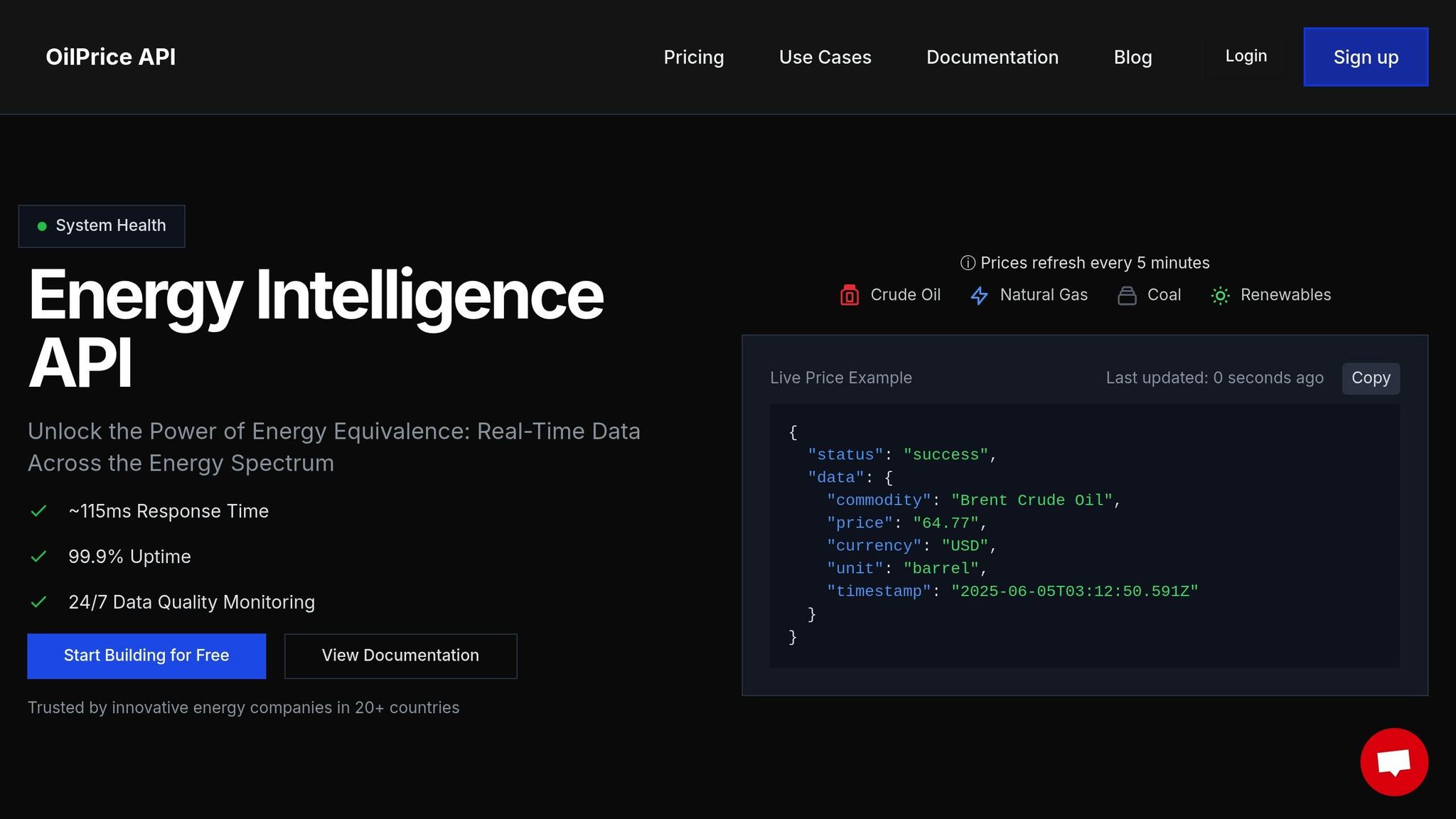
Platforms like OilpriceAPI showcase how well-designed APIs and infrastructure can streamline real-time data integration. OilpriceAPI provides both real-time and historical price data for key commodities like Brent Crude, WTI, Natural Gas, and Gold. Its JSON REST API integrates seamlessly with existing investment systems.
The implementation process is straightforward. Firms acquire API keys, install the required SDKs, and configure their systems to receive real-time data streams. OilpriceAPI handles the complex backend processing, delivering clean, standardized data that's ready for immediate analysis.
Reliability and performance are central to OilpriceAPI's design. Focused on core commodities vital for diversification strategies, the platform allows investment managers to set up alerts for significant price changes. For instance, a sharp movement in oil or gold prices can automatically trigger portfolio reviews. By combining reliable data delivery, automated workflows, and intelligent analysis, OilpriceAPI turns raw market data into actionable insights, enabling firms to stay agile and make informed decisions in volatile markets.
Conclusion: Improving Diversification with Real-Time Data
The integration of real-time commodity data has reshaped how diversification strategies are executed. Investors now have the ability to respond quickly to market shifts and base decisions on up-to-the-minute conditions, a critical edge in today’s unpredictable markets. Considering that commodities make up over 35% of the Consumer Price Index, tracking their movements in real time is essential for effective portfolio management. This approach demands not just quick responses but also ongoing refinements to asset allocations.
Real-time data is key to effective diversification, enabling constant monitoring and dynamic rebalancing. With this capability, advisors can track portfolio drift in real time and immediately correct allocations when they stray from target levels. This minimizes the risk of overexposure or missed opportunities for performance.
"With real-time data, advisors can continuously monitor portfolio drift and immediately identify when allocations deviate from target levels. This allows for timely adjustments, reducing the likelihood of overexposure to risk or underperformance. Real-time data also supports better trade execution, as advisors can react instantly to market movements and execute trades based on current conditions, optimizing outcomes for clients." - intelliflo
Beyond simple price tracking, real-time data empowers proactive risk management by enabling continuous oversight of portfolio performance. This capability is especially vital during periods of commodity market volatility, where delays in accessing data can lead to misaligned portfolios or missed trading opportunities.
Platforms like OilpriceAPI showcase how real-time tools can be seamlessly integrated into investment workflows. By offering real-time and historical data on key commodities - such as Brent Crude, WTI, Natural Gas, and Gold - through a JSON REST API, OilpriceAPI equips investment professionals with the insights needed for in-depth market analysis and effective risk management.
As commodity markets remain dynamic - illustrated by a 4.7% rise in the Commodity Index during the first three weeks of 2025 - investment professionals who leverage these tools are better positioned to make informed decisions, mitigate risks, and enhance profitability in a complex market landscape.
Reliable data streams, advanced analytics, and strong infrastructure transform raw market data into actionable insights. This equips firms to maintain diversified, agile portfolios that can adapt to shifting market conditions while striving for optimal risk-adjusted returns.
FAQs
How does real-time data help investors manage risks in volatile markets?
Real-time data gives investors a powerful edge in managing risks, especially in unpredictable markets. By offering up-to-the-minute insights into price changes and market trends, it enables faster decision-making. This means investors can act quickly to adapt to sudden shifts, helping to reduce potential losses.
Having access to live data also allows for constant monitoring of portfolios. Investors can spot emerging risks and fine-tune their strategies as needed. For instance, identifying sharp price swings or sudden changes in commodity trends in real time can help protect investments and strengthen portfolios against market volatility.
How can APIs help integrate real-time data into investment strategies and address common challenges?
APIs simplify the process of integrating real-time data into investment strategies by offering instant access to the latest market information. This enables investors to react swiftly to market shifts, enhancing their ability to manage risk and maintain a well-diversified portfolio. Plus, by automating the flow of data, APIs cut down on manual tasks, reducing the chance of errors and saving valuable time.
They also tackle common issues like mismatched data formats and outdated systems by relying on standardized protocols for data exchange. This ensures smooth communication between platforms and boosts data accuracy. For investment firms, using APIs means more efficient operations, better-informed decisions, and the flexibility to adapt in a constantly changing market.
How does real-time data improve diversification decisions during economic uncertainty?
Real-time data is a game-changer when it comes to making smarter diversification choices, especially during unpredictable economic times. It gives investors up-to-the-minute insights into market trends, allowing them to tweak their portfolios with precision. Picture this: in times of market volatility, keeping a close eye on real-time price shifts in commodities like oil, gold, or natural gas can reveal opportunities to either shield against risks or jump on emerging trends.
Economic indicators add another layer of insight. For example, a rise in manufacturing orders might hint at economic growth, encouraging investors to explore sectors that could benefit from expansion. By tapping into real-time data, investors can stay ahead of market changes, manage risks more effectively, and keep their portfolios on steadier ground.