Integrating APIs for Real-Time Data in ML
Integrating APIs for Real-Time Data in ML
Machine learning models need current data to perform well, especially in fast-changing industries like commodities or trading. Static datasets can lead to outdated insights, while real-time APIs provide up-to-date information, enabling systems to adapt to market changes. For instance, tools like OilpriceAPI offer real-time and historical pricing for commodities like Brent Crude, WTI, Natural Gas, and Gold, making it easier to build responsive ML applications.
Key Takeaways:
- Real-time data is crucial for ML in volatile markets.
- OilpriceAPI delivers timely pricing for four key commodities and integrates easily via JSON REST.
- Other APIs may offer broader datasets, including economic indicators or exchange-specific details.
- Scalability and cost structures vary across APIs, making it important to choose one that aligns with your project's size and needs.
Quick Comparison:
| Feature | OilpriceAPI | Other APIs |
|---|---|---|
| Data Coverage | Brent Crude, WTI, Natural Gas, Gold | Commodities, financial markets, economic data |
| Integration | JSON REST | JSON REST, WebSocket, SDKs |
| Scalability | Tiered plans (Hobby to Enterprise) | Rate limits, pay-per-use, or flat fees |
| Focus | U.S. market alignment | Broader, global data sources |
If your ML project focuses on energy or commodities, OilpriceAPI simplifies data integration. However, for broader datasets, pairing it with additional sources may be necessary.
Build Real-Time AI/ML APIs Using Only SQL (BigQuery/Vertex on GCP)
1. OilpriceAPI
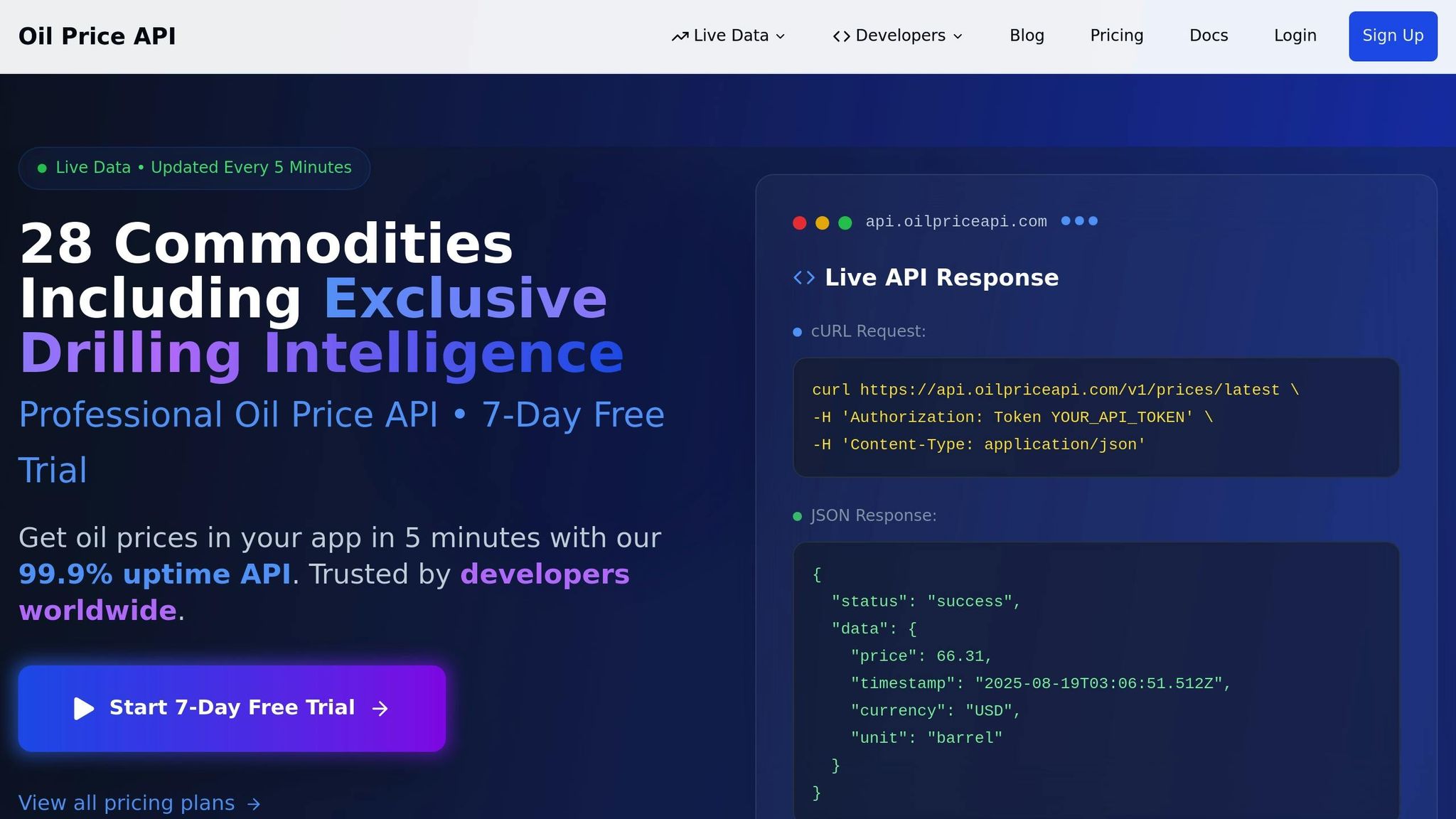
OilpriceAPI provides real-time and historical pricing data for Brent Crude, WTI, Natural Gas, and Gold. It's designed with machine learning (ML) applications in mind, ensuring access to accurate and timely data.
Data Coverage
This API focuses on four key commodities. Brent Crude and WTI serve as globally recognized benchmarks for oil prices, while Natural Gas data captures essential energy market trends. Gold pricing, often used in financial models as a hedge, adds another layer of market insight. It delivers real-time prices for immediate analysis and historical data for training models on trends. With multiple time frame options - ranging from minute-by-minute updates to daily, weekly, and monthly summaries - it caters to a variety of analytical needs, fitting seamlessly into ML workflows.
Integration Flexibility
OilpriceAPI uses a JSON REST framework, making it easy to integrate into machine learning pipelines. This setup simplifies the process of incorporating data into your projects.
Scalability
To accommodate different project sizes, OilpriceAPI offers tiered subscription plans: Hobby, Business, and Enterprise. These plans scale with your data requirements, supporting everything from initial model development to large-scale production.
U.S. Market Compliance
OilpriceAPI aligns with U.S. market standards by formatting prices in U.S. dollars and using standard U.S. number conventions (e.g., $1,234.56). This ensures consistency for users operating within the American market.
2. Other Commodity Data APIs
Real-time data APIs cover a broad spectrum, including financial markets, economic indicators, and exchange-specific sources. These diverse data streams play a crucial role in shaping how machine learning (ML) workflows are designed and implemented.
Data Coverage
Financial market APIs typically provide extensive datasets that include commodity futures alongside stocks, bonds, and currency pairs. These APIs pull data from major commodity exchanges, offering insights into a wide range of products, from agricultural goods to precious metals.
Economic data providers focus on key indicators that affect commodity prices. They supply information such as inventory levels, production statistics, weather reports, and geopolitical updates - factors that directly influence supply and demand. This type of data is especially useful for ML models that incorporate macroeconomic variables into price forecasting.
Exchange-specific APIs connect directly to individual commodity trading platforms. These APIs deliver highly detailed data, such as order book details, trade volumes, and real-time price movements. However, using them often requires familiarity with the specific data formats and trading protocols of each exchange.
Integration Flexibility
Beyond data coverage, the ease of integration is another factor that determines how well an API fits into ML workflows.
Most APIs use REST with JSON, making them straightforward to integrate with popular ML frameworks like TensorFlow, PyTorch, and scikit-learn.
WebSocket connections are commonly used for applications like high-frequency trading. These connections allow for continuous data streaming without the need for repeated HTTP requests, offering an efficient way to handle real-time data.
SDK support varies widely. Some providers offer robust software development kits for languages like Python, R, and Java, which can simplify implementation and maintenance. Others may only provide basic API documentation, requiring more development effort.
Scalability
APIs come with different rate limits, ranging from per-minute caps to monthly data quotas, which can influence development and deployment timelines.
For production-level ML systems, reliable infrastructure is essential. Some providers ensure high uptime through global content delivery networks, while others depend on single data centers. The choice often hinges on whether your ML models require constant real-time data or can manage occasional interruptions.
Cost structures also vary. Some APIs charge flat monthly fees, while others use usage-based pricing. High-volume ML applications might benefit from volume discounts, whereas smaller-scale projects may prefer pay-per-request models that align costs with actual usage.
U.S. Market Compliance
For U.S.-based applications, data is often standardized to align with local formats. International providers may require additional conversions to meet these standards.
Handling timestamps is another critical aspect. Many APIs provide data in UTC, but aligning this with U.S. trading hours - such as Eastern Time - can be crucial for ML models that rely on time-of-day patterns or need to sync with U.S. market events.
Regulatory compliance is another consideration. Some providers adhere to certifications specific to U.S. financial data distribution. For ML applications in regulated industries, choosing a provider with the right compliance credentials can simplify deployment and help mitigate regulatory risks.
sbb-itb-a92d0a3
Advantages and Disadvantages
When choosing a real-time data API, it's all about finding the right balance between usability and the specific data needs of your project. OilpriceAPI stands out as a specialized solution for commodity data, offering dependable pricing information for assets like Brent Crude, WTI, Natural Gas, and Gold. It's particularly well-suited for machine learning models focused on energy and precious metals markets.
Here’s a quick look at what OilpriceAPI brings to the table:
| Feature | OilpriceAPI Details |
|---|---|
| Data Freshness | Provides real-time and historical pricing for Brent Crude, WTI, Natural Gas, and Gold |
| Ease of Integration | Simple JSON REST API that reduces integration hurdles and speeds up development |
| Scalability | Tiered subscription plans (Hobby, Business, Enterprise) to match varying project requirements |
| U.S. Market Alignment | Built to align with U.S. market standards, making regulatory compliance easier |
| Cost Structure | Transparent pricing model designed for predictable budgeting across different usage levels |
This breakdown highlights why OilpriceAPI is a strong choice for machine learning workflows.
One of the standout features is its simplicity. The JSON interface enables data scientists and developers to integrate commodity pricing data quickly, cutting down on setup time and allowing teams to focus on building and fine-tuning their models. This approach makes prototyping and deployment more efficient.
That said, there’s a potential limitation to consider. OilpriceAPI focuses on a narrow range of commodity assets. If your machine learning application demands a broader spectrum of financial data or includes economic indicators, you might need to pair it with additional data sources to meet those needs.
Conclusion
Selecting the right API comes down to aligning your machine learning (ML) needs with a solution that fits like a glove. For U.S.-based applications centered on commodity markets, OilpriceAPI stands out by offering precise pricing data for Brent Crude, WTI, Natural Gas, and Gold. Its streamlined approach cuts through unnecessary complexity, making it easier to build focused ML applications.
Instead of drowning users in excessive data, OilpriceAPI zeroes in on delivering accurate, targeted information. This makes it an excellent choice for energy sector projects, trading algorithms, and risk management tools. Its use of a JSON REST structure ensures quick and seamless integration, enabling development teams to transition efficiently from concept to production.
However, this targeted design does come with limitations. If your ML project requires a broader range of financial indicators or market data, you'll need to supplement OilpriceAPI with additional sources to meet those demands.
The API’s scalable pricing structure is another key advantage, making it a practical choice for projects of various sizes. For U.S. businesses balancing tight budgets with the need to scale, OilpriceAPI offers a reliable and cost-effective solution. Its alignment with U.S. standards ensures dependable deployment, ideal for teams prioritizing speed, accuracy, and consistency in commodity-focused ML applications.
FAQs
How can integrating real-time data through APIs improve machine learning models in fast-changing markets?
Integrating real-time data via APIs can elevate the performance of machine learning models in fast-paced markets. By providing constantly updated information, these integrations enhance both the accuracy and responsiveness of predictions.
For example, APIs that deliver continuous data streams - like live pricing updates for commodities or financial assets - allow models to quickly adjust to sudden market changes. This reduces prediction errors and sharpens decision-making. In dynamic environments where timing and precision are key, such capabilities help businesses anticipate trends, manage risks, and respond to volatility with greater confidence.
What should you consider when selecting an API for real-time data in machine learning projects?
When choosing an API for real-time data in machine learning projects, there are a few essential aspects to consider. These include the accuracy and frequency of data updates, the ease of integration with your current systems, the quality of its documentation and support, and the dependability of its data sources.
Take OilpriceAPI as an example: it offers real-time updates every 5 minutes and pulls data from reliable government sources. This ensures both precision and trustworthiness - qualities that are crucial for machine learning models that depend on timely and credible commodities data to generate meaningful insights.
Why would a machine learning application need additional data sources beyond OilpriceAPI for better analysis?
While OilpriceAPI offers real-time and historical price data for key commodities like Brent Crude, WTI, Natural Gas, and Gold, relying on additional data sources can significantly enhance the performance of machine learning models. Commodity prices are shaped by a wide range of external influences, including economic shifts, geopolitical developments, weather patterns, and movements in broader financial markets.
By integrating these complementary datasets, machine learning models can better analyze and predict market behavior. This approach helps provide a more comprehensive view of the factors driving price fluctuations, leading to more accurate predictions and smarter decision-making.