Commodity APIs are transforming how businesses access and share data. The key lies in interoperability - ensuring systems can communicate seamlessly without technical barriers. Here's what you need to know:
- Why it matters: Interoperability reduces errors, speeds up decision-making, and simplifies compliance in commodity trading.
- Key challenge: Different data standards in software are the biggest obstacle to creating cohesive systems.
- Top solution: APIs like OilpriceAPI use standardized formats (JSON, REST) and real-time updates to simplify integration.
Quick Overview
- OilpriceAPI: Focuses on real-time data for key commodities (e.g., Brent Crude, WTI) with JSON and XML formats.
- Other providers: Broader coverage but face challenges like legacy systems and inconsistent standards.
Bottom line: Interoperability is essential for efficient trading, and choosing the right API depends on whether you need specialized or broad market data.
1. OilpriceAPI
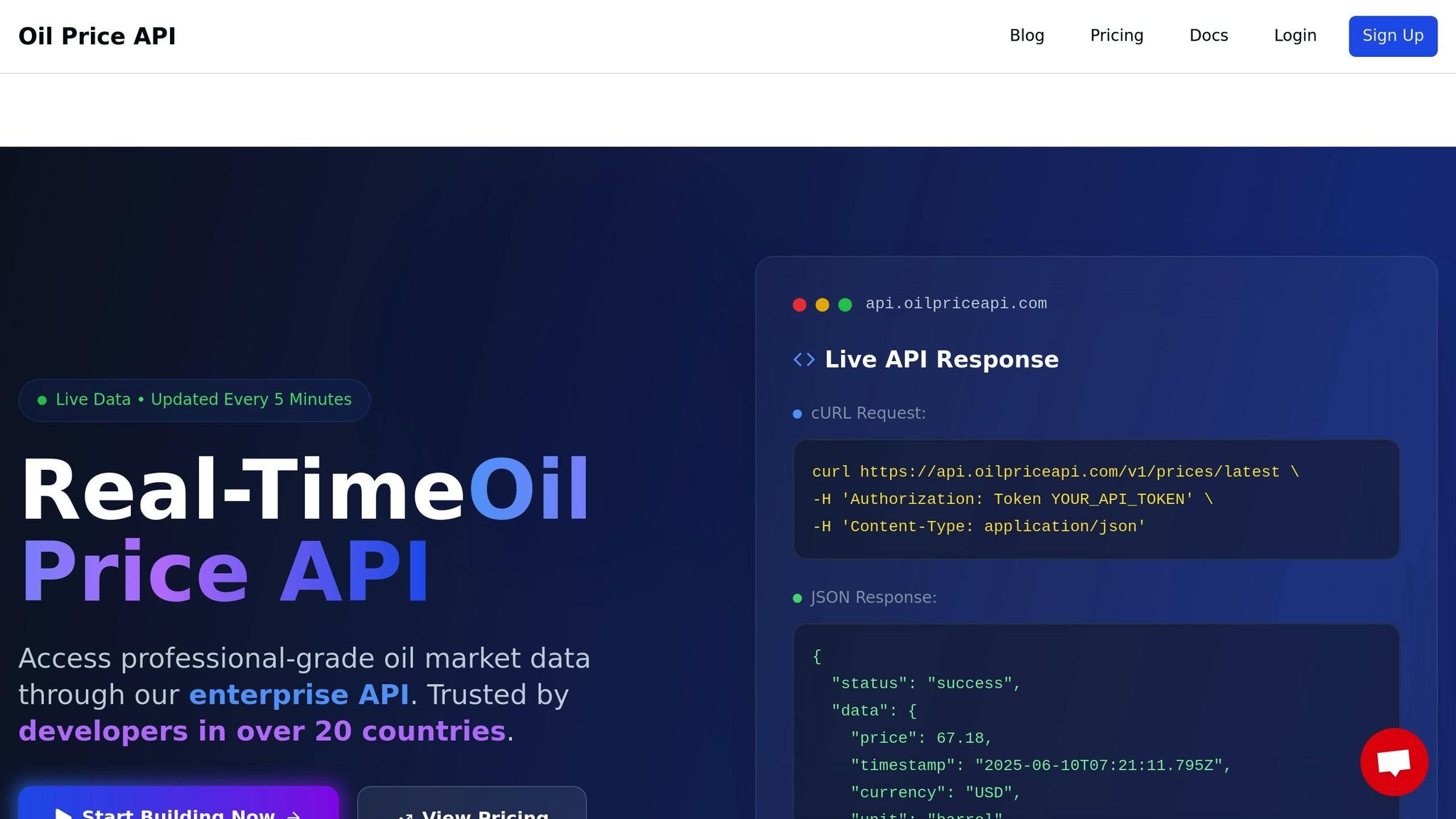
OilpriceAPI is designed to simplify access to critical energy market data, ensuring smooth integration across systems. Its user-friendly approach tackles some of the biggest challenges in commodity trading, like inconsistent formats and restrictive access, by adhering to widely accepted standards.
Interoperability Standards Support
One of the standout features of OilpriceAPI is its commitment to solving issues caused by inconsistent API structures and rigid pricing models that often disrupt seamless integration. Built on REST API principles, it uses universally accepted web standards, making it compatible with virtually any programming language or system that handles HTTP requests. Studies show that technologies promoting seamless connections between systems help overcome traditional barriers to interoperability. With OilpriceAPI, organizations can integrate its features without worrying about proprietary formats or limitations.
Real-Time Data Capabilities
OilpriceAPI doesn’t just stop at compatibility - it also delivers real-time updates every 5 minutes for key commodities like Brent Crude, WTI, Natural Gas, and Gold. This ensures trading systems access fresh, actionable data while maintaining optimal performance.
Data Format Standardization
To make integration even smoother, OilpriceAPI uses JSON as its primary data format, with XML available for systems that rely on older technologies. Timestamps follow the UTC standard (ISO 8601 format), eliminating confusion caused by time zone differences. Additionally, standardized error codes make it easier for developers to handle exceptions, leading to more reliable and consistent integrations.
Security and Authentication
Given that 91% of organizations reported API security incidents last year, OilpriceAPI places a strong emphasis on data protection. It employs encryption, authentication, and strict access controls to secure both real-time and historical commodity data. This ensures developers can integrate the API with confidence, knowing it meets high standards for security and reliability. The platform’s flexible approach focuses on delivering secure and functional integration outcomes without being tied to rigid methodologies.
2. Other Commodity API Providers
While OilpriceAPI has its own streamlined approach, the broader commodity API space is marked by diverse methods and varying levels of integration efficiency. Providers in this landscape employ different strategies to tackle interoperability and ensure seamless data accessibility. Exploring these strategies sheds light on the broader industry challenges and sets the stage for understanding key technical aspects of interoperability.
Interoperability Standards Support
For many commodity API providers, smooth data sharing is crucial for supply chain operations involving producers, suppliers, regulators, and auditors. Effective integration ensures that various systems work together cohesively, which is particularly important in complex supply chains. For instance, one provider integrates directly with SAP S/4HANA, automating data synchronization to ensure compliance. This highlights that meeting EUDR compliance demands not only traceability but also robust interoperability between systems.
However, achieving interoperability isn't without hurdles. Legacy systems, data security risks, scalability constraints, regulatory inconsistencies, and high compliance costs remain significant barriers. These challenges emphasize the ongoing need for better cross-platform compatibility.
Real-Time Data Capabilities
The demand for real-time and historical data delivery is driving API development across various commodity markets. Handling massive volumes of data presents challenges in maintaining speed, accuracy, and system performance. Providers must strike a balance between these factors while ensuring reliable connections across trading platforms and analytics systems. These performance demands directly influence the compatibility and efficiency of such systems.
Data Format Standardization
Standardized data formats, like JSON and XML, are widely used by commodity API providers, often following RESTful API principles and specifications such as OpenAPI and AsyncAPI. For example, the Bureau of Economic Analysis (BEA) API allows users to choose between JSON and XML formats via the ResultFormat parameter. Similarly, the Commodities-API simplifies data interpretation by delivering exchange rates relative to USD.
In fact, 94% of organizations now use APIs, with two-thirds relying on API management software. The API software market is valued at $175 billion, growing at a rapid 30% annually. These standardized practices play a key role in ensuring smooth cross-platform integration.
Security and Authentication
Security is a cornerstone of the commodity API industry, with providers implementing multiple layers of protection to safeguard data. Common measures include strong authentication and authorization protocols, encryption for data in transit and at rest, rate limiting, API gateways, AI-driven threat detection, and API firewalls. Given the financial risks of security breaches and the hefty fines for non-compliance under GDPR, these protections are critical.
Leading fintech firms often set the standard for API security. For example, Plaid uses OAuth 2.0 for authentication and applies end-to-end encryption. Stripe employs tokenization and conducts regular security audits and penetration tests, while Revolut incorporates advanced encryption, multi-factor authentication, and real-time traffic monitoring.
As an Akamai expert explains:
"APIs are also attractive to hackers because of their potential use in larger data loss. By targeting API endpoints in a distributed denial-of-service (DDoS) attack, a hacker could significantly disrupt a system's operations." - Akamai
These robust security measures are vital for maintaining trust and ensuring the reliability of systems across commodity trading platforms.
Advantages and Disadvantages
When implementing interoperability standards for commodity APIs, organizations encounter both benefits and challenges that can influence efficiency and scalability.
| Aspect | Advantages | Disadvantages |
|---|---|---|
| OilpriceAPI Approach | Offers a streamlined JSON REST API providing real-time and historical data for Brent Crude, WTI, Natural Gas, and Gold; simplifies integration; focuses on specific commodities for precise data | Limited coverage to specific commodities; may necessitate additional APIs for broader market data; reliance on a single provider for critical pricing information |
| Standardized Interoperability | Enables secure and efficient data exchange across systems; removes silos, speeding up processes; supports multi-platform compatibility | Development costs for APIs can exceed $20,000 depending on complexity; demands substantial upfront investment in system redesign |
| Cross-Platform Integration | Promotes smooth data sharing between departments and partners, encouraging innovation; allows quick adaptation to new business needs; improves information flow | Raises security concerns as sensitive data must be protected during integration; reliance on third-party services can disrupt operations during provider outages |
| Data Governance | Ensures data remains accurate, consistent, and complete across systems; strong governance practices uphold data quality throughout its lifecycle; avoids vendor lock-in through open standards | Lack of coordination can result in inconsistencies in standards and protocols; legal restrictions and commercial sensitivities can limit data sharing |
These comparisons underscore the real-world challenges and opportunities organizations face when working with commodity APIs. Although interoperability offers significant potential, many APIs fail to fully deliver on these promises.
High initial costs and the emergence of new security vulnerabilities require organizations to adopt advanced, multi-layered security measures. Basic authentication alone isn’t enough to safeguard sensitive commodity trading data.
Another pressing issue is data quality. Divergent definitions and classification systems often cause inconsistencies, making integration difficult. The lack of standardization not only hampers collaboration but also increases traceability costs and complicates regulatory compliance.
Ultimately, organizations must weigh the trade-off between specialized accuracy and broader market integration. While broad-spectrum providers offer extensive market data, solutions like OilpriceAPI excel in delivering highly focused data with simpler integration processes. The decision hinges on whether the priority lies in comprehensive coverage or deep expertise in specific commodities.
sbb-itb-a92d0a3
Summary
When it comes to integrating data efficiently in the realm of commodity APIs, organizations have clear options. Tools like OilpriceAPI stand out by offering streamlined JSON REST APIs tailored specifically for key commodities. These APIs focus on delivering real-time updates with precise, targeted data. Instead of trying to cover the entire market, they prioritize simplicity and accuracy, making them faster and more reliable for specific use cases.
The benefits of adopting such API solutions are tangible. For instance, companies leveraging API-based interoperability often see faster implementation timelines, sometimes as quick as six to eight weeks. A notable example is Michigan State University Federal Credit Union, which saw a 67% drop in API-related customer service tickets and a 26% reduction in support chats after adopting a standardized API solution.
Colby Ross, CEO of Project Finance, highlights the value of this approach:
"API connectivity ensures greater transparency, flexibility, and control for both providers and users."
For businesses focusing on core commodities, specialized APIs like OilpriceAPI offer a strategic advantage. This trend aligns with the global push for standardized data sharing, with 71 regulations worldwide now mandating APIs for interoperability and data exchange.
FAQs
What steps does OilpriceAPI take to ensure data security and prevent API security breaches?
OilpriceAPI takes data security seriously, employing a range of measures to protect user information and block unauthorized access. These include regular security audits to identify vulnerabilities, multi-factor authentication (MFA) for accessing sensitive systems, and clear incident response protocols to handle potential threats swiftly.
To keep data safe during transmission, OilpriceAPI relies on encryption technologies, ensuring sensitive information stays private and out of reach from unauthorized individuals. By following industry standards for API security, the platform emphasizes authentication, data encryption, and proactive threat management, giving users a secure and dependable way to access commodity price data.
What challenges exist in making commodity APIs compatible across systems, and how does OilpriceAPI solve them?
Interoperability Challenges in Commodity APIs
Working with commodity APIs often feels like navigating a maze. Inconsistent data formats, lack of standardization, and the need to integrate with a mix of systems can create significant hurdles. Many older platforms weren’t built with real-time data sharing in mind, leading to inefficiencies, increased costs, and delays in decision-making.
OilpriceAPI steps in to simplify this process. Its user-friendly JSON REST API is designed to work seamlessly with existing systems. By delivering real-time and historical commodity price data in a standardized format, it eliminates the usual headaches of integration. The result? Easier data analysis, platform compatibility, and quicker, more confident decision-making - all without the technical frustrations of outdated systems.
Why is real-time commodity data essential for traders, and how does OilpriceAPI help?
Real-time commodity data plays a crucial role for traders, as market prices can shift in the blink of an eye due to economic events, geopolitical developments, or changes in supply and demand. With access to the most current information, traders can act quickly, capitalize on opportunities, and reduce potential risks.
OilpriceAPI delivers precise, real-time pricing data for essential commodities such as Brent Crude, WTI, Natural Gas, and Gold. This keeps users updated on the latest market movements, helping them make smarter, faster decisions.