Load Balancing for Real-Time Market Data Feeds
Load Balancing for Real-Time Market Data Feeds
Real-time market data feeds are critical for trading platforms, enabling traders to make fast decisions in volatile markets. But managing these feeds is challenging due to massive data volumes, latency issues, and scalability demands. Load balancing solves these problems by distributing traffic across servers, ensuring faster response times, reduced downtime, and better performance during market surges.
Key takeaways:
- Latency: Delays in data delivery can result in lost trading opportunities. Load balancing helps reduce latency by up to 70%.
- Scalability: Platforms can handle sudden surges in trading activity without performance dips.
- Reliability: Continuous monitoring and failover mechanisms ensure uninterrupted access to data.
- Cost Efficiency: Systems scale up or down based on demand, avoiding over-provisioning.
For commodity trading platforms using tools like OilpriceAPI, load balancing ensures smooth delivery of real-time data for oil, natural gas, and gold prices. This setup keeps traders informed, cuts execution times, and maintains system reliability during high-stress periods.
Bottom line: Load balancing is the backbone of scalable, low-latency trading systems, ensuring platforms remain fast, reliable, and efficient even during peak market activity.
How High-Volume Trading Affects Data Systems
Cloud System Stress During Market Surges
When trading activity suddenly spikes, cloud-based systems face immense pressure, often pushing even the most advanced infrastructures to their breaking point.
In the U.S., equity trades have been growing at an annual rate of 4.35%, surpassing 9 billion trades in 2019. Similarly, exchange-traded derivatives saw a 15% jump in volume from 2018 to 2019, exceeding 33 billion contracts. These surges aren’t spread out over days - they often unfold within minutes or hours during periods of market volatility.
This rapid increase in trading activity creates a tug-of-war between throughput and latency. As systems handle a flood of simultaneous requests, response times inevitably slow down. This delay can be disastrous, especially when traders rely on split-second data to make critical decisions.
Consider Nasdaq’s data lake, which scaled from processing 30 billion records daily to an astounding 70 billion, with peaks hitting 113 billion records. Robert Hunt, Vice President of Software Engineering at Nasdaq, shed light on how they managed the surge:
"We were able to easily support the jump from 30 billion records to 70 billion records a day because of the flexibility and scalability of Amazon S3 and Amazon Redshift."
However, not all systems handle such demands gracefully. Many cloud systems slow down or deliver data inconsistently under the weight of unexpected surges. What runs smoothly during normal trading hours can falter during high-frequency trading, where even minor delays can ripple into significant challenges in managing massive data loads.
Common Problems in High-Volume Data Management
The stress of market surges doesn’t just test system capacity - it exposes deeper issues in managing high-volume data. These challenges can undermine the reliability and accuracy of critical information, creating significant risks in fast-moving markets. For instance, in commodity trading, where oil prices can shift dramatically within minutes, even a slight delay in data updates can lead to costly errors.
Traditional systems, which are designed to handle gigabytes or terabytes of data, struggle to meet the demands of high-volume trading, where processing needs escalate to petabytes or even exabytes.
| Feature | Traditional Data Systems | High-Volume Trading Requirements |
|---|---|---|
| Data Processing | Hourly/Daily updates | Per-second updates |
| Volume Capacity | Gigabytes to Terabytes | Petabytes to Exabytes |
| Data Stability | Stable, predictable | Volatile, unpredictable spikes |
| System Configuration | Normal specifications | High-performance requirements |
When systems are overwhelmed, maintaining real-time accuracy becomes a near-impossible task. Traditional databases often can’t keep up with the volume, speed, or variety of modern datasets. This can lead to data being archived or deleted prematurely, resulting in the loss or corruption of key market information.
Infrastructure failures add yet another layer of complexity. While cloud systems generally recover faster than on-premise setups, recovery times can still create gaps in data delivery. Organizations also face challenges in maintaining visibility into their networks and resources when transitioning to the cloud, making it harder to identify and resolve issues quickly.
The financial stakes are high. According to McKinsey, data-driven organizations see EBITDA increases of 15% to 25% and outperform their competitors. But this only holds true when their data systems operate reliably. When high-volume trading overwhelms these systems, the resulting downtime or inaccuracies can erode a company’s competitive edge at the worst possible moments.
Richard Harmon, Vice President and Global Head of Financial Services at Red Hat, highlights the importance of scalability in these scenarios:
"Cloud environments provide firms with the scalability and flexibility to support on-demand real time analytics that is critical for intraday risk management during periods of excessive market volatility."
To address these challenges, advanced load balancing techniques are essential. Building systems that can handle both routine trading activity and sudden spikes - without compromising accuracy or speed - is crucial to maintaining performance during high-stress market conditions.
Live: Systems Design - Stock Tick API
How Load Balancing Fixes Scalability Problems in Real-Time Data
Load balancing plays a critical role in addressing scalability challenges by efficiently managing system resources. Instead of letting a single server crumble under the weight of heavy traffic during market surges, load balancing spreads the workload across multiple servers, ensuring smoother performance.
What is Load Balancing?
In simple terms, load balancing is a method of distributing network traffic across several servers to prevent any one server from being overwhelmed. Think of it as a traffic cop, directing data to the right server to keep everything running smoothly.
For trading platforms, this means incoming requests - like those for real-time oil prices or commodity data - are spread across multiple servers. When a sudden influx of traders needs updates simultaneously, the load balancer ensures no single server is overburdened. This improves response times, reduces latency, and ensures better overall performance. It also boosts reliability by constantly monitoring server health and rerouting traffic if a server goes down.
The results can be game-changing. For instance, one financial trading platform cut its trade execution time from 2 seconds to just 250 milliseconds after adopting load balancing. They also doubled the number of trades they could handle.
Main Load Balancing Methods
There are several ways to implement load balancing, each suited to different needs:
- Round Robin: This straightforward method distributes requests sequentially across servers. If all servers have similar capabilities, this is a simple and effective choice. However, it doesn’t account for varying server loads.
- Least Connections: This method dynamically directs traffic to the server with the fewest active connections. It’s especially useful during volatile trading periods when some requests take longer to process.
- IP Hash: By using a client’s IP address, this method ensures that traders consistently connect to the same server. This is helpful for maintaining session data or personalized settings, though it can lead to uneven traffic distribution.
- Weighted Methods: These take server capabilities into account, assigning more requests to stronger servers while lighter servers handle fewer connections. This requires careful configuration to work effectively.
| Method | Best Use Case | Key Advantage | Consideration |
|---|---|---|---|
| Round Robin | Equal server capabilities | Simple to implement | Doesn’t factor in server load |
| Least Connections | Variable request processing times | Dynamic traffic distribution | More complex setup |
| IP Hash | Session consistency needed | Maintains client-server relationships | May result in uneven loads |
| Weighted | Mixed server capabilities | Optimizes resource usage | Needs precise configuration |
Choosing the right approach depends on the specific demands of your trading environment. Some algorithms adapt in real time to server conditions, while others follow fixed rules.
Load Balancing Benefits for Real-Time Market Data
The advantages of load balancing go well beyond traffic distribution, delivering noticeable improvements in performance and reliability for trading systems.
One major benefit is latency reduction. For trading platforms, where every millisecond counts, load balancing can cut server response times by up to 70%. In fast-moving markets like commodities, where prices for oil or gold can shift in seconds, this speed can be the difference between a successful trade and a missed opportunity. For example, reducing trade execution time from 2 seconds to 250 milliseconds directly impacts profitability.
Another key advantage is improved uptime. Load balancing can reduce downtime during peak traffic periods by as much as 95%. This reliability ensures platforms remain operational even during unexpected surges in activity.
Scalability is another major win. Trading platforms can handle massive spikes in volume without performance dips. One platform, for instance, doubled its daily trade capacity from 500,000 to 1,000,000 transactions after implementing load balancing. This capability is essential during major market events when trading activity skyrockets.
Operational efficiency also gets a boost. Platforms can handle up to 30% more activity without needing additional resources, making load balancing a cost-effective solution.
For commodity trading platforms, such as those using OilpriceAPI, load balancing ensures smooth distribution of real-time pricing for Brent Crude, WTI, Natural Gas, and Gold. This prevents bottlenecks when multiple traders request updates simultaneously during market-moving events. Additionally, failover protection automatically redirects traffic if a server encounters issues, ensuring uninterrupted access to critical data.
"Load balancing safeguards are becoming standard additions to the market data distribution networks of high-volume trading floors and Web-based trading systems." – WatersTechnology Staff [14]
In high-pressure market conditions, these benefits ensure trading platforms stay functional, turning potential system overloads into manageable challenges and keeping traders connected when it matters most.
sbb-itb-a92d0a3
Best Practices for Load Balancing in Trading Systems
Implementing load balancing in trading platforms requires a well-thought-out strategy and the right infrastructure. The success of these systems hinges on meeting strict technical demands, fine-tuning APIs, and ensuring seamless delivery of commodity-specific data.
Infrastructure and Monitoring Requirements
Trading systems thrive on speed, and low-latency infrastructure is non-negotiable. Financial platforms often need to execute trades in under 1 millisecond. Achieving this requires colocated servers near major financial exchanges, fiber optic connections, and advanced networking techniques like kernel bypass to cut down UDP round-trip latency.
A cloud-native architecture based on microservices is ideal, as it allows individual components to scale independently when demand fluctuates. Tools like Docker can streamline this process, enabling automatic scaling during traffic spikes. To handle the sheer volume of requests, message queuing systems such as Apache Kafka act as buffers, optimizing load distribution.
Bandwidth demands in trading systems can be extreme. For example, OPRA estimates that supporting their feed requires 37.3 Gbps, and this figure jumps to 53 Gbps when combined with the CTA SIP. To manage such requirements, platforms must establish multiple redundant network connections with diverse carriers, ensuring no single point of failure.
Real-time monitoring is another cornerstone of effective load balancing. Metrics like total connections, inbound traffic, CPU usage, and transaction response times must be continuously tracked. This visibility ensures any issues are detected immediately, keeping traffic distribution smooth and uninterrupted.
"OpManager's reports offer a streamlined, efficient way to access vital information about a load balancer's performance. These reports provide clear, precise summaries of critical metrics and data, allowing users to quickly assess the health and status of their network infrastructure."
Security is equally critical. Robust encryption, firewalls, and multi-factor authentication protect sensitive financial data while ensuring compliance with evolving regulations. Additionally, threshold-based alerts notify administrators of performance issues or hardware failures, preventing small problems from escalating during high-stakes trading periods.
With the infrastructure in place, the next step is configuring APIs to support efficient load balancing.
Setting Up APIs for Load Balancing
REST APIs play a key role in distributing data across multiple servers. For platforms like OilpriceAPI, endpoints should be designed to efficiently serve real-time data for commodities like Brent Crude, WTI, Natural Gas, and Gold.
In load-balanced environments, authentication and rate limiting become more complex. OAuth needs to function seamlessly across all server instances, while rate limiting must track usage globally to prevent users from bypassing limits by accessing different servers.
SSL termination at the load balancer simplifies performance and management. By offloading decryption tasks to the load balancer, application servers can focus on processing requests, and SSL certificates only need to be managed at a single point.
Health checks are crucial for maintaining system reliability. These checks should verify server availability, API responsiveness, and the freshness of data. For instance, servers providing outdated commodity prices are effectively non-functional. Caching frequent requests, such as current oil prices, at the load balancer level boosts response times while ensuring caches are promptly updated when prices change.
Data pagination is another essential practice. This prevents servers from being overwhelmed when traders request bulk historical data or large datasets, ensuring consistent performance even during high-demand periods.
Using Load Balancers for Commodity-Specific Endpoints
Once APIs are optimized, load balancers can be tailored to handle specific commodity data, further enhancing performance. For example, oil price data often experiences traffic surges during market open and close, while gold prices may see steadier demand throughout trading hours. Addressing these nuances ensures data delivery remains efficient.
Weighted routing helps manage traffic based on commodity demand and server capacity. High-volume commodities like WTI crude oil may require more robust hardware and should receive a larger share of traffic to avoid bottlenecks during major market events.
Geographic routing also plays a significant role. U.S. traders, for instance, need data formatted in dollars per barrel for oil and dollars per ounce for gold, with timestamps in Eastern Time. Directing U.S. traffic to servers optimized for these preferences reduces processing overhead and improves user experience.
Session affinity can be particularly useful for commodity-specific endpoints. Traders often request related data points - like current price, daily high/low, and volume - in quick succession. Ensuring these requests are handled by the same server improves cache efficiency and reduces redundant work.
For platforms using OilpriceAPI, creating separate load balancer pools for different commodities allows for independent scaling. For instance, if natural gas trading spikes due to weather events, those endpoints can scale up without affecting oil price delivery. The JSON REST API structure makes it easier to maintain consistency across these separate pools.
Monitoring commodity-specific metrics is vital for ongoing optimization. Track which endpoints see the most traffic, identify peak usage times, and adjust server allocations based on actual trading patterns. This approach ensures resources align with real-world demand rather than assumptions.
As Dan McKinley wisely puts it, "Choose boring technology". Reliable, proven load balancing solutions with robust monitoring capabilities often outperform newer, flashier alternatives when reliability is the top priority in trading environments.
Case Study: Scaling Market Data Delivery with OilpriceAPI
Using OilpriceAPI for U.S. Traders
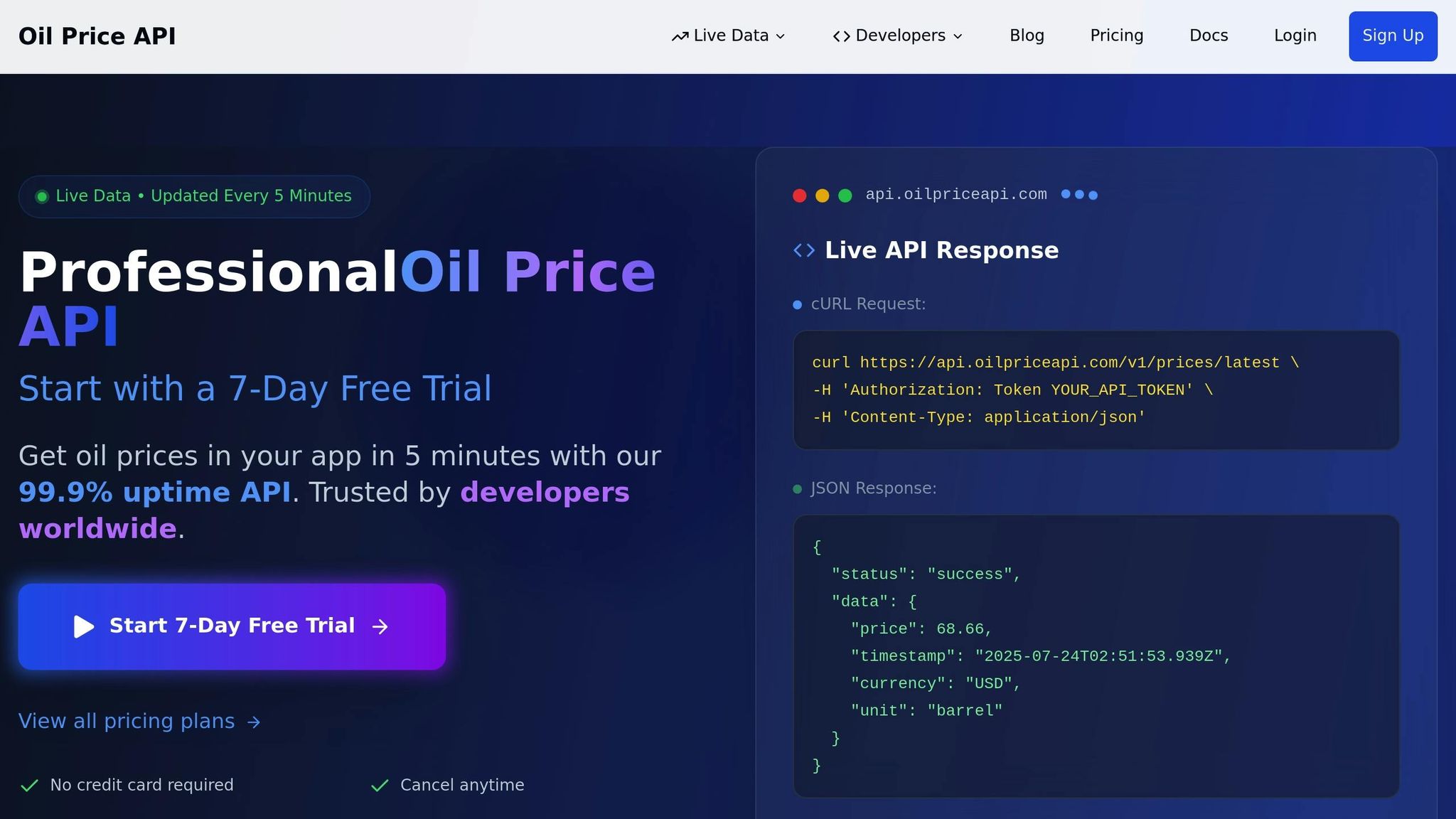
For U.S.-based trading platforms, having commodity data formatted in dollars and aligned with Eastern Time is a must. OilpriceAPI delivers on this requirement through its JSON REST API, providing both real-time and historical pricing for Brent Crude, WTI, Natural Gas, and Gold.
What makes OilpriceAPI a game-changer? It simplifies the process by removing the hassle of managing multiple data sources, handling currency conversions, and adjusting for time zones. This ensures traders receive timely, correctly formatted data while minimizing errors and streamlining data processing workflows.
In fast-paced trading environments, staying up-to-date is critical. OilpriceAPI’s real-time data feeds keep traders informed of price changes as market conditions shift, enabling smarter decisions during periods of high volatility. Whether users need minute-by-minute updates or historical trends for long-term analysis, the API supports a variety of trading strategies. Its JSON REST structure also makes it easy to integrate into modern platforms, especially those built with microservices, without requiring major infrastructure changes.
This precise data delivery sets the stage for integrating advanced load balancing techniques.
Combining OilpriceAPI with Load Balancing
Pairing OilpriceAPI with optimized load balancing creates a scalable and reliable system for delivering market data. Load balancers distribute incoming API requests across multiple servers, preventing overloads during peak trading activity. This is especially valuable when geopolitical events or market shifts cause spikes in data requests. By managing traffic efficiently, load balancing reduces the risks of delays and system bottlenecks.
A more tailored approach can be achieved through commodity-specific routing. For instance, WTI crude oil requests can be directed to servers equipped to handle higher volumes, while gold price queries can be routed to servers optimized for steady, consistent processing.
Health checks are another key element. By continuously monitoring server performance and ensuring data from OilpriceAPI is up-to-date, load balancers can temporarily remove underperforming servers, keeping the system accurate and responsive.
Benefits for Commodity-Focused Trading Platforms
The combination of OilpriceAPI and effective load balancing offers clear advantages for commodity-focused trading platforms. High availability ensures traders can access critical price data even during market turbulence, which is essential for making timely decisions.
This setup also addresses common challenges like latency and scalability. By intelligently distributing API requests and incorporating caching strategies, latency is minimized, meeting the speed demands of modern trading systems. Dynamic resource scaling further optimizes costs by adjusting capacity based on trading activity - scaling down during quiet periods and ramping up during surges.
For U.S. traders, compliance with local data standards is simplified. Load balancers can route requests to servers that deliver prices in dollars and timestamps in Eastern Time, eliminating the need for additional processing.
As trading platforms grow and new commodities are added, this scalable infrastructure can easily adapt. New server instances can be integrated seamlessly, supporting increased trading volumes and enabling platforms to handle complex trading strategies. This robust system not only enhances risk management but also helps traders navigate volatile markets with greater confidence.
Conclusion: Improving Market Data Feeds with Load Balancing
Load balancing plays a crucial role in managing real-time market data by distributing it intelligently across servers. This prevents bottlenecks and ensures systems remain scalable and reliable, even during periods of high activity. With the ability to achieve ultra-low latency - often under 1 millisecond - load balancing minimizes disruptions and keeps data flowing smoothly, even during volatile market conditions. This creates a strong foundation for delivering commodity-specific improvements.
"Real-time market data helps to reduce risks and can increase accuracy, which in turn leads to an all-over higher efficiency. Investors, advisors, and asset managers can better understand current risks and opportunities while they are aware of market regulations." – United Fintech
Take the example of OilpriceAPI: when integrated with load balancing, it provides continuous, precisely formatted data for commodities like Brent Crude, WTI, Natural Gas, and Gold. It boasts an impressive 99.99% uptime, delivers data accurate to two decimal points, and updates as frequently as every 60 seconds. This showcases how load balancing not only accelerates data delivery but also enhances the practical value of specialized APIs in unpredictable markets.
Beyond performance, load balancing helps optimize resources and reduce infrastructure costs. Systems can scale up during peak trading periods and scale down during quieter times, avoiding the need for costly over-provisioning while still maintaining top-tier performance.
Security also gets a boost with load balancing, thanks to features like strong encryption and multi-factor authentication. For U.S.-based platforms, these measures align with local regulations, ensuring secure data delivery in compliant formats tailored to U.S. standards.
FAQs
How does load balancing help reduce delays in real-time market data feeds?
Load balancing helps cut down on delays by spreading incoming traffic across several servers. This keeps any one server from being overloaded, ensuring a more consistent and efficient flow of data.
It also routes requests to the quickest or nearest server, reducing data travel time. This boosts the speed and reliability of real-time market feeds, making them more responsive and dependable.
What challenges do trading platforms face during high-volume trading, and how does load balancing help?
During busy trading periods, platforms can struggle with challenges like server overload, slower response times, and even unexpected outages. These issues can disrupt operations and frustrate users.
A solution to this is load balancing, which works by spreading incoming traffic evenly across several servers. This approach helps avoid traffic jams, minimizes delays, and keeps the platform running smoothly, even when trading activity is at its highest. The outcome? A more dependable platform and a smoother experience for users.
What are the best practices for implementing load balancing in trading platforms to ensure smooth and reliable real-time data feeds?
To maintain top-notch performance and reliability, trading platforms should consider these key practices for load balancing:
- Spread traffic evenly across all servers to avoid overloads and ensure steady performance across the board.
- Leverage cloud-based architectures to scale effortlessly, accommodating traffic spikes as they occur.
- Prepare for peak trading periods, such as market openings, by ensuring the infrastructure can manage heavy traffic loads without hiccups.
- Use redundancy and horizontal scaling to reduce downtime and keep the platform running smoothly, even during unexpected traffic surges or server issues.
These strategies help trading platforms provide a smooth, real-time experience, enabling users to access market data and make informed decisions without interruptions.