Real-Time WTI, Brent & Drilling Intelligence API for Energy Traders
Real-Time WTI, Brent & Drilling Intelligence API for Energy Traders
Want to make smarter energy trades in less time? Real-time data is the key. With tools like OilpriceAPI, you can access up-to-the-minute WTI, Brent crude, and drilling metrics in just seconds. This allows you to react faster, reduce risks, and make informed decisions in volatile markets.
Key Takeaways:
- Real-time updates: Get WTI, Brent crude, and drilling data refreshed every 5 minutes with a 50ms response time.
- Historical insights: Analyze long-term trends alongside live pricing for better forecasting.
- Easy integration: RESTful API with JSON format ensures quick setup for trading systems.
- Reliable performance: 99.9% uptime ensures uninterrupted access during critical trading hours.
For energy traders, combining live pricing with drilling intelligence means understanding both current market conditions and future supply shifts. This is especially critical in the unpredictable U.S. energy market, where prices react instantly to geopolitical events and inventory reports. Tools like OilpriceAPI simplify this complexity, offering fast, reliable data to help you stay ahead.
Ready to trade smarter? Let’s dive into how real-time APIs are transforming energy trading.
Learn Exactly How to Get Crude Oil, Natural Gas & Other Commodities Prices in Excel
Key Features of OilpriceAPI for Energy Traders
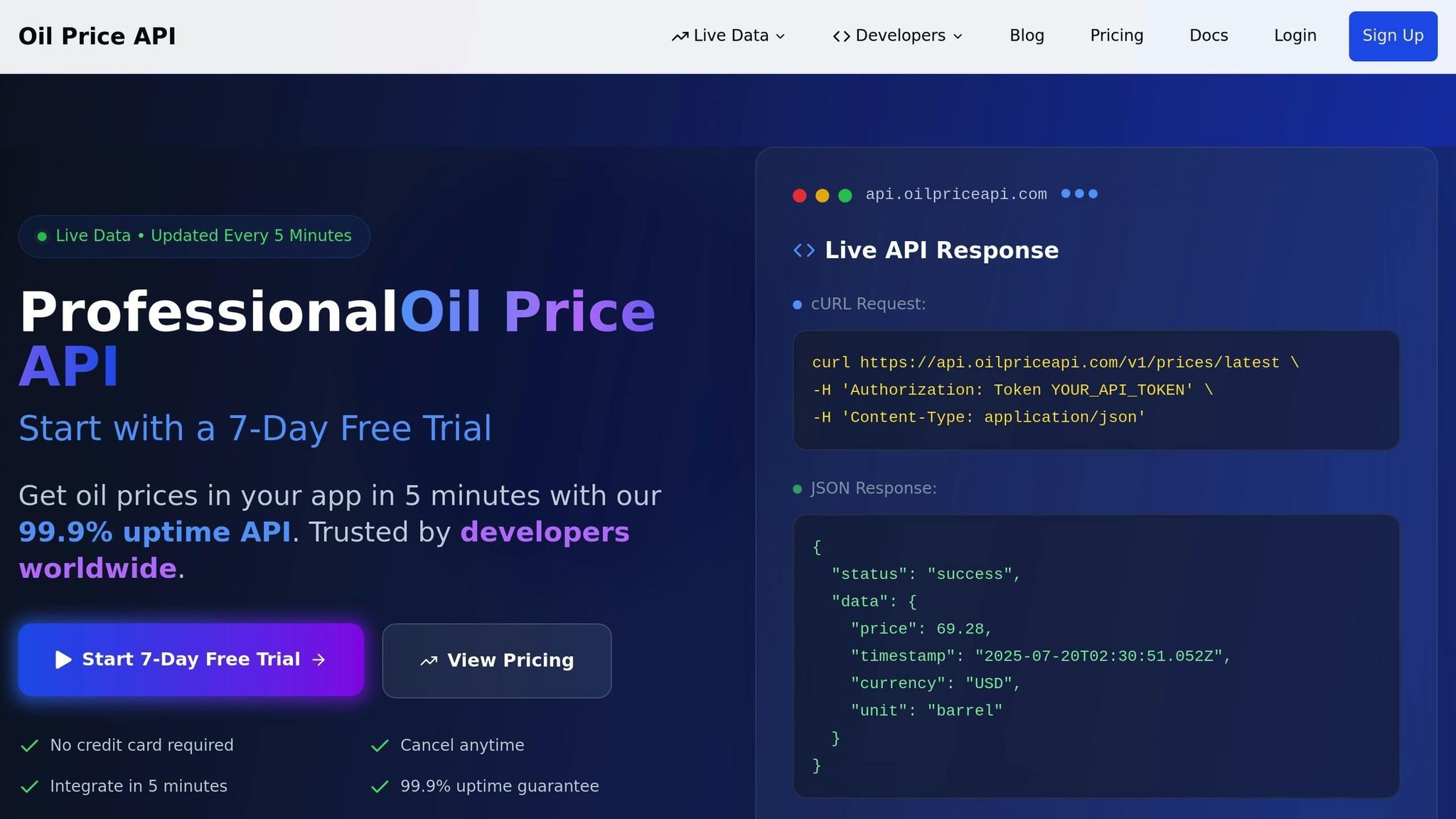
In the fast-moving U.S. energy markets, having reliable and timely data is critical. OilpriceAPI, trusted by over 83 global companies, delivers a suite of features designed to meet the needs of energy traders in real-world scenarios.
Real-Time and Historical Pricing Data
OilpriceAPI provides real-time pricing for key energy commodities like WTI Crude Oil, Brent Crude, Natural Gas, and Gold. Data refreshes every 5 minutes during trading sessions, ensuring traders stay updated with the latest market movements. For those looking to analyze trends, the platform also offers extensive historical data to support strategic planning. Additionally, it supports multiple currencies, including USD, EUR, and GBP, making it versatile for international trading needs.
One of the standout features of OilpriceAPI is its ability to combine granular real-time data with comprehensive historical datasets - all accessible through a single interface. This allows traders to easily shift between monitoring short-term price changes and evaluating long-term market trends.
Simple API Integration
OilpriceAPI is designed with ease of use in mind, ensuring technical teams can integrate it without unnecessary complexity. As a RESTful API, it works seamlessly with existing trading systems, portfolio management tools, and custom applications. The JSON format ensures compatibility with most programming languages and platforms commonly used in the energy trading industry.
"Get oil prices in your app in 5 minutes with our 99.9% uptime API. Trusted by developers worldwide." - OilpriceAPI
The platform's well-documented resources simplify the integration process, allowing traders and developers to quickly connect OilpriceAPI to their systems. This speed of implementation is particularly valuable in dynamic markets where time is of the essence.
High-Frequency Updates for U.S. Trading Hours
U.S. energy markets operate nearly around the clock, with crude oil futures trading almost 24 hours a day, five days a week. OilpriceAPI is built to handle these demanding schedules, offering a 99.9% uptime guarantee and an average response time of just 50 milliseconds. Its robust infrastructure, supported by redundant systems and a global CDN, ensures consistent performance even during periods of high trading activity, such as major news events or inventory report releases.
| Performance Metric | Specification |
|---|---|
| Average Response Time | 50ms |
| Uptime Guarantee | 99.9% |
| API Type | RESTful JSON |
For algorithmic traders executing hundreds of trades daily, this blend of speed and reliability is a game-changer. It provides the confidence to build advanced trading strategies, knowing the data will remain accurate and accessible, regardless of market conditions or trading volumes.
Practical Applications of Real-Time Data for Energy Traders
Real-time data is revolutionizing the way energy traders navigate today’s unpredictable markets. With WTI and Brent crude prices shifting throughout U.S. trading hours, tools like OilpriceAPI provide traders with immediate and precise pricing data, enabling them to seize opportunities and manage risks effectively.
Monitoring Live Market Movements
Energy traders depend on real-time WTI and Brent crude data to track price fluctuations and respond swiftly to market changes. For example, shifts in the WTI-Brent spread can signal potential trading opportunities.
"The spread is mean reverting because most of the price shocks are only temporal, so the spread moves back to its long-term economic equilibrium, and therefore it is possible to create a trading strategy based on this mean reversion." – Quantpedia
Typically, WTI trades at a slight premium to Brent because it yields slightly more gasoline. Traders can use this understanding to apply convergence strategies when prices stray from their usual patterns. Additionally, real-time data helps traders assess supply-demand dynamics. For instance, an oversupply in the market generally leads to declining crude oil prices. Weekly inventory reports from the Energy Information Administration (EIA) and the American Petroleum Institute (API) can also cause significant price volatility.
This constant monitoring lays the groundwork for more in-depth market analysis and risk management strategies.
Analyzing Historical Trends and Forecasting
By combining historical data with live updates, traders can create well-informed market forecasts. Technical indicators such as moving averages and the Relative Strength Index (RSI) provide insights into trends and momentum. For instance, a 50-day moving average above the 200-day indicates an uptrend, while an RSI below 30 or above 70 suggests potential buying or selling opportunities. These signals, when confirmed by real-time data, offer traders actionable insights.
Here’s a quick look at key technical indicators:
| Indicator | Primary Use | Trading Signal |
|---|---|---|
| Moving Averages | Identify trends | 50-day above 200-day = uptrend |
| RSI | Detect overbought/oversold | Below 30 = buy, above 70 = sell |
| Bollinger Bands | Measure volatility | Price touching bands may signal a reversal |
Fundamental analysis is equally valuable. Tracking OPEC meetings and U.S. inventory reports helps traders anticipate price swings influenced by global supply conditions. For example, a strong inverse correlation (–0.77) between Cushing inventory data and WTI futures enables traders to predict price movements when new inventory data is released.
Improving Risk Management and Hedging Strategies
Real-time data, combined with technical analysis, enables traders to manage risk more effectively in volatile markets. Quick access to live data allows for timely responses to adverse price changes. During U.S. trading hours, where price swings can be rapid, energy companies - often exposed to wholesale fluctuations ranging from 15% to 80% - must hedge their positions carefully. Tools like stop-loss orders ensure trades are executed within acceptable risk levels, typically limiting losses to 1–2% of capital.
Hedging strategies can range from straightforward to complex. Take this options hedging example: A nuclear plant with operating costs of $20 per MWh buys a May Put option with a $21 strike price for $0.30 per MWh. If spot prices drop to $17 per MWh, the option generates a $4 per MWh profit, resulting in net revenue of $20.70 per MWh - enough to cover operational expenses.
In a futures hedging scenario, a utility managing 100 MWh during peak hours might purchase 400 contracts at $30 per MWh. If spot prices rise to $40 per MWh, the futures position yields a $10 per MWh profit, offsetting increased spot market costs and potentially saving around $320,000 overall. When events like geopolitical tensions or extreme weather threaten production, traders can swiftly adjust their hedge ratios to handle the heightened volatility.
sbb-itb-a92d0a3
Integrating Drilling Intelligence with Price Data
Building on the earlier discussion about real-time pricing, drilling intelligence adds another layer of insight by predicting supply changes. When energy traders combine real-time price data with drilling intelligence, they gain a sharper understanding of both current market conditions and future supply trends.
What Is Drilling Intelligence?
Drilling intelligence refers to a collection of operational data that tracks upstream oil and gas activities. This includes metrics like active rig counts, well completion rates, production volumes per well, and drilled-but-uncompleted (DUC) inventories. Together, these metrics serve as early indicators of supply shifts, which directly influence WTI and Brent crude prices.
For example, active rig counts in prolific regions such as the Permian and Eagle Ford Basins are critical. The Permian Basin alone is expected to account for more than 50% of U.S. oil production by 2026. Meanwhile, the Eagle Ford Basin, known for its efficiency, achieved a 101% permit development rate in 2022. These regional differences highlight how drilling intelligence can reveal varying production potentials across basins.
Why Combine Real-Time Price Data with Drilling Metrics?
By integrating drilling intelligence with live price data, traders can better anticipate supply-driven price changes before they occur. For instance, an increase in rig activity could signal higher production volumes in the months ahead, potentially driving prices down. Conversely, a drop in rig activity might hint at tighter supply conditions, which could push prices higher.
This relationship is reflected in market projections. U.S. crude oil production is expected to climb to 13.5 million barrels per day by 2025, while WTI crude prices are forecast to dip from an average of $70 per barrel in 2025 to $62 per barrel in 2026. Additionally, the oil and gas AI market is expected to grow from $5.31 billion to $15.01 billion by 2029, underscoring the growing role of AI in analyzing both price data and drilling metrics to uncover patterns that might otherwise go unnoticed.
The impact of AI-driven drilling intelligence is already evident. One major oil company improved platform availability by just 1%, which translated into an annual revenue increase of about $300 million. Their predictive analytics system accurately forecasted 75% of historical failures with an average lead time of nine days, allowing preventive measures that avoided production delays. This proactive approach delivered an estimated annual economic benefit of $800 million across their offshore platforms.
These insights naturally extend to trading desks, enabling more informed and proactive decision-making.
Real-Time Alerts for U.S.-Based Trading Desks
To capitalize on this data, real-time alerts that merge price movements with drilling updates provide traders with instant notifications when drilling metrics deviate from historical trends. These alerts, powered by AI, have reduced downtime by approximately 45%. For instance, if well completion rates spike during a period of market volatility, traders receive immediate updates, helping them better understand the supply factors at play.
Shell, for example, cut unscheduled downtime by 20% and reduced maintenance costs by 15% after adopting AI-enhanced predictive maintenance across its rigs. This improvement in operational efficiency leads to more reliable production forecasts, giving traders a clearer picture of future supply conditions.
"The predictions give the operating team sufficient warning time to take actions to avoid events." - Joy Oyovwevotu, Total Lead Drilling Engineer
To fully leverage these systems, energy companies are encouraged to assess their operations and embrace a data-driven approach. Exxon, for example, uses AI to accelerate well development, achieving a 40% reduction in data preparation time. This ensures traders have access to accurate and timely information, enhancing their ability to respond to market dynamics effectively.
Benefits and Considerations for U.S. Market Participants
OilpriceAPI offers a range of features that make it a powerful tool for energy traders, but it also comes with some practical considerations. From real-time data access to customization options, the platform provides valuable resources for informed decision-making, while requiring careful planning to address its technical and operational demands.
Benefits of Using OilpriceAPI
Speed and accuracy are at the core of OilpriceAPI's appeal. With real-time crude oil prices and trends, traders can make decisions in seconds - a key advantage during volatile trading sessions where prices can shift dramatically.
The platform also goes beyond basic pricing by offering extensive data coverage. Users can access historical crude oil price data, enabling them to analyze trends and develop tools like price forecasting models and risk assessment systems. These resources support both short-term trading strategies and long-term planning.
Another standout feature is the customization and alert system. Traders can tailor data feeds to focus on specific crude oil grades or regional price differences. For example, a trader focused on West Texas Intermediate (WTI) can configure alerts exclusively for WTI price movements, avoiding irrelevant updates about Brent crude. This is made possible by using parameters like by_code (default: BRENT_CRUDE_USD). These alerts are especially useful during volatile periods. According to Standard Chartered, oil price volatility typically ranges from 35–45%, but recent levels of 15–25% are unusually low.
Ease of integration is another benefit. With detailed documentation, SDKs, and support, developers can integrate OilpriceAPI into their workflows with minimal friction.
While these features provide significant advantages, a thoughtful approach to implementation is essential for maximizing their potential.
Key Considerations for Implementation
To fully leverage OilpriceAPI, traders should keep the following factors in mind:
API request limits vary by subscription plan - Hobby, Business, and Enterprise - each offering different allowances. Managing these limits effectively and ensuring secure token authentication are critical.
Data management is another important aspect. Traders need to handle API error codes for troubleshooting, implement error-handling mechanisms, and understand pagination to retrieve large datasets. Since timestamps are provided in UTC, converting them to local time (considering Daylight Saving Time) is necessary for U.S. trading desks. Additionally, parameters like by_type and by_code help refine data queries, and selecting the right endpoint (e.g., /latest or /past_day) ensures the appropriate level of detail.
Market volatility also requires strategic use of real-time data. As trading expert Rahul Arora advises:
"Trading oil is actually quite easy. Avoid extremely volatile events, don't try and predict them. Let them incur and then respond, it's a wiser way to make profits and minimize risk."
Comparison Table of Benefits and Trade-Offs
Here’s a quick overview of OilpriceAPI’s benefits and the trade-offs to consider:
| Aspect | Benefits | Considerations |
|---|---|---|
| Data Speed | Real-time updates for immediate decisions | Requires stable internet and robust error handling |
| Historical Analysis | Comprehensive data for trend insights | Handling large datasets may increase API call frequency |
| Customization | Tailored feeds for specific needs | Custom setups can add complexity |
| Integration | Easy-to-use RESTful API with strong support | Requires technical know-how for secure implementation |
| Cost Structure | Flexible pricing tiers for different users | Higher data needs may necessitate more expensive plans |
| Alert System | Real-time notifications for key price changes | Overuse of alerts can lead to fatigue during high volatility |
| Data Accuracy | Reliable, validated data for better decisions | Dependence on one source could pose risks |
Balancing these benefits with operational challenges is key. For most U.S.-based energy trading firms, the ability to access real-time data often outweighs the technical and financial hurdles, especially when navigating the unpredictable nature of oil markets.
Conclusion: Empowering Energy Traders with Real-Time Intelligence
Energy trading is a fast-paced world where decisions need to be made in moments. Having access to real-time intelligence gives traders a crucial advantage over relying on outdated or delayed data.
Key Takeaways for Energy Traders
OilpriceAPI updates its data every 5 minutes with a lightning-fast 50ms response time, allowing traders to act immediately - especially during volatile market conditions. This speed is essential for staying ahead in a rapidly shifting landscape.
By integrating real-time pricing data with drilling intelligence, OilpriceAPI provides a well-rounded toolkit for traders. Unlike traditional methods that depend on historical data and forecasting models, real-time data processing delivers actionable insights that can improve operations and manage costs more effectively. As Błażej Radomski, Principal Analyst for Europe and Japan Power Markets at Wood Mackenzie, explains:
"Access to real-time data can make all the difference. The forecast is always the starting point, and it must be precise, accurate and of high quality. Furthermore, it must be frequently updated and delivered in an accessible way – over an API for example."
Reliability is just as critical as speed. With a 99.9% uptime guarantee, OilpriceAPI ensures uninterrupted access to essential market data, even during peak trading times. Trusted by over 83 companies globally, this level of dependability gives traders the confidence to make informed decisions in unpredictable markets.
What sets OilpriceAPI apart is its accessibility. Starting at just $15.00 per month, with a free tier and a 7-day free trial, energy trading firms - big or small - can tap into professional-grade market intelligence without breaking the bank.
How OilpriceAPI Simplifies Energy Trading
OilpriceAPI is designed to make energy trading more efficient and less complicated.
Through its RESTful API, comprehensive documentation, and round-the-clock support, the platform transforms complex market data into actionable insights, letting traders focus on strategy rather than technical hurdles.
The service doesn’t stop at basic price feeds. It offers a complete picture of energy markets by combining real-time WTI and Brent crude prices with drilling intelligence and natural gas data. This broader coverage helps traders develop sophisticated risk management strategies and uncover opportunities that might otherwise go unnoticed.
For U.S.-based trading desks, timely alerts from OilpriceAPI enable quick decisions, reducing the risk of losses caused by delayed information. In markets where prices can shift multiple times per second, having this real-time intelligence can be the difference between a profitable trade and a missed chance.
With its precise, up-to-the-minute data, OilpriceAPI equips energy traders with the tools they need to make confident, informed decisions in an ever-changing market.
FAQs
How can real-time pricing data and drilling intelligence help energy traders make better decisions?
Integrating real-time pricing data with drilling intelligence empowers energy traders with precise, up-to-the-minute insights into market trends and production activities. This combination enables traders to react swiftly to price changes, pinpoint lucrative opportunities, and fine-tune their trading strategies for better outcomes.
Moreover, having access to real-time data minimizes uncertainty and operational risks by delivering a more transparent view of supply, demand, and drilling metrics. With this information at their fingertips, traders can navigate the fast-moving energy markets with greater confidence and smarter decision-making.
What are the technical requirements for integrating OilpriceAPI with trading systems?
To make the most out of OilpriceAPI in your trading systems, start by ensuring it aligns with your current setup. Stick to standard data formats like JSON or XML for smooth integration. Also, keep an eye on the data update frequency and rate limits to prevent any disruptions. For secure and uninterrupted access, make sure to implement reliable authentication methods.
Your trading system should also be equipped to handle real-time data efficiently. This means having high-performance computing resources, a scalable system design, and low-latency data processing. These elements are crucial for leveraging the API's features effectively and improving the quality of your trading decisions.
How can energy traders combine historical data with real-time updates to build accurate forecasting models?
Energy traders can build more precise forecasting models by blending historical price trends with real-time market data. Historical data reveals patterns and long-term behaviors, while real-time insights help traders respond swiftly to market fluctuations.
By merging these data sources, traders can:
- Identify new trends as they develop.
- Adjust and fine-tune historical models to reflect current conditions.
- Make smarter decisions in rapidly shifting, unpredictable markets.
This combination keeps forecasts adaptable and up-to-date, sharpening trading accuracy and enhancing strategic planning.