Subscription APIs for ERP Commodity Pricing
Subscription APIs for ERP Commodity Pricing
Modern ERP systems struggle with real-time commodity price updates, a challenge solved by subscription-based APIs. These APIs integrate directly into ERP systems, offering live and historical data for commodities like oil, gas, metals, and agriculture. This ensures accurate pricing, minimizes errors, and supports better decision-making. Here's a quick overview of the top providers:
- OilpriceAPI: Focuses on energy commodities and gold with 5-minute updates. Offers tiered pricing and easy integration using JSON REST API.
- Provider B: Covers a wide range of commodities, including agriculture and metals. Flexible pay-as-you-go pricing with advanced integration options.
- Provider C: Built on Microsoft Dynamics 365, tailored for commodity traders. Offers enterprise licensing and trading-specific tools.
Key Takeaway: Choose OilpriceAPI for simplicity, Provider B for broad coverage, or Provider C for enterprise-level needs.
How to integrate EDI into an ERP using APIs? Here's an Example with Netsuite ERP #ediconsultants
1. OilpriceAPI
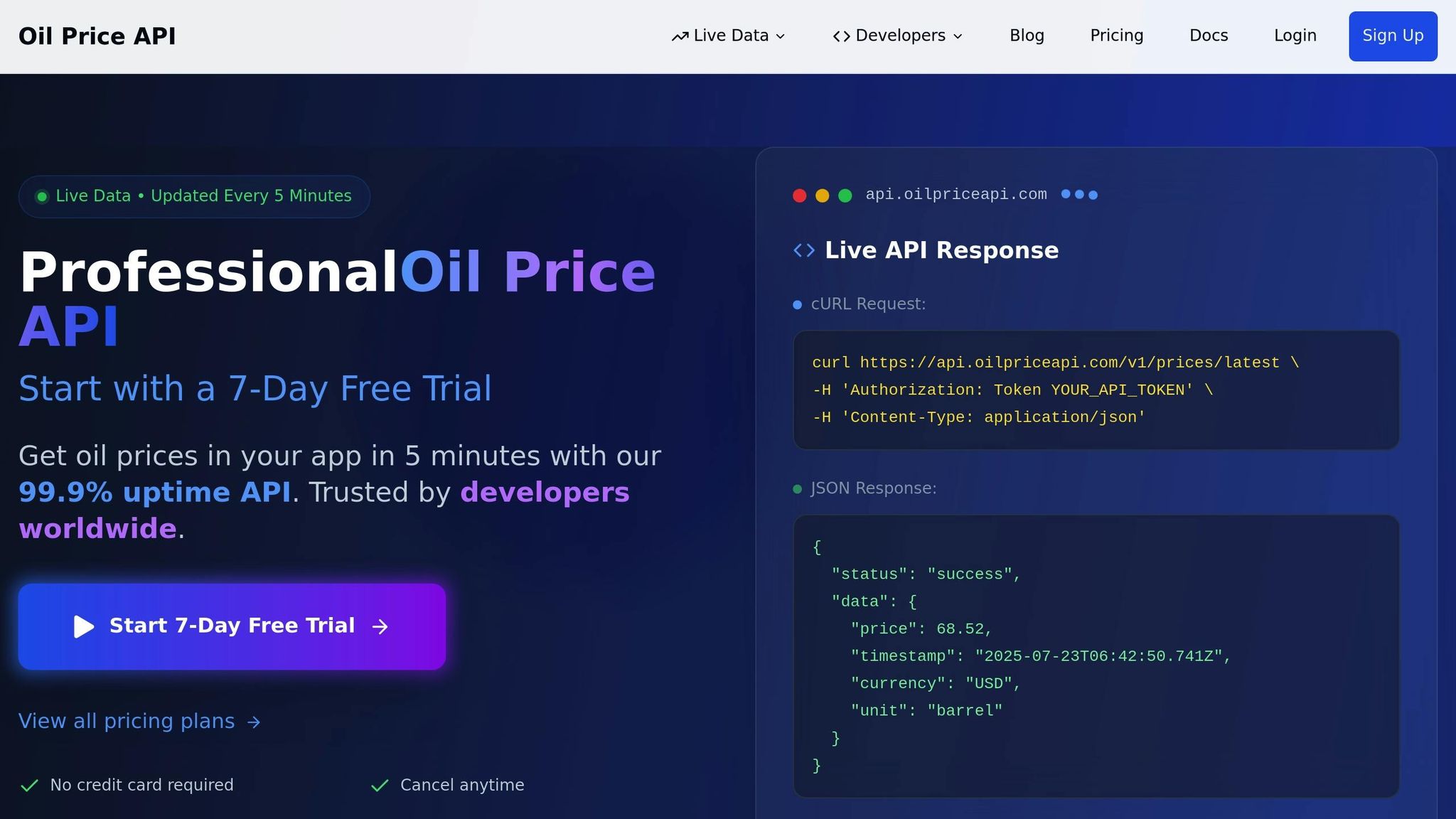
OilpriceAPI is a tailored solution designed for businesses that need precise, real-time commodity pricing integrated directly into their ERP systems. Its focus on oil, natural gas, and gold pricing makes it especially useful for companies operating in energy-intensive sectors.
Data Coverage
OilpriceAPI delivers comprehensive data on major energy commodities and gold through its REST API, with updates every 5 minutes to ensure ERP systems stay current.
The API tracks key crude oil benchmarks like WTI, Brent, and Dubai (all priced in USD). It also provides natural gas pricing for Henry Hub (NATURAL_GAS_USD), UK NBP (NATURAL_GAS_GBP), and Dutch TTF (DUTCH_TTF_EUR). Additionally, it includes coal and gold prices, as well as key currency pairs such as GBP/USD and EUR/USD.
For businesses requiring trend analysis or price modeling, the platform offers historical data going back up to one year. Dedicated endpoints for both real-time and historical data simplify integration into ERP systems. Multi-currency support, including USD, EUR, and GBP, further streamlines operations for companies with international footprints.
Integration Features
OilpriceAPI's RESTful design ensures smooth ERP integration using standard HTTP requests. Data is returned in JSON format, making it compatible with most modern ERP systems.
"Access oil and energy price data through our REST API. Designed for seamless ERP integration." - OilpriceAPI Docs
The platform uses a token-based authentication system, requiring an API token in the Authorization header for each request. Developers can rely on detailed documentation, complete with practical cURL examples, to simplify setup and troubleshooting.
This straightforward architecture supports scalable and efficient pricing integration.
Pricing and Scalability
OilpriceAPI offers flexible subscription plans to suit various business needs, including Hobby, Business, and Enterprise tiers. With a 99.9% uptime guarantee, the platform ensures dependable data delivery, a critical factor for businesses reliant on accurate commodity pricing.
Support and Documentation
The platform’s developer-focused approach has earned recognition for its ease of use. EU-Startups noted:
"Simple token-based authentication and clear integration examples make it a go-to choice for developers and market researchers alike." - EU-Startups
Comprehensive documentation and practical code examples significantly reduce implementation time, helping IT teams integrate the API into ERP systems faster. With support available for both technical and business inquiries, OilpriceAPI ensures that organizations can efficiently manage their commodity pricing data.
2. Provider B
Provider B stands out as a key player in the realm of commodity management solutions (CMS), addressing the intricate challenges of integrating commodity pricing. Unlike traditional ERP systems, which often fall short in this area, Provider B offers tools specifically designed for businesses deeply engaged in buying or selling commodities.
Data Coverage
Provider B supports a wide range of commodities, including agricultural products, metals, oil, gas, electricity, and coal. While standard ERP systems focus on transactions and assign fixed values to purchased items, Provider B takes a different approach. It emphasizes positions, valuing commodities based on current market prices. By combining physical and financial commodity pricing with forecasts and cost models, the platform provides a more dynamic and market-aligned perspective. This extensive data coverage forms the backbone of its integration capabilities.
Integration Features
Provider B facilitates smooth data exchange between CMS platforms and ERP systems. The platform offers integration through APIs, vendor connectors, and third-party solutions. Users benefit from customizable modules, adaptable interfaces, and tailored integration options. Many of these integrations leverage iPaaS (Integration Platform as a Service) solutions, known for their scalable architecture and advanced customization compared to traditional point-to-point methods. These features significantly enhance ERP systems' ability to manage fluctuating commodity prices effectively.
Pricing and Scalability
Pricing with Provider B is flexible and adjusts based on features, user count, and usage levels. This scalability allows businesses to align costs with their evolving commodity trading needs. Customers can easily upgrade or downgrade their plans, making the platform a practical investment. The technology behind Provider B enables businesses to scale efficiently - automation, seamless systems integration, and ERP connectivity help manage growing demands without a proportional rise in operational costs.
Support and Documentation
Provider B complements its offerings with strong support services. It provides detailed documentation to guide users in integrating commodity management features with existing ERP systems. The support teams are well-versed in the complexities of commodity management, which spans purchasing, selling, trading, logistics, and financial planning. They are equipped to address the unique needs of commodity management systems, which require a level of industry-specific expertise not typically found in general ERP solutions. This support ensures businesses can unify their view of costs and profits, a crucial step toward effective commodity pricing integration.
sbb-itb-a92d0a3
3. Provider C
Provider C offers a specialized approach to commodity trading ERP solutions, building on the capabilities of Microsoft Dynamics 365 F&SCM. Instead of a generic enterprise software package, this solution blends Microsoft’s powerful cloud infrastructure with features specifically designed for the unique needs of commodity trading. This focus allows for comprehensive data coverage across various commodity sectors.
Data Coverage
Provider C supports a wide range of commodities, spanning metals & concentrates, grains & pulses, dairy, coffee, tea & cocoa, and agri-food and feed products. The platform is designed to address the specific requirements of each sector, including handling, pricing, and documentation. It provides real-time position overviews that are essential for risk management and informed decision-making. Additionally, it supports mark-to-market calculations for a variety of contract types, such as purchase agreements, inventory positions, sales contracts, futures, and foreign exchange positions.
"Your commodity has its own focus and specific needs. We know your market and speak your language." – DycoTrade
Integration Features
Built on the foundation of Microsoft Dynamics 365 F&SCM, Provider C combines SaaS capabilities with trading-specific tools. The system covers the entire trading lifecycle, from initial item setup and delivery coordination to pricing management and cash flow tracking. It also ensures compliance with mark-to-market pricing requirements, keeping the system aligned with current market conditions. This design allows seamless integration into existing Microsoft-based enterprise environments while accommodating the unique needs of different commodity sectors, including handling, pricing, reporting, contracts, and logistics. These integrations are further enhanced by customized services and detailed documentation.
Support and Documentation
Provider C provides extensive support through an international network of partners, which is particularly beneficial when local expertise in Microsoft Dynamics AX is required. To ensure the solution meets operational needs, Provider C conducts brief process scans to tailor its offerings accordingly.
"With DycoTrade you can evaluate your trade risks and make data-driven decisions based on permanent insight in commodities tradebooks and currency positions." – DycoTrade
This strong support system combines technical ERP knowledge with a deep understanding of commodity markets, enabling Provider C to deliver precise and effective solutions for a variety of sectors.
Provider Comparison
When comparing subscription APIs, several factors stand out: pricing structures, the range of data offered, update speeds, ERP integration capabilities, target audiences, and support options.
| Feature | OilpriceAPI | Provider B | Provider C |
|---|---|---|---|
| Pricing Model | Tiered subscription (Hobby, Business, Enterprise) | Pay-as-you-go with volume discounts | Enterprise licensing |
| Data Coverage | Energy commodities and precious metals (e.g., Brent Crude, WTI, Natural Gas, Gold) | Broad coverage across agricultural, energy, and metals markets | Focused on select commodities critical for trading |
| Update Frequency | Real-time and historical | Real-time with frequent updates | Real-time overviews |
| ERP Integration | JSON REST API for flexible integration | Direct ERP system connections | Optimized for Microsoft-based environments |
| Target Market | Small to enterprise businesses | Mid-market to enterprise | Enterprise commodity traders |
| Support Model | Comprehensive API documentation and developer support | Technical integration assistance | Global partner network |
OilpriceAPI stands out for its tiered pricing, offering predictable costs across Hobby, Business, and Enterprise plans. In contrast, Provider B uses a pay-as-you-go model with discounts based on usage, while Provider C opts for enterprise licensing tailored to large-scale needs.
When it comes to data, OilpriceAPI focuses on energy commodities like Brent Crude and WTI, as well as precious metals such as gold. Provider B casts a wider net, including agricultural markets, while Provider C narrows its scope to commodities essential for trading professionals.
Integration options vary as well. OilpriceAPI uses a JSON REST API, allowing flexible connections to ERP systems. Provider B’s tools cater to more advanced technical setups, and Provider C specializes in environments built around Microsoft technologies.
Support approaches also differ. OilpriceAPI provides detailed documentation and developer assistance, making it easier for users to get started. Provider B emphasizes help with complex integrations, while Provider C relies on a global network of partners to assist its clients.
These differences are key to identifying the right API for your ERP integration and data needs.
Conclusion
Choosing the right subscription API for ERP commodity pricing involves balancing costs, features, and integration challenges to suit your specific needs. Here's a quick look at the standout options:
OilpriceAPI offers predictable pricing and straightforward ERP integration, making it a strong choice for organizations with limited technical resources or tight implementation timelines. Its tiered pricing plans, easy-to-use API, thorough documentation, and solid developer support simplify the process and reduce barriers for quick adoption.
Provider B, on the other hand, shines with its extensive data coverage and flexible pay-as-you-go pricing. However, managing high-frequency data usage is crucial to keep costs under control. For organizations with complex ERP setups, their technical integration support can be a significant advantage, although it may lead to longer implementation times.
For large enterprises, Provider C delivers advanced integration features tailored for large-scale deployments. While its licensing fees are higher, the dedicated support and specialized capabilities make it a compelling choice for organizations with more intricate needs.
It's worth noting that poor-quality data costs the U.S. economy up to $3 trillion annually, underscoring the importance of selecting APIs with reliable accuracy. Additionally, companies using AI-powered ERP systems have reported a 27.1% reduction in costs. Integrating an ERP system isn’t just a one-time effort - it’s a strategic investment in your organization’s future digital growth.
For businesses focused on energy commodities and seeking a quick, seamless integration, OilpriceAPI is likely the best fit. However, if you need broader market coverage or enterprise-level features, weigh the alternatives carefully based on your specific commodity needs, technical requirements, budget, and long-term growth plans.
FAQs
How do subscription-based APIs enhance commodity pricing in ERP systems?
Subscription-based APIs simplify the process of managing commodity pricing within ERP systems by delivering real-time and historical data straight to your platform. This ensures pricing information is always accurate and current, allowing businesses to avoid costly errors and adapt swiftly to market changes.
By automating the flow of data, these APIs cut down on manual tasks and save valuable time. They also make it easier to spot trends and make smarter decisions. This is especially important for industries like oil, gas, and precious metals, where price swings can have a major effect on daily operations and overall profitability.
How can OilpriceAPI benefit businesses in energy-intensive industries?
OilpriceAPI supports businesses in energy-heavy sectors by delivering real-time and historical price data for essential commodities such as Brent Crude, WTI, Natural Gas, and Gold. This service enables companies to monitor market shifts and trends closely, helping them make smarter, data-driven decisions.
When integrated with ERP systems, OilpriceAPI simplifies workflows, refines pricing strategies, and strengthens financial planning. Reliable, up-to-the-minute data not only boosts operational efficiency but also plays a crucial role in maintaining profitability in a challenging market landscape.
How can I integrate OilpriceAPI with my existing ERP system?
Integrating OilpriceAPI with your ERP system is simpler than you might think. Here's how you can get started:
- Get Your API Token: First, secure your API token. This token is essential for accessing data securely.
- Configure Data Flows: Decide how pricing information will interact with your ERP system. This step ensures the data flows align with your business processes.
- Establish Connections: Set up seamless communication between the API and your ERP platform to ensure everything runs smoothly.
- Map Data Fields and Adjust: Match the data fields from the API to your ERP system. Apply any adjustments or modifiers to suit your specific requirements.
Once everything is in place, your ERP system will benefit from real-time updates on commodity prices like Brent Crude, WTI, Natural Gas, and Gold. This ensures your decision-making is always backed by accurate, up-to-date information.