Top APIs for BI Integration: Brent Crude Focus
Top APIs for BI Integration: Brent Crude Focus
Want to integrate Brent Crude pricing into your BI tools? APIs make it effortless to connect real-time and historical commodity data to platforms like Power BI, Tableau, and Looker. This ensures your dashboards and reports stay up-to-date with market trends, helping you make informed decisions.
Here’s what you need to know:
- Brent Crude's Significance: It's the global oil benchmark, influencing industries like energy, finance, and logistics.
- API Benefits: Automates data flow, reduces manual errors, and delivers accurate, real-time updates.
- Key Features to Look For:
- Real-Time Data: Essential for trading and risk management.
- Historical Data: Vital for trend analysis and forecasting.
- Reliability: High uptime and fast response times are non-negotiable.
- Security: Look for encryption and authentication features.
- Scalability: APIs should grow with your business needs.
- Example API: OilpriceAPI offers real-time and historical data, customizable queries, and seamless integration with popular BI tools.
Integrating Brent Crude data into your BI platform can streamline decision-making across industries, from energy trading to supply chain optimization.
How To Get Live WTI, Brent, and Henry Hub Natural Gas Forward Curves Into Excel Without Bloomberg

Key Factors for Evaluating Brent Crude APIs
Choosing the right API for Brent Crude data integration is a critical decision for U.S. businesses. The ideal solution should align with operational needs, meet compliance standards, and support long-term goals. A poor choice can lead to data inconsistencies, system downtime, or integration headaches, all of which can disrupt decision-making and strategic planning. Here’s what to consider when evaluating APIs for seamless BI integration.
Real-Time and Historical Data Access
In fast-moving markets, access to real-time data during trading hours is non-negotiable. Even brief delays can influence trading strategies, risk evaluations, and operational decisions. The most effective APIs ensure live price updates, keeping businesses informed at every moment.
Historical data is equally important, especially for analyzing trends and backtesting strategies. APIs offering extensive historical datasets give businesses the tools they need for in-depth analysis and market insights.
To integrate smoothly with BI dashboards, pricing data should be provided in U.S. dollars, using standard American formatting (e.g., $XX.XX per barrel). This ensures consistency across reports and minimizes the need for manual adjustments.
API Reliability and Compatibility
Reliability is a cornerstone of any API. High uptime - ideally 99.9% - is essential to avoid disruptions, especially during volatile market conditions. Downtime at critical moments can result in missed opportunities or flawed analysis.
Security is another top priority. APIs should include robust features like SSL encryption, API key authentication, and rate limiting to safeguard data. Compliance with recognized security standards, such as SOC 2 Type II, adds an extra layer of trust.
Compatibility with popular BI tools simplifies integration. The best APIs work seamlessly with platforms like Microsoft Power BI, Tableau, and Google Looker Studio, often using standard JSON REST endpoints. Detailed documentation and native connectors further streamline the process, reducing setup time.
Fast and consistent response times are also vital. APIs must handle data requests efficiently to ensure timely dashboard updates and accurate reporting.
Customization and Scalability Options
APIs should be flexible enough to adapt to changing business needs. Customizable query parameters allow users to pull only the data they require, such as filtering by date range or specific intervals. This reduces bandwidth usage and ensures relevance.
Scalability is another critical factor. As businesses grow, their data needs expand. APIs that offer tiered pricing and can handle increasing demand without major infrastructure changes are better equipped to support long-term growth.
For deeper insights, APIs that provide granular data - like trading volumes, bid-ask spreads, and market depth - can enhance forecasting models and risk assessments, offering a competitive edge.
Lastly, the integration process should be as smooth as possible. High-quality documentation, code examples in multiple programming languages, and responsive developer support can significantly reduce implementation time and help resolve issues quickly. These resources are invaluable for ensuring a successful setup and ongoing usage.
OilpriceAPI: Features and Benefits for BI Integration
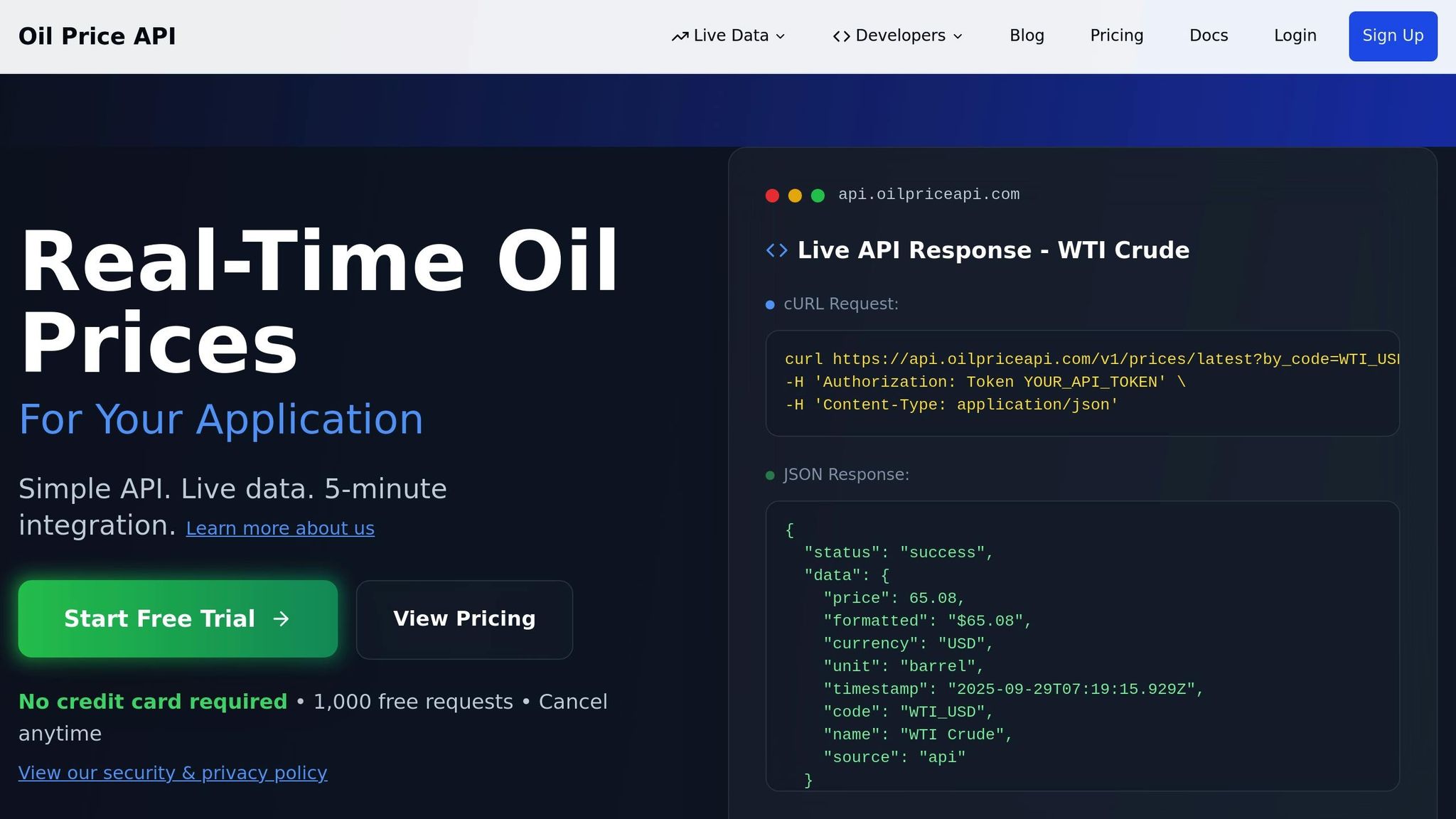
OilpriceAPI is a RESTful service designed to provide real-time data for Brent Crude and other commodities, making it easy for U.S. businesses to integrate pricing data into their BI platforms. Let’s dive into its standout features, seamless BI compatibility, and flexible subscription options.
Core Features of OilpriceAPI
OilpriceAPI delivers both real-time and historical data for commodities like Brent Crude, WTI, Natural Gas, and Gold, with BRENT_CRUDE_USD as the default code.
Here’s what makes it versatile:
-
Endpoints for Every Need
- Use the
prices/latestendpoint to fetch the most up-to-date pricing information. - The
pricesendpoint provides access to a wide range of historical data. - Time-specific endpoints (e.g., past day, week, month, or year) make it easy to retrieve data for common time frames.
- Use the
-
Customizable Queries
Tailor your data requests to fit your needs. For example:- The
by_typeparameter lets you specify data types likespot_priceordaily_average_price. - The
by_codeparameter allows filtering by commodity codes such asBRENT_CRUDE_USD,WTI_USD,NATURAL_GAS_USD, orGOLD_USD. - Use
by_periodwithfromandtotimestamps for precise historical ranges.
- The
All responses are formatted in JSON and use ISO-8601 UTC timestamps, ensuring compatibility across different systems.
BI Tool Integration with OilpriceAPI
OilpriceAPI’s JSON REST architecture is built to work seamlessly with popular BI tools like Microsoft Power BI, Tableau, and Google Looker Studio. Its standardized data format reduces the need for complex transformations, making it easy to connect directly to live Brent Crude pricing feeds. For U.S.-based businesses, pricing data is formatted in U.S. dollars, adhering to American currency standards, which simplifies financial reporting and dashboard creation.
With real-time data, BI dashboards can display live market trends during trading hours. Meanwhile, historical data supports deeper insights, such as trend analysis, backtesting, and forecasting. The API's intuitive design, clear endpoints, and straightforward API key authentication make integration smooth and hassle-free.
Subscription Plans and Scalability
OilpriceAPI offers three subscription tiers to suit a variety of business needs:
- Hobby Plan: Perfect for individual traders and small businesses with basic data requirements.
- Business Plan: Designed for mid-sized companies and trading firms that need higher request limits and frequent updates.
- Enterprise Plan: Provides unlimited scalability and premium support, ideal for large organizations and institutional users.
Each plan includes tailored API request limits, allowing businesses to start with a plan that matches their current needs. As your data requirements grow, upgrading is simple, ensuring that OilpriceAPI can scale alongside your BI goals. Whether you’re building straightforward dashboards or managing complex, organization-wide BI systems, these plans are designed to keep your data flowing.
sbb-itb-a92d0a3
Use Cases for Brent Crude Price Data in BI Platforms
Bringing Brent Crude pricing data into BI platforms opens up a world of strategic possibilities for U.S. businesses across various sectors. Whether it's energy trading, manufacturing, or logistics, access to both real-time and historical data empowers companies to make smarter decisions, manage risks, and boost efficiency. Here’s how different industries put this data to work.
Trading Analysis and Risk Management
Energy trading firms depend heavily on real-time Brent Crude data to stay ahead in volatile markets. By integrating live pricing feeds into BI dashboards, traders can track price movements throughout the day, spot trends as they develop, and respond swiftly to market changes.
These platforms also allow traders to visualize how Brent Crude prices correlate with other financial instruments, offering a broader view of how oil price shifts could impact their overall portfolios.
For firms using algorithmic trading systems, reliable JSON data is a must. These systems execute trades automatically based on predefined criteria like price breakouts or moving averages, ensuring operations run smoothly without data gaps.
Financial Forecasting and Reporting
Brent Crude data isn’t just for trading - it’s a critical tool for financial planning and analysis. Investment firms and financial institutions use it to strengthen their predictive analytics. Historical price trends, when combined with economic indicators, help analysts create models that better forecast energy sector performance and commodity-linked securities.
Portfolio managers use BI tools to integrate Brent Crude pricing into their workflows, keeping a close eye on how oil price movements influence energy-related investments. Including Brent Crude analysis in monthly or quarterly reports adds depth to performance reviews, offering a clearer picture of portfolio impacts.
Financial planning teams also rely on long-term historical data to simulate different economic scenarios. By studying how Brent Crude prices reacted during past recessions, geopolitical events, or economic booms, they can fine-tune investment strategies and asset allocations to prepare for future market shifts.
Supply Chain and Procurement Optimization
Manufacturers tap into Brent Crude data to make smarter procurement decisions. When integrated into BI dashboards, this data helps procurement teams figure out the best times to buy materials, negotiate supplier contracts, and manage inventory based on expected price trends.
In transportation and logistics, oil price data is key to managing costs. By analyzing how fuel price changes impact operational expenses, companies can adjust customer pricing, optimize delivery routes, and make informed decisions about fleet management and fuel hedging.
Chemical and petrochemical companies use this data to predict raw material costs and adapt their production schedules. For instance, when oil prices drop, they might ramp up production of petroleum-based products. On the flip side, rising prices could encourage a shift toward alternative feedstocks or more efficient processes.
Airlines and shipping companies also rely on historical pricing trends to design smarter fuel hedging programs. By examining seasonal patterns, geopolitical influences, and economic cycles, they can time their hedging strategies more effectively, minimizing the impact of fuel price volatility on their bottom line.
Choosing the Right API for BI Integration
Selecting the right API for Brent Crude integration is a critical step in ensuring smooth operations and accurate decision-making. A poorly chosen API can lead to data gaps, downtime, and missed opportunities in the market. On the other hand, the right API serves as the backbone of your business intelligence (BI) processes, delivering reliable, accurate, and timely data that your teams can depend on.
Reliability is the cornerstone of any effective API. Look for one that guarantees consistent uptime and has a proven track record of dependability. An API backed by robust infrastructure is essential for high-frequency data needs, ensuring your operations run without interruptions.
Data quality and coverage are equally important. The best APIs provide both real-time pricing updates and extensive historical data that spans several years. This combination allows your BI tools to handle everything from immediate market notifications to long-term trend analysis and even predictive modeling.
Ease of integration is another crucial factor. APIs that use standard JSON REST protocols integrate effortlessly with platforms like Tableau, Power BI, and custom dashboards. Well-documented endpoints and clean design reduce the complexity of implementation, saving your team valuable time and minimizing ongoing maintenance.
Scalability is key for businesses looking to grow. Whether your focus is on basic price tracking or more advanced multi-commodity analysis, the API you choose should handle increasing data demands and evolving use cases without requiring a complete overhaul. OilpriceAPI is a prime example, offering flexible plans that adapt to your BI needs over time.
OilpriceAPI stands out by providing real-time and historical pricing data for commodities like Brent Crude, WTI, Natural Gas, and Gold through a user-friendly JSON REST API. With subscription plans ranging from Hobby to Enterprise, businesses of all sizes can scale their data access as their needs grow. This flexibility, combined with an intuitive design, underscores the importance of simplicity and scalability in API selection.
Beyond technical features, cost and upgrade flexibility are key considerations. A good API offers tiered pricing plans that align with your usage, making it easier for smaller firms to access professional-grade data while maintaining clear paths for upgrades as their requirements expand.
Your specific use case should guide your decision. For instance, trading firms may prioritize rapid updates, supply chain managers might need extensive historical trends, and manufacturers may require data on a broader range of commodities. Matching these needs with the right API ensures a tailored approach to data integration.
Finally, the integration process should be straightforward. APIs with comprehensive documentation, sample code, and responsive support teams can significantly reduce implementation risks. Developers should be able to access sample data and create basic visualizations within just a few hours, speeding up the time-to-value for your BI tools.
FAQs
How does integrating Brent Crude price data into BI tools benefit businesses across industries?
Integrating Brent Crude price data into BI tools allows businesses to tap into real-time and historical market insights, helping them spot trends, predict price changes, and make smarter decisions. This kind of data integration supports better planning, operational efficiency, and adaptability to shifting market conditions.
Industries like oil and gas, finance, and manufacturing stand to gain significantly by leveraging this information. They can use it to streamline operations, minimize risks, and boost profitability. Access to precise, up-to-date data empowers companies to align their strategies with market trends, giving them a competitive advantage.
What should I look for in an API to integrate Brent Crude data into BI platforms?
When selecting an API to bring Brent Crude data into your BI platforms, prioritize real-time data access to ensure timely insights, high data accuracy for dependable analysis, and easy integration with your BI tools to keep workflows efficient.
You’ll also want to consider robust security features to safeguard sensitive information, scalability to handle expanding business demands, and detailed documentation to simplify both setup and troubleshooting. These elements work together to keep operations running smoothly and empower confident, data-driven decision-making.
How does OilpriceAPI ensure secure and reliable access to Brent Crude price data for businesses?
OilpriceAPI places a strong emphasis on data security and reliability, operating on a robust infrastructure that boasts a 99.9% uptime guarantee. The platform employs a secure JSON REST API, ensuring all data is transmitted with encryption to safeguard sensitive information during access.
The price data - covering both real-time and historical Brent Crude figures - comes exclusively from trusted commercial providers. This guarantees accuracy and consistency, enabling businesses to seamlessly integrate current commodities data into their systems and make well-informed decisions.