Commodity Prices vs. Employment Cycles
Commodity Prices vs. Employment Cycles
Commodity prices and employment cycles are deeply interconnected, shaping economic trends across industries and regions. Here's the core idea:
- Commodity prices (like oil, gold, or agricultural goods) are highly volatile, fluctuating due to supply, demand, and global events. A 1% price increase can lower unemployment by one basis point and increase job vacancies by 0.3% at peak levels.
- Employment cycles reflect patterns in job creation and loss during economic expansions or contractions. These cycles are influenced by commodity price changes, which act as both income and cost shocks.
Key takeaways:
- Rising commodity prices can boost jobs in resource-heavy sectors but may harm industries reliant on commodities due to higher costs.
- Regional and sectoral impacts vary: resource-dependent areas benefit during booms, while export-heavy regions may suffer from stronger currencies.
- Global events, inflation, and currency shifts amplify these effects, with time delays often complicating employment responses.
Real-time data, like that offered by platforms such as OilpriceAPI, is critical for analyzing and forecasting how commodity prices impact jobs. Combining real-time insights with historical data helps policymakers and businesses make informed decisions in an unpredictable economic landscape.
Understanding Phases of Business Cycle
How Commodity Prices Affect Employment Cycles
Commodity price fluctuations play a pivotal role in shaping employment trends. While they can fuel job growth and income in commodity-producing industries, they often create challenges for non-commodity sectors due to rising costs and competitive pressures.
Income Growth in Commodity-Producing Sectors
When commodity prices climb, industries tied to resource extraction and production tend to thrive. For instance, in Norway, an 8% increase in oil prices correlated with a 0.2% uptick in private consumption. Even more striking, the growth in non-oil output was reported to be 5 to 8 times larger than the growth in oil production. Although these commodity-producing sectors make up a smaller portion of total employment, the wealth they generate can ripple through the economy, boosting domestic demand and indirectly creating jobs in other industries. However, the flip side of this dynamic is the strain it places on non-commodity sectors.
Higher Costs for Non-Commodity Industries
Rising commodity prices may spell trouble for industries that rely heavily on these resources. Increased input costs can erode profit margins and, in some cases, lead to job cuts. Energy-intensive sectors are particularly vulnerable. For example, in the metals and power industries, sustained high commodity prices can cause EBITDA margins to shrink by over 20 percentage points. This is largely because the metals sector allocates nearly 80% of its operating expenses to energy and raw materials.
Within the energy sector itself, the impact varies. Exploration and Production (E&P) companies, whose revenues are directly tied to commodity prices, feel the effects most acutely. As commodity prices rise, so does their revenue, making them highly sensitive to price swings. Refiners, on the other hand, can offset rising crude costs by passing those increases on to consumers. Meanwhile, oilfield-services companies often experience delayed effects, as their fortunes depend on how E&P companies adjust their capital expenditures.
"So, the E&P companies, they're the ones that extract and sell the commodity. So, they're selling the commodity price, it's pretty clear if the commodity goes up, and so does their revenue. And that makes them very sensitive to those commodity prices."
Different Sector Responses to Price Changes
The ripple effects of commodity price changes manifest differently across sectors. Nontradable industries - those focused on local goods and services like retail and hospitality - tend to benefit. Higher commodity prices boost domestic demand, which can support job growth in these areas. However, tradable sectors face a different challenge. The "Dutch disease effect" often comes into play, where rising commodity prices strengthen the domestic currency. This makes exports less competitive internationally, leading to job losses in export-focused industries. Historical patterns show that these dynamics have significantly influenced employment during periods of economic downturn.
This divergence in sectoral responses highlights a critical point: the overall impact on employment depends largely on how much of the demand surge from rising commodity prices spills over into non-commodity sectors.
Comparing Effects Across Economic Conditions
The link between commodity prices and employment isn’t one-size-fits-all - it changes depending on economic conditions, skill levels, and where you’re looking. These dynamics set the stage for a closer look at how workers’ skills and regional factors shape job outcomes in different ways.
Economic Growth vs. Recession Periods
When the economy is growing, rising commodity prices often reflect strong demand, which can boost jobs in resource-heavy areas. But during recessions, the story shifts. Global downturns usually bring weaker demand and disruptions to supply chains, which push commodity prices down.
Since 1996, global shocks have driven more than two-thirds of the volatility in commodity prices. About 50% of these swings stem from demand changes, while supply issues account for roughly 20%. A dramatic example unfolded during the early COVID-19 crisis: crude oil prices plummeted to just above $10 per barrel, only to skyrocket to $120 following Russia’s 2022 invasion of Ukraine. These wild fluctuations created uncertainty for industries reliant on commodities, complicating employment planning.
Recoveries from recessions also follow a unique pattern. Commodity prices tend to bounce back as market disruptions ease and demand picks up again. However, employment in commodity-dependent sectors often lags behind broader economic recovery. Why? Companies typically wait for prices to stabilize before committing to new hires.
High-Skill vs. Low-Skill Job Markets
The skill level of workers plays a big role in how commodity price changes affect wages. Workers with specialized skills tend to experience sharper wage losses during demand slumps but also enjoy bigger gains when conditions improve. For instance, when exports rise, a highly skilled worker (in the 75th percentile) might see a 14% greater earnings increase compared to someone with average skills. On the flip side, during periods of rising imports, those with specific skills could lose about 8% more than their less-specialized counterparts.
This pattern aligns with human capital theory, which suggests that workers with specialized skills face higher costs when adapting to adverse shocks because their expertise doesn’t easily transfer to other industries or roles. Interestingly, younger workers seem to weather these shifts better than older ones, as their skills often prove more flexible in response to market changes.
But skill level isn’t the only factor at play - where people live matters, too.
Regional Differences Across the U.S.
Commodity price changes ripple through the economy in different ways depending on the region. Areas that rely heavily on resource extraction and processing feel the effects of price swings more directly. For example, in regions deeply tied to commodity production, price shocks can influence economic activity significantly, albeit modestly overall. Meanwhile, in areas dependent on commodity imports, rising oil prices often lead to economic slowdowns, with GDP falling and unemployment climbing.
Although direct employment in commodity-producing sectors accounts for just 3% to 6% of jobs, the impact extends far beyond these industries. Because commodities make up over 35% of the Consumer Price Index (CPI), price fluctuations drive inflation and affect nearly every sector.
Recent data illustrate how these regional differences play out. After the CPI hit a peak of 9.1% for the 12 months ending in June 2022, it dropped to 2.9% by the close of 2024. During this time, overall commodity prices rose a modest 0.3%, which helped stabilize employment in regions sensitive to commodity markets - avoiding the dramatic swings seen in earlier cycles.
"For investors, it's a time to approach commodities markets with a sense of caution."
sbb-itb-a92d0a3
Global Economic Factors and Their Impact
Global economic forces play a key role in shaping how commodity price changes affect employment. These influences add an important layer to understanding sector-specific responses and regional variations, offering insight into why the same price movement can yield different outcomes depending on timing and location.
Inflation and Currency Changes
Trends in global inflation heavily influence how shifts in commodity prices impact employment across the United States. With commodities accounting for over 35% of the Consumer Price Index (CPI), their price movements have a direct effect on inflation, which in turn shapes employment decisions. For example, surging energy prices in 2022 added more than 2 percentage points to global inflation. However, as commodity prices began to drop in 2023, they contributed to a decline in the U.S. CPI, which fell to 2.9% by the end of 2024.
Currency fluctuations also play a critical role. When the U.S. dollar strengthens, exports become more expensive for foreign buyers, while imports become cheaper. This dynamic affects employment differently across trade-sensitive and domestic-focused industries. The Federal Reserve’s efforts to maintain inflation at around 2% annually further influence currency values, creating ripple effects throughout commodity markets and employment cycles. Looking ahead, global commodity prices are expected to drop by 12% in 2025 and another 5% in 2026, reaching levels last seen in 2020. While this decline may ease inflationary pressures, it also signals weaker global demand, potentially affecting jobs in commodity-driven regions.
International Economic Events
History shows that international developments can reshape the relationship between commodity prices and employment. For example, the gold rushes in California and Australia during the late 1840s and early 1850s sparked inflation and employment booms in mining regions, while raising costs in other sectors.
More recently, global events have underscored this interconnectedness. The 2012 BRICS Summit’s Delhi Declaration noted how aggressive monetary policies in advanced economies caused excessive volatility in capital flows and commodity prices:
"Excessive liquidity from the aggressive policy actions taken by central banks in advanced countries to stabilize their domestic economies had been spilling over into emerging market economies, fostering excessive volatility in capital flows and commodity prices."
This volatility complicates employment planning. For instance, China’s unwrought aluminum imports surged by 633% in 2020 and another 75% in 2021, reducing the availability of aluminum in other markets. Transportation costs also reflect these pressures, with the Baltic Dry Index climbing 75% in 2021. Additionally, financial crises often push commodity prices downward. A composite crisis index shows a -0.23 correlation with commodity prices, meaning financial instability tends to lower prices. These shifts can ripple through dependent industries, reshaping employment landscapes over time.
Time Delays in Employment Responses
One of the most challenging aspects of the commodity-employment relationship is the time lag between price changes and their impact on jobs. Employment cycles often react to commodity price fluctuations with delays, leading to prolonged shifts in job markets.
Commodity price shocks influence domestic demand and job vacancies through changes in the real exchange rate. Although the commodity-producing sector represents just 3% to 6% of employment in countries like Australia, Canada, and New Zealand, the broader economic effects are significant. For every 1% increase in commodity prices, unemployment rates are estimated to drop by 1 basis point, while unfilled job vacancies can rise by up to 0.3% at their peak. These effects take time to unfold - price increases first boost demand for non-commodity goods, and the resulting currency appreciation encourages businesses to post more job openings.
In fact, commodity price shocks may explain up to one-third of unemployment increases. This timing mismatch poses challenges for policymakers and businesses trying to interpret market signals and act accordingly.
World Bank economists warn that these timing issues could become even more pronounced. Ayhan Kose, Deputy Chief Economist at the World Bank Group, explains:
"In an era of geopolitical tensions, surging demand for critical minerals, and more frequent natural disasters, that could become the new normal. Successfully navigating through repeated commodity prices swings will require developing economies to build fiscal space, strengthen their institutions, and improve investment climates to facilitate job creation."
These delays highlight the importance of timely data and responsive policies to keep up with shifting market conditions.
Using Real-Time Data for Better Decisions
The intricate link between commodity prices and employment trends calls for access to precise, up-to-the-minute data. For decision-makers, even a few seconds can make all the difference. Monitoring these changes in real time is essential to understanding how fluctuations in commodity prices influence job markets across various sectors and regions.
Building on earlier discussions about the connection between commodities and employment, real-time data has become an indispensable tool for making informed, timely decisions.
Why Combine Real-Time and Historical Data?
Both real-time and historical data offer valuable insights into market trends, consumer behavior, and economic conditions. Together, they enable more accurate and timely decision-making. When it comes to the relationship between commodities and employment, this data often acts as a leading indicator of economic health, revealing changes in employment patterns, job vacancies, and wages before larger economic shifts occur.
Historical data helps uncover long-term trends - like the 14.2-year and 3.8-year cycles identified in commodity price datasets. On the other hand, real-time monitoring enables quick reactions to emerging patterns, making it easier to forecast with precision. For example, real-time data has been shown to enhance customer acquisition, retention, and profitability.
The COVID-19 pandemic highlighted just how critical timely data can be. It provided essential insights into job losses, the rise of remote work, and sectoral shifts, which informed policy responses during a period of rapid change.
However, relying solely on historical data has its limits:
"Historical data outlines where we've been but falls short of guiding where we should head next."
This underscores the need to combine real-time insights with historical context for a well-rounded understanding of how commodity price changes influence employment cycles.
OilpriceAPI: A Key Data Tool
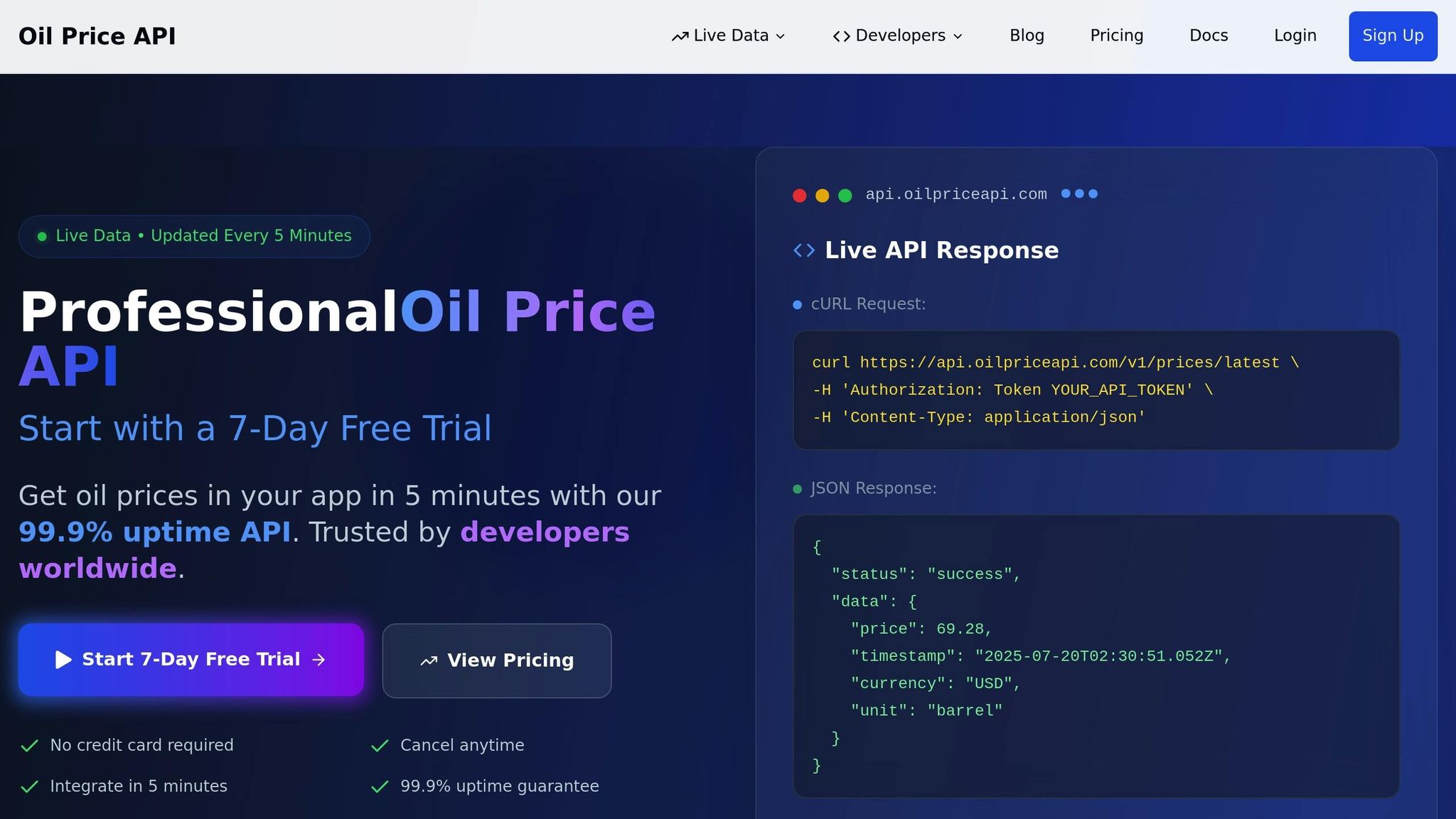
To harness these insights, reliable tools for both real-time and historical data are essential. OilpriceAPI offers a JSON REST API that provides real-time and historical price data for commodities like Brent Crude, WTI, Natural Gas, and Gold. This platform simplifies price analysis, empowering users to make informed decisions based on accurate, current data.
The API’s real-time capabilities meet the speed demands of today’s markets, helping users reduce risks and make precise decisions. Some of its standout features include:
- Easy integration for users of all technical levels
- Comprehensive real-time metrics
- Endpoints covering short-term and long-term trends
OilpriceAPI offers subscription plans - Hobby, Business, and Enterprise - with varying request limits, making it accessible to a broad audience. Its historical data feature is particularly useful for building forecasting models by providing context from real-world events, which is vital for understanding how employment in different industries reacts to commodity price shifts over time.
Applications for Policymakers and Analysts
Policymakers and analysts can use real-time commodity data to make better decisions and gain insights across sectors like finance, energy, and governance.
Economic forecasting is one area where real-time data proves invaluable. For instance, rising commodity prices often signal economic growth. Research shows that commodity returns can predict GDP growth for the following quarter, giving policymakers the ability to anticipate employment trends before they are fully realized.
Labor market policy also benefits from real-time insights. Stakeholders such as policymakers, employers, and educators can use this data to design workforce programs that align better with market demands. By tracking commodity price changes, it’s easier to identify which industries are poised for job growth or decline, enabling more targeted interventions.
Risk management sees marked improvement with current data. Real-time monitoring allows for early detection of potential downturns, giving regions reliant on commodity production the chance to implement support measures before unemployment spikes.
Traders and investors also gain a competitive edge. Machine learning models can process large datasets in real time, helping identify optimal entry and exit points in the market. These tools support the creation of effective trading strategies.
Operationally, real-time data enhances efficiency and resource allocation. It enables organizations to act proactively, backed by the latest information. To maximize these benefits, businesses should invest in robust data systems capable of handling high-volume streams and ensure their teams are skilled in working with AI technologies, refining applications as they go.
Conclusion: Main Points on Commodity-Employment Links
Summary of Main Findings
The link between commodity prices and employment cycles reveals varied economic dynamics depending on whether a country is a net producer or consumer. Our analysis highlights key mechanisms that shape how commodity price changes influence labor markets.
Commodity prices affect economies through two main pathways: income effects and cost effects. These effects differ by region and sector, shaping employment outcomes in unique ways.
Large commodity price swings - those exceeding 30% within a year or two - introduce uncertainty that ripples through labor markets. The impact varies geographically. For instance, rising energy prices hinder economic growth in Pakistan, while in the USA, oil price increases have shown positive long-term effects on economic growth. Similarly, in Indonesia, higher crude oil and palm oil prices have been linked to significant economic gains. In agriculture, fertilizer costs - which account for 15–20% of total production expenses - can have a major influence on farming-related jobs and industries.
On a global scale, commodities make up about 17% of international trade and are essential inputs in production. Their price movements act as critical indicators of global economic health, emphasizing the importance of dynamic data analysis in today’s unpredictable markets.
The Importance of Data-Driven Decisions
Given these findings, data-driven strategies are essential for managing the complex relationship between commodity prices and employment trends. The analysis demonstrates that price volatility directly affects employment cycles, making both real-time and historical data crucial for informed decision-making.
To fully grasp the interaction between commodity prices and labor markets, it’s necessary to monitor both short-term fluctuations and long-term patterns. Analytical tools capable of processing multiple data streams are indispensable for understanding these intricate relationships.
Commodity prices often act as early signals of economic shifts, predicting employment changes before they appear in traditional labor statistics. Combining historical data with real-time monitoring allows for better forecasting and strategic planning. For example, historical data reveals long-term trends, while real-time insights enable immediate responses. This dual approach is particularly valuable, as commodity returns have been shown to predict GDP growth in the following quarter.
Platforms like OilpriceAPI provide the infrastructure needed for this level of analysis. By offering real-time and historical data on key commodities like Brent Crude, WTI, Natural Gas, and Gold, the platform helps users track price movements that influence employment trends across sectors and regions.
For policymakers, access to precise commodity data enables proactive measures. When rising commodity prices signal inflation risks - considering that commodities account for over 35% of the Consumer Price Index - governments can implement monetary or fiscal policies before employment disruptions escalate.
As global supply chains grow increasingly interconnected, the relationship between commodity markets and labor dynamics becomes more complex. Organizations that utilize comprehensive commodity data can better manage risks, plan strategically, and improve operational efficiency.
Every GDP or unemployment shift reflects the economy's health.
In today’s fast-changing economic landscape, having access to and leveraging real-time data is critical for maintaining stability and supporting sustainable employment growth.
FAQs
How do changes in commodity prices affect jobs in non-commodity industries?
Fluctuations in commodity prices can send shockwaves through industries not directly tied to those commodities. When prices climb, they often inject more wealth into commodity-related sectors, which can spark increased economic activity. This surge typically translates to higher consumer spending and a growing appetite for goods and services, prompting non-commodity businesses to expand and add jobs.
On the flip side, a drop in commodity prices can curb spending and dampen economic growth. This slowdown may lead to fewer job opportunities in non-commodity industries. The extent of the impact, however, hinges on the specific commodity in question, the magnitude of the price shift, and the overall state of the economy.
How does real-time data help businesses and policymakers adapt to shifts in commodity prices and employment trends?
Real-time data is a game-changer for businesses and policymakers, offering the ability to react swiftly to shifts in commodity prices and employment trends. With current insights at their fingertips, decision-makers can act faster, allocate resources more effectively, and tweak strategies as needed.
For businesses, this translates to smarter investment decisions and staying one step ahead of market swings. Policymakers, on the other hand, can rely on this data to craft more precise plans and take actions that promote economic stability and growth. Having access to dependable, real-time data is critical for navigating the ever-changing dynamics of commodity markets and employment patterns.
Why is there often a delay between changes in commodity prices and their impact on employment, and how can businesses plan for it?
Commodity price changes don’t immediately impact employment. That’s because shifts in prices take time to work their way through wages, production levels, and investment decisions. These changes often happen in phases, which slows how quickly the labor market feels the effects.
To manage these delays, businesses can keep a close eye on commodity price trends and rely on data-driven tools to predict market shifts. By adopting flexible workforce strategies, companies can adjust staffing and operations more effectively, staying ahead of the delayed ripple effects of price changes.