How WebSocket Powers Real-Time Commodity APIs
How WebSocket Powers Real-Time Commodity APIs
Commodity markets move fast, and delays in data can mean big losses. WebSocket offers a better way to deliver real-time commodity prices by replacing outdated HTTP polling. Here's why it matters:
- Real-Time Updates: WebSocket creates a constant connection between client and server, ensuring instant price updates without delays.
- Low Latency: Unlike HTTP polling, WebSocket minimizes delays, making it ideal for high-speed trading and risk management.
- Efficient Bandwidth Use: It reduces network strain by avoiding repetitive requests and sending only necessary updates.
- Scalability: WebSocket handles thousands of simultaneous connections, allowing smooth performance during peak market activity.
For traders, analysts, and automated systems, WebSocket ensures they get the latest prices for commodities like Brent Crude, WTI, Natural Gas, and Gold - when every millisecond counts.
The Complete Guide to WebSockets
Problems with Traditional Data Delivery Methods
Before WebSocket technology emerged, data delivery was largely governed by HTTP polling. While it served its purpose, this method struggled to keep up with the demands of modern commodity markets, especially when rapid price updates were essential.
HTTP Polling Performance Issues
HTTP polling operates by having applications repeatedly query the server to check if new data is available. While simple in concept, this approach comes with several performance pitfalls, especially in high-frequency trading environments.
One of the biggest issues is the network overhead. Every polling request involves a full HTTP handshake, which means repeatedly opening and closing connections. This process creates unnecessary network traffic and wastes resources.
Another drawback is the delayed updates caused by fixed polling intervals. In fast-moving markets, even slight delays can disrupt trading decisions, as updates are only checked periodically, not in real time. Additionally, the frequent back-and-forth of polling increases bandwidth usage, with repeated transmissions of headers and authentication data placing extra strain on both client networks and server infrastructure.
Efforts to address these problems, such as long polling, aim to keep connections open for longer periods. However, this approach introduces its own set of challenges, like connection timeouts that require complex reconnection mechanisms. Long polling can also be disrupted by proxy servers or firewalls, which may interfere with sustained connections.
Effects on Commodity Market Data
These inefficiencies have a direct impact on commodity markets. Delayed updates force traders to rely on outdated price information, which can compromise automated trading systems and risk management strategies. On top of that, the repeated polling requests put a heavy load on both networks and servers, pushing API providers to maintain higher server capacities just to handle the strain.
During periods of intense market activity, the surge in polling requests can overwhelm servers, leading to performance bottlenecks and service disruptions - precisely when accurate, timely data is most critical.
These limitations highlight the need for a better approach, which is where WebSocket technology comes in. By enabling persistent, bidirectional connections, WebSocket eliminates the inefficiencies of traditional polling methods, making it possible to deliver real-time data updates that are crucial for modern commodity markets.
How WebSocket Powers Real-Time Commodity APIs
WebSocket technology has revolutionized how commodity APIs deliver data. By establishing a persistent, two-way connection between clients and servers, WebSocket eliminates the need for constant back-and-forth HTTP requests. This setup allows for instant, seamless data flow, laying the foundation for real-time delivery of commodity information.
WebSocket Architecture for Real-Time APIs
Once the initial handshake is complete, WebSocket creates a persistent TCP connection that enables simultaneous, two-way communication. Many commodity APIs rely on a subscription-based model, where clients subscribe to specific data streams - like Brent crude oil or natural gas prices - and the server pushes updates directly to those subscribers. The protocol uses lightweight text or binary frames, reducing overhead while maintaining stateful connections. This design allows servers to remember client preferences, ensuring updates are delivered promptly and efficiently.
WebSocket vs. HTTP Polling Performance
The advantages of WebSocket over HTTP polling become clear when comparing performance metrics:
| Metric | WebSocket | HTTP Polling | Performance Advantage |
|---|---|---|---|
| Single Request Latency | 83 ms average | 107 ms average | About 22% faster |
| 50 Parallel Requests | ~180 ms | ~5 seconds | Roughly 96% faster |
| Requests Per Second | ~3,900 RPS | ~950 RPS | Around 310% higher throughput |
| Data Overhead | 54 bytes total | 282 bytes total | About 81% less bandwidth usage |
| Concurrent Connections | Unlimited | 6 (Chrome default) | – |
For industries where every millisecond counts, such as commodity trading, these metrics highlight WebSocket's clear advantage. Its speed, combined with robust security and efficient connection management, makes it an ideal choice for handling volatile market conditions.
Security and Connection Management
Securing WebSocket connections involves using WSS (WebSocket Secure), which employs TLS encryption similar to HTTPS. Authentication is handled during the initial handshake and remains active throughout the session. Many commodity APIs use token-based authentication to establish secure connections.
Managing open WebSocket connections is equally important since they continuously consume resources. Best practices include using keep-alive mechanisms like ping/pong frames to monitor connection health. On the client side, robust logic ensures disconnections are detected and connections are automatically re-established using exponential backoff to avoid overloading servers. Setting connection timeouts helps maintain uninterrupted data flow, even during network disruptions. These security and management practices complement WebSocket's performance, ensuring reliable and secure delivery of real-time data.
sbb-itb-a92d0a3
Benefits of WebSocket Integration in Commodity APIs
Integrating WebSocket technology into commodity APIs offers clear advantages, enhancing data delivery, operational efficiency, and overall user satisfaction.
Faster Data Delivery and Reduced Latency
WebSocket's design relies on a persistent connection, bypassing the delays of the traditional request-response cycle. This allows commodity APIs to deliver price updates much more quickly. For example, during volatile market conditions - like sudden shifts in crude oil prices - traders gain immediate access to critical updates. By providing near real-time data, WebSocket-powered APIs ensure users stay aligned with current market trends.
This rapid delivery is particularly beneficial for traders managing multiple commodities, enabling them to monitor price changes across their entire portfolio without delays.
Efficient Bandwidth Usage and Enhanced Scalability
WebSocket's lightweight communication frames and two-way data flow significantly reduce bandwidth usage. Instead of broadcasting unnecessary information, it allows for precise, targeted updates, optimizing network resources.
Scalability is another strength. Stateful connections maintain client context, eliminating repetitive tasks like re-authentication or redundant data requests. Techniques such as connection pooling and load balancing further help manage a large number of concurrent connections. These efficiencies ensure that commodity APIs remain responsive and reliable, even as user demand increases.
Enhanced User Experience and Cost Efficiency
The performance boost provided by WebSocket integration translates directly into a better user experience. Applications built on these APIs can display price updates instantly, offering users a seamless and responsive interface that reflects live market conditions. Developers also benefit from a simplified architecture that avoids the complexities of polling mechanisms.
Cost savings are another key advantage. Providers see reduced server loads and lower data transfer expenses, while users enjoy more efficient applications with reduced power consumption on mobile devices. Additionally, the consistent and smooth delivery of data minimizes errors and inconsistencies, supporting more accurate decision-making in the fast-paced commodity market.
OilpriceAPI: Real-Time Commodity Data in Action
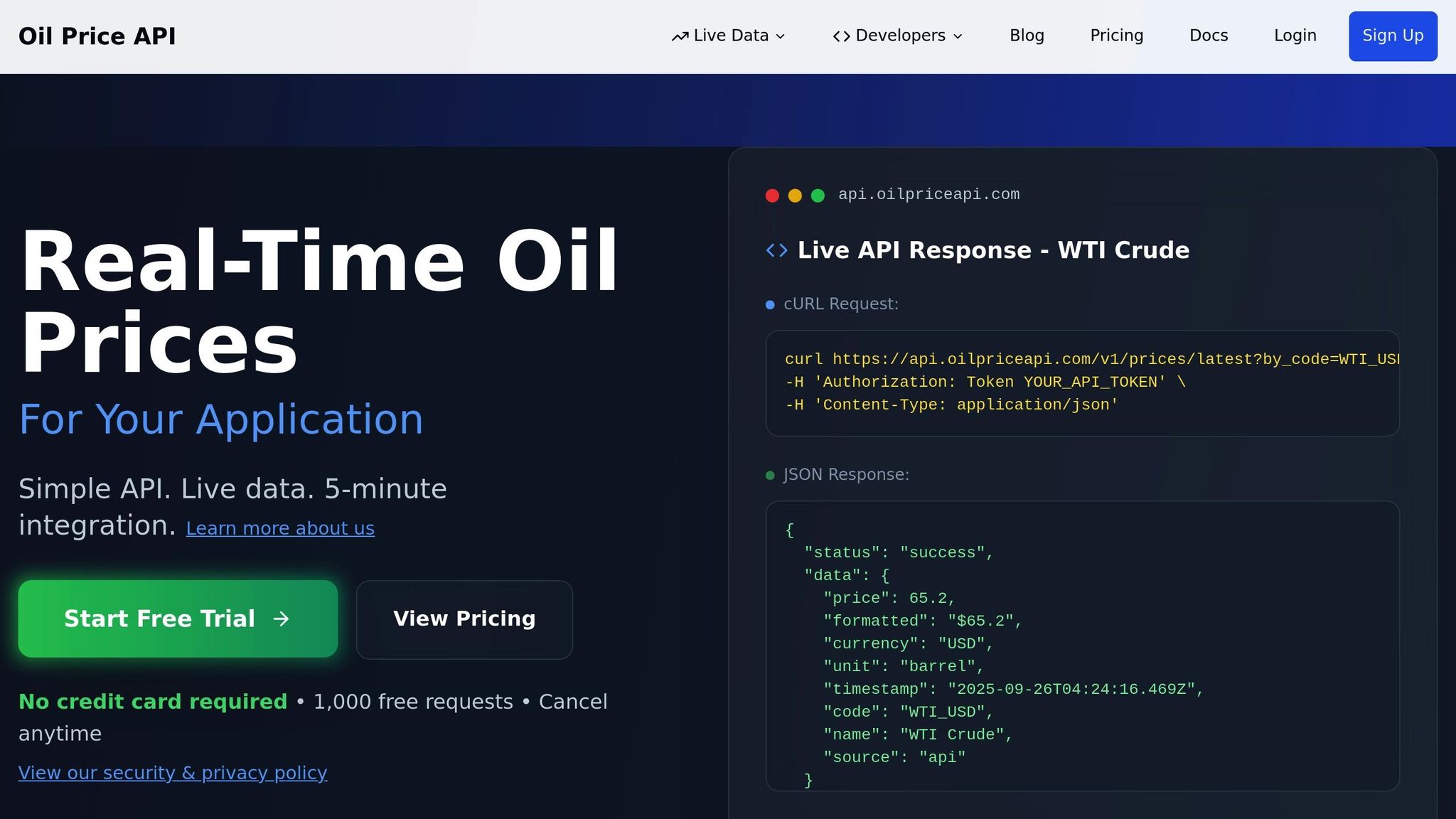
OilpriceAPI takes advantage of modern data delivery methods to provide traders and developers with the tools they need to stay ahead in fast-paced markets. By offering both live and historical commodity prices, it empowers users to make well-informed decisions with ease.
Real-Time Data for Key Commodities
With OilpriceAPI, you can access up-to-the-minute pricing for major commodities like Brent Crude, WTI, Natural Gas, and Gold. Using RESTful endpoints, the API delivers this data in a straightforward format with specific commodity codes: BRENT_CRUDE_USD, WTI_CRUDE_USD, NATURAL_GAS_USD, and GOLD_USD. The /v1/prices/latest endpoint provides live updates, while historical data is available for different time frames, including the past day, week, month, and year, all organized in a paginated format [2].
API Features and Developer Support
OilpriceAPI uses a JSON-based structure, making integration with various programming languages seamless. Authentication is handled through an API token placed in the Authorization header. Whether you're an individual hobbyist or part of a large enterprise, subscription options - Hobby, Business, and Enterprise - are tailored to suit different needs. Plus, the API's detailed documentation, complete with practical examples, ensures developers can get started quickly and effectively.
Designed with Efficiency in Mind
While OilpriceAPI primarily relies on RESTful endpoints, its architecture incorporates principles similar to WebSocket technology. By delivering optimized JSON responses and maintaining robust endpoint management, it ensures high performance and scalability. Even during periods of intense market activity, the API is built to handle multiple concurrent requests without a hitch.
Conclusion: The Future of Real-Time Commodity APIs with WebSocket
WebSocket technology is reshaping how commodity data is delivered. By enabling persistent, two-way communication, WebSocket APIs eliminate the need for HTTP polling, ensuring data is delivered instantly - a critical advantage in today’s fast-moving commodity markets. This shift highlights the potential of advanced solutions like OilpriceAPI.
The growing adoption of WebSocket technology is backed by compelling data. Building an in-house WebSocket system can require substantial resources, with annual maintenance costs ranging from $100,000 to $200,000. Additionally, 65% of custom-built WebSocket solutions have faced notable outages or downtime in the last 12 to 18 months.
For those active in commodity markets, the benefits of WebSocket-powered APIs go beyond just technical enhancements. Low-latency data is essential for high-frequency trading and algorithmic systems, where even the smallest delay can affect profitability. With WebSocket APIs, traders can send orders while simultaneously receiving real-time market updates, enabling more informed and timely decisions.
OilpriceAPI is a prime example of this evolution in real-time data delivery. Alongside its JSON REST API for commodities like Brent Crude, WTI, Natural Gas, and Gold, it incorporates the efficiency and speed associated with WebSocket technology. This ensures users receive data precisely when they need it - whether they’re tracking rapid market changes or performing in-depth trend analysis.
Looking ahead, the future of commodity APIs lies in scalable and secure technologies. As WebSocket technology continues to advance, APIs that integrate these capabilities will become essential tools for anyone committed to staying ahead in commodity market analysis and decision-making.
FAQs
How does WebSocket technology enhance real-time data delivery for commodity trading?
WebSocket technology transforms the way real-time data is delivered by creating a persistent, two-way connection between clients and servers. Unlike traditional HTTP polling, which requires repeated requests, WebSockets allow servers to push updates to clients instantly. In fast-paced environments like commodity markets, this means quicker access to live price updates and essential data.
With reduced latency and lower bandwidth consumption, WebSockets make data exchange more efficient. For traders, this real-time communication translates to faster decision-making and improved accuracy, which are critical in rapidly changing markets.
What security measures ensure safe and reliable data delivery in WebSocket connections for commodity APIs?
WebSocket connections for commodity APIs incorporate several security measures to ensure real-time data delivery remains safe and dependable. One of the primary steps is using the Secure WebSocket (WSS) protocol, which encrypts data to shield it from eavesdropping and man-in-the-middle attacks.
Additional safeguards include origin checks to block unauthorized cross-site WebSocket connections, setting limits on message sizes to prevent resource exhaustion, and capping the number of connections or requests from a single IP address to reduce the risk of denial-of-service (DoS) attacks. Together, these practices protect the integrity, confidentiality, and availability of real-time commodity data streams.
How does WebSocket technology improve real-time data delivery in commodity APIs like OilpriceAPI?
WebSocket technology transforms real-time data delivery in commodity APIs by allowing instant, two-way communication between servers and clients. Unlike the older polling methods that repeatedly request updates, WebSocket keeps a continuous stream open, ensuring updates are delivered as they happen - no lag, no waiting.
This method not only boosts the speed and responsiveness of data updates but also cuts down on bandwidth usage, making it a more efficient solution for managing large volumes of real-time information. For example, users of platforms like OilpriceAPI can access live commodity prices, such as Brent Crude or Gold, in real time. This gives them the tools to make quicker, smarter decisions based on the latest market data.