Oil Price API with Sub-200ms Response Times - Perfect for Trading Apps
Oil Price API with Sub-200ms Response Times - Perfect for Trading Apps
In fast-moving commodity markets, speed and accuracy are critical. OilpriceAPI delivers real-time oil price data with sub-200ms response times, making it an ideal solution for trading applications. Here's why it stands out:
- Ultra-Fast Data: Average response time of 50ms ensures immediate access to live prices for crude oil, natural gas, and gold.
- Reliability: 99.9% uptime guarantees consistent performance during market volatility.
- Real-Time Updates: Provides live price updates every 5 minutes, enabling quicker decision-making and precise risk management.
- Developer-Friendly: Easy integration with REST API, JSON format, and multiple programming languages.
- Flexible Plans: From free trials to high-volume subscriptions, options cater to individual developers and large trading desks.
For traders, sub-200ms response times mean faster trade execution, reduced slippage, and better risk management. Whether you're building algorithmic trading systems or portfolio dashboards, this API ensures your tools stay ahead in volatile markets.
Start using OilpriceAPI today to integrate live oil prices into your trading systems.
How Low-Latency Data Improves Trading Apps
Faster Algorithmic Trading with Real-Time Data
In today's high-frequency trading environment, where 55% of all US equities market volume involves high-frequency trading strategies, algorithmic trading systems depend on microsecond precision to seize fleeting profit opportunities. For instance, when geopolitical events or supply chain disruptions cause oil prices to fluctuate, algorithms need immediate access to updated WTI or Brent Crude prices to recalibrate positions on the fly.
"If you're not fast enough, you're going to get run over and just be part of the liquidity for faster groups." - Joe Signorelli, EVP and Global Head of Quantitative Trading Solutions at Trading Technologies
OilpriceAPI delivers commodity price updates with sub-200ms response times, ensuring algorithms can act on market changes almost instantly. This speed becomes especially critical during volatile periods when energy markets respond sharply to breaking news or shifts in global demand. Quick execution not only enhances profitability but also supports precise risk management, allowing traders to act decisively in high-pressure situations.
Better Risk Management and Market Analysis
Low-latency data plays a crucial role in effective risk management, enabling trading systems to monitor and adjust positions in real time. Unlike delayed price feeds that might lag by seconds or minutes, real-time data allows traders to respond instantly to sharp market swings, particularly during periods of high volatility when energy prices can change dramatically within minutes.
"Latency is important because it affects execution quality." - Johan Sandblom, President and Head of Business Development at Lime Trading
With real-time pricing updates, traders can build more accurate models and adapt strategies faster. This capability enables continuous monitoring of commodity price movements, identifying trends, and triggering timely alerts when critical price thresholds are reached.
Research indicates that 100% of customers struggling with risk management saw improvements after adopting real-time data solutions. The ability to track exposure continuously, rather than relying on periodic updates, helps traders avoid missing key price movements and enhances their ability to safeguard positions during market turbulence.
Use Cases for U.S.-Based Trading Desks
For U.S.-based trading desks, the combination of faster execution and real-time risk insights offers clear operational benefits. Energy trading desks, for example, require instant price updates in formats familiar to U.S. markets - prices in USD per barrel, timestamps in MM/DD/YYYY format, and volumes aligned with standard conventions.
Sub-200ms updates are critical for detecting price spreads in WTI and Brent Crude. When geopolitical tensions disrupt oil supply routes, prices for these commodities can diverge rapidly. Trading applications equipped with real-time data can immediately flag these spreads, enabling traders to capitalize on arbitrage opportunities before they vanish.
Portfolio management systems also benefit significantly from real-time data. Whether tracking positions in crude oil, natural gas, or gold, continuous monitoring ensures accurate calculations of position values, margin requirements, and risk exposure. Features like dynamic stop-loss orders automatically adjust based on live price movements, while decision-making dashboards integrate real-time commodity prices, position data, and analytics, offering instant insights into trading performance and market conditions.
These tools empower trading desks to act decisively during volatile market conditions, improving overall efficiency and ensuring they remain competitive in fast-moving markets. By leveraging precise, real-time market intelligence, traders can stay ahead in an ever-changing landscape.
Downloading Oil Prices from the Web in Python
OilpriceAPI Features and Integration
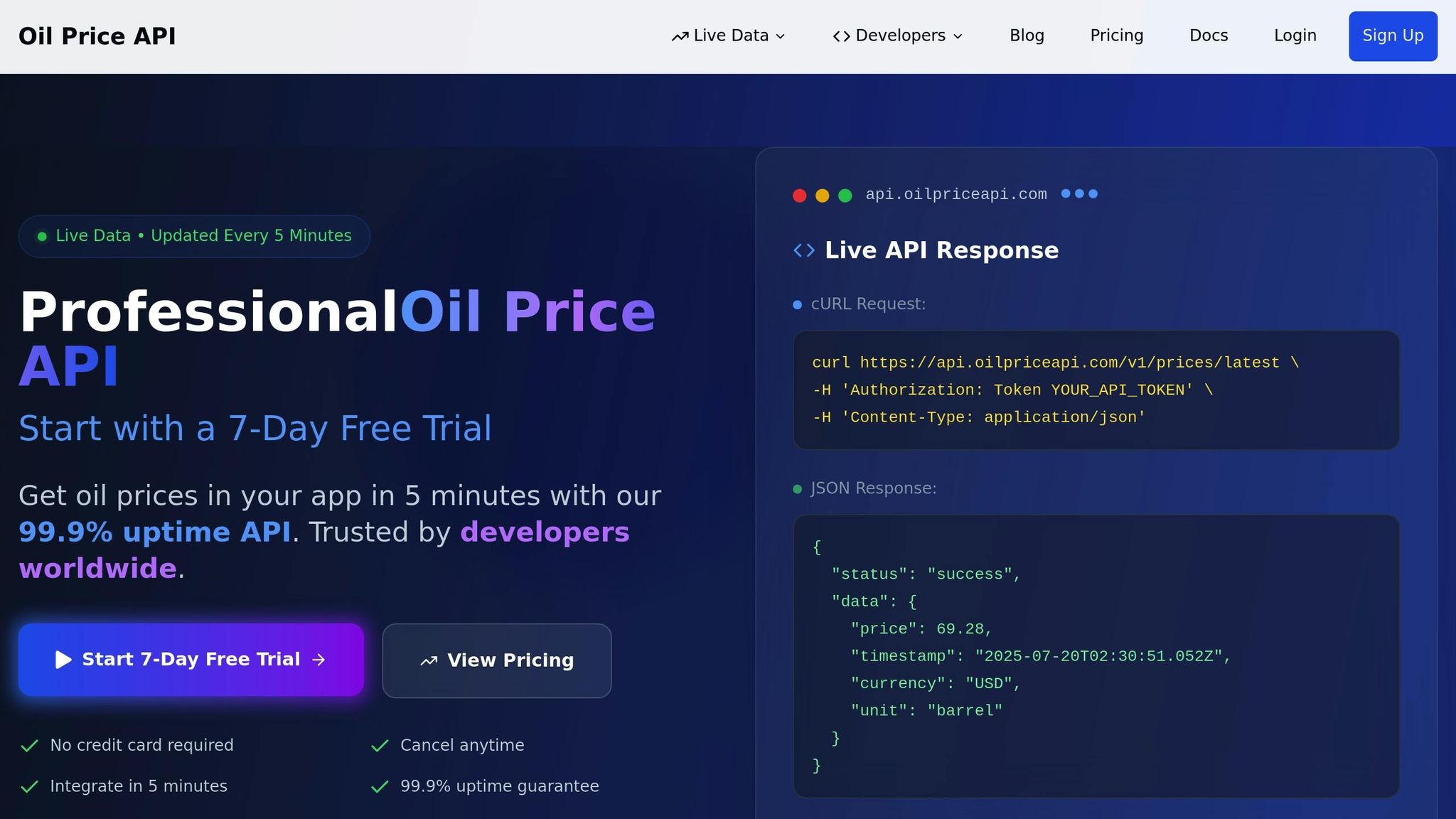
OilpriceAPI prioritizes fast data delivery, making it a go-to choice for trading applications. Its integration process and subscription options are designed to cater to a wide range of users, from individual developers to large trading desks.
Core Features of OilpriceAPI
OilpriceAPI offers key features tailored for trading applications. One standout is the real-time price updates every 5 minutes for major commodities like WTI, Brent Crude, Natural Gas, and Gold. This frequency ensures traders get timely market data without overwhelming their systems with excessive API calls.
"Access comprehensive oil and energy data via our REST API. Built for developers, data scientists, and financial analysts." - OilpriceAPI Docs
The API boasts an average response time of 50ms and a 99.9% uptime guarantee, ensuring reliable performance during high-stakes trading periods when quick access to data is crucial.
For those analyzing long-term trends, the API includes historical data, helping traders develop backtesting models and identify patterns over time. It also supports multiple currencies, including USD, which is especially useful for U.S.-based trading platforms. Data is provided in JSON format, making integration straightforward for developers.
Additional developer-friendly features include standardized error codes for easier troubleshooting and UTC timestamps in ISO 8601 format, which ensure uniform time tracking across various systems and time zones.
Developers will appreciate the simplicity of the integration process, backed by detailed documentation and a smooth authentication setup.
Easy Integration for Developers
OilpriceAPI is designed with developers in mind, offering a seamless integration experience. Its REST API adheres to widely accepted principles, making it quick to implement for most development teams. The platform provides detailed documentation with sample code, so developers can get started without unnecessary guesswork.
Authentication is simplified with a single API key for token-based access. Errors are managed using standard HTTP status codes, which makes debugging intuitive for teams already familiar with web APIs.
The API automatically formats data in USD, following U.S. conventions, which is particularly beneficial for trading desks based in the United States. Developers can also test the API using the free tier before committing to a paid plan, ensuring compatibility with their existing systems. Its RESTful design supports multiple programming languages like Python, JavaScript, C#, and Java, making it versatile for integration into various trading platforms.
Subscription Plans for Different Needs
OilpriceAPI offers four subscription plans, each tailored to varying operational requirements. Here's a breakdown:
- Free Trial: Provides 1,000 API requests per month, basic real-time oil prices, and community support. Ideal for developers testing the waters.
- Exploration: Offers 10,000 monthly requests with email support, suitable for small-scale operations.
- Production Boost: Includes 50,000 requests per month, access to historical data, a 99% SLA uptime guarantee, and priority support.
- Reservoir Mastery: At $129 per month, this plan supports 250,000 requests monthly, real-time updates via WebSocket, webhooks for notifications, and a 99.9% SLA uptime guarantee. It also includes dedicated support with Slack integration.
| Plan | Monthly Requests | Historical Data | SLA Uptime | Support Level |
|---|---|---|---|---|
| Free Trial | 1,000 | ✗ | None | Community |
| Exploration | 10,000 | ✗ | None | |
| Production Boost | 50,000 | ✓ | 99% | Priority |
| Reservoir Mastery | 250,000 | ✓ | 99.9% | Dedicated + Slack |
These plans cater to a range of needs, from testing and small-scale use to high-demand trading operations requiring real-time updates and dedicated support.
sbb-itb-a92d0a3
Real-World Use Cases for OilpriceAPI in Trading
OilpriceAPI's advanced features and smooth integration have made it an essential tool for trading operations. Across the United States, trading firms depend on its ultra-low latency to support high-frequency trading, where even milliseconds can make a difference. Here’s how OilpriceAPI is being used in real-world trading scenarios.
Algorithmic Trading and Automation
In algorithmic trading, speed and accuracy are everything. These systems rely on instant price updates to execute trades before market conditions shift. OilpriceAPI provides continuous updates on key commodities like WTI, Brent Crude, Natural Gas, and Gold, ensuring automated systems have the live data they need.
High-frequency trading algorithms use this data to seize short-lived arbitrage opportunities. Meanwhile, momentum trading strategies benefit by tracking price movements across various timeframes, allowing traders to act when technical resistance levels are broken.
Real-Time Portfolio and Risk Management
Portfolio managers use OilpriceAPI to keep a close watch on commodity exposures throughout the trading day. Its real-time updates allow them to react swiftly to market shifts, spot new trading opportunities, and manage risk effectively. For example, risk systems can calculate Value at Risk (VaR) metrics and initiate hedging trades when oil prices move beyond set thresholds.
The API also supports portfolio adjustments and margin optimization by providing live pricing. Historical data capabilities enable stress testing, helping managers simulate how positions might behave under extreme conditions. Additionally, real-time pricing is critical for constructing forward curves, which combine spot prices with futures data to price long-term contracts and evaluate storage economics.
Decision-Making Dashboards
Beyond automated systems, OilpriceAPI powers dashboards that give traders a comprehensive view of the market. These dashboards display up-to-the-minute prices, percentage changes, and volume data for major oil benchmarks, helping traders make informed decisions quickly.
Interactive heat maps highlight unusual market activity, such as sudden spikes in Natural Gas prices, which might signal supply disruptions. Alerts notify traders of critical price thresholds, while performance tracking dashboards combine live pricing with position data to show how market movements affect portfolios. Additionally, correlation displays reveal how changes in one commodity could influence related markets, offering deeper insights for strategic decision-making.
Benefits of Sub-200ms Response Times
When it comes to trading, milliseconds matter. The difference between sub-200ms response times and slower APIs can significantly impact profitability. In fast-moving markets, where prices for oil, natural gas, and gold can shift in an instant, OilpriceAPI’s ultra-low latency provides a crucial edge. Here’s how sub-200ms speeds elevate trading performance.
Performance Benefits for Trading Apps
Sub-200ms response times enable faster trade execution - a critical factor in volatile commodity markets. In trading, speed is directly tied to profit, and having access to real-time data can be the difference between capitalizing on a market opportunity and missing it.
Take, for example, Zenithive’s stock trading app developed in Malaysia. Built using GoLang, the app achieves sub-200ms response times, a capability essential for high-frequency trading. This performance level ensures 100% data accuracy, operates 24/7, and results in faster decision-making, a smoother user experience, and improved trading efficiency.
"The sub-200ms response time is a game-changer, allowing us to execute trades with precision and speed. The seamless integration with stock market APIs and the user-friendly interface make this platform stand out in the industry. Our team has seen significant improvements in efficiency and confidence since adopting this system." - Project Glimpse, Real-time stock trading app user
Beyond speed, sub-200ms response times ensure data freshness. Unlike slower APIs, which may deliver information that’s already outdated by seconds or even minutes, these near-instant updates provide traders with real-time accuracy. This helps eliminate costly slippage - where trades execute at unintended prices - and supports instant stop-loss execution and hedging strategies before market conditions worsen.
Research from the SEC highlights the importance of low latency, showing that 25% of cancellations and 20% of trades occur within a 50-millisecond window. This demonstrates how faster response times allow for more agile order management and better overall trading performance.
Sub-200ms vs. Slower APIs: A Comparison
Here’s a side-by-side look at how sub-200ms APIs outperform slower ones in key trading metrics:
| Metric | Sub-200ms API (OilpriceAPI) | Slower API (500ms+) | Impact on Trading |
|---|---|---|---|
| Trade Execution Speed | Instantaneous | Significantly slower | Higher slippage risk |
| Data Freshness | Real-time updates | Delayed by seconds | Outdated pricing leads to poor decisions |
| Order Cancellation Rate | 25% within 50ms window | Higher cancellation rates | Reduced ability to manage orders dynamically |
| Market Opportunity Capture | Immediate response | Missed opportunities | Lost arbitrage and momentum trades |
| Risk Management | Instant stop-loss execution | Delayed risk responses | Larger potential losses |
The financial stakes are enormous. Even a 1-millisecond delay can cost large firms millions of dollars annually. As Goldman Sachs aptly put it:
"In financial markets, computing speed is a significant advantage." - Goldman Sachs
High-frequency trading (HFT) environments, which make up about 55% of the U.S. equities market volume, benefit the most from sub-200ms speeds. In these scenarios, every millisecond saved multiplies across thousands of trades, amplifying gains. While latency needs vary by asset type, oil and commodity trading often demand the fastest possible response times to capture fleeting arbitrage opportunities.
This speed advantage is supported by advancements in trading infrastructure. Tony Jones, Head of Low Latency Strategy at BSO, noted:
"The last five years have seen remarkable changes, primarily driven by hardware improvements such as routers, switches, and advancements in fiber optics." - Tony Jones, Head of Low Latency Strategy at BSO
For trading apps handling oil price data, sub-200ms response times are not just a luxury - they’re a necessity. In markets where programmed trading accounts for 70% of daily volume, these speeds enable better price discovery, improved liquidity, and advanced risk management strategies that slower APIs simply cannot match.
Conclusion: Improve Trading Efficiency with OilpriceAPI
In the fast-paced world of trading, where every millisecond counts, OilpriceAPI delivers the speed and precision needed to stay ahead. With response times under 200ms, it provides the edge that modern trading platforms demand.
Key Takeaways
Speed is everything in trading. With an average response time of 50ms and 99.9% uptime, OilpriceAPI ensures swift decision-making in volatile markets. This kind of performance reshapes how traders handle the unpredictability of commodity markets, bolstering both algorithmic strategies and risk management.
Real-time crude oil updates are crucial for precise market tracking. Whether you’re developing high-frequency trading systems or portfolio management tools, OilpriceAPI ensures your applications stay up-to-date.
Its integration is straightforward, thanks to a RESTful API design that offers simple endpoints and customization options.
Customizable alerts add another layer of functionality, enabling automated systems to react instantly to key price changes - essential for trading strategies that operate within tight timeframes.
These features make OilpriceAPI a powerful solution for responsive and efficient trading environments.
Call to Action
Take advantage of sub-200ms response times and transform your trading systems.
Start using OilpriceAPI today to see how real-time, low-latency data can enhance your trading strategies.
Get your API token now and integrate live oil prices seamlessly. With subscription plans ranging from Hobby to Enterprise, you can tailor your plan to match your trading volume and needs.
The commodity markets never rest, and neither should your trading tools. Equip your platform with the speed it needs to seize market opportunities before they vanish.
FAQs
How does OilpriceAPI's sub-200ms response time improve trading app performance?
OilpriceAPI boasts a response time of under 200ms, delivering commodity price updates to trading applications almost instantly. This lightning-fast speed is essential for high-frequency trading, algorithmic strategies, and market analysis, where even the smallest delay can affect profitability.
By providing data at such high speeds, traders can execute orders faster, respond to market shifts in real time, and make more precise decisions. This low-latency performance gives trading platforms a competitive edge in dynamic markets, ensuring smooth user experiences and better trading results.
How does real-time oil price data help manage risks in trading systems?
Real-time oil price data plays a crucial role in managing trading risks by allowing traders to react quickly to market changes. With immediate access to updated prices, they can make well-informed decisions, adjust their strategies on the fly, and reduce potential losses during periods of market volatility.
This data is also vital for automated trading tools and algorithms, ensuring they function with the most current and precise information. By doing so, traders can boost efficiency and stay ahead in the fast-paced world of trading.
How can developers seamlessly integrate OilpriceAPI into their trading platforms, and which programming languages are supported?
Developers can seamlessly incorporate OilpriceAPI into their trading platforms through its user-friendly REST API. The integration process is made straightforward with comprehensive documentation, practical code snippets, and ready-to-use SDKs.
The API is compatible with major programming languages like Python, JavaScript, Java, C++, and C#, catering to diverse development environments. By accessing real-time oil price data, you can enhance algorithmic trading, conduct in-depth market analysis, and build effective decision-making tools with ease.