Top Indicators Linking Renewables to Oil Prices
Top Indicators Linking Renewables to Oil Prices
Renewable energy and oil prices are deeply connected through market trends, policies, and investment shifts. Here’s a quick snapshot of how they influence each other:
- Oil Price Volatility: A 1% increase in oil prices correlates with a 0.16% rise in renewable energy consumption. Spikes in oil prices often make renewables more attractive.
- Falling Costs of Renewables: Solar installation costs dropped from $4,808/kW in 2010 to $857/kW in 2021, making renewables cost-competitive regardless of oil prices.
- Policy Impact: Strong environmental policies, like carbon taxes, reduce fossil fuel investments while boosting renewable adoption.
- Economic Growth and Uncertainty: Economic shifts and unclear energy transition policies can lead to volatile oil prices, driving renewable investments as a hedge.
- Global Investment Trends: Clean energy manufacturing investments reached $200 billion in 2023, up 75% from the previous year, reflecting a growing shift toward renewables.
These indicators highlight the interplay between renewables and oil, helping businesses and policymakers navigate this evolving energy landscape.
Renewables vs. Fossil Fuels: The True Cost of Energy
Key Indicators to Track Renewables and Oil Price Connection
To understand the complex relationship between renewable energy and oil prices, it’s crucial to monitor specific indicators that reveal how these markets interact. These metrics provide valuable insights for investors, policymakers, and energy companies navigating an increasingly interconnected energy landscape.
Oil Price Volatility
Oil price volatility is a key factor linking renewable energy adoption to the fossil fuel market.
The market value of oil represents 5% of world GDP, yet its price can move by 50% within months.
Such dramatic swings ripple across the energy sector, influencing investment decisions. When oil prices spike, renewables often gain traction as they become more economically competitive. Conversely, low oil prices can tighten profit margins, prompting governments to consider policy adjustments.
Oil price shocks are prominent determinants of renewable energy adoption.
Higher fossil fuel costs naturally push clean energy alternatives into the spotlight. In 2022, the renewable energy sector saw a record-breaking investment of
$495 billion, up 17% from the previous year.
Tools like OilpriceAPI allow analysts to track real-time Brent Crude and WTI prices, while historical data helps identify trends that align with renewable energy investment cycles. These insights are invaluable for predicting market shifts and understanding the broader impact of oil price volatility.
Environmental Policy Strength
Environmental policies play a significant role in shaping the connection between oil and renewables. Regulatory measures often dictate the direction of investment and market behavior.
Climate Policy Uncertainty has steadily increased since 2016, peaking in November 2021,
causing instability that affects both fossil fuel and renewable sectors. For instance, carbon taxes can immediately lower the value of oil and gas assets by reducing future demand projections. This demonstrates how policy changes can shift market dynamics even before they’re fully implemented.
Stronger environmental regulations tend to discourage fossil fuel investments.
A one standard deviation increase in exposure to climate policy leads to a reduction of around 3% in investment by a typical oil and gas company.
Even more strikingly,
climate policy risk has an even stronger effect, with a typical shock in uncertainty reducing investment by around 4%.
At the same time, subsidies and tax incentives influence the market. For example,
subsidies for fossil fuel consumption reached $550 billion in 2013,
while governments also offer incentives for renewable energy. The balance between these competing policies determines which sector gains a competitive edge.
Renewable Energy Adoption Rates
The rate at which renewable energy is adopted directly impacts oil demand, especially in electricity generation and transportation.
In 2019, renewable energy consumption surpassed coal consumption for the first time since 1885, and this trend is expected to continue.
Adoption rates vary depending on the technology and region. For example, the cost of solar energy dropped significantly from $4,808/kW in 2010 to $857/kW in 2021. Similarly, onshore wind costs fell from $2,044/kW to $1,325/kW during the same period.
As renewables become more affordable, they create substitution effects in the energy market.
Renewable energy demand is closely tied to its comparative cost-efficiency against fossil fuels.
This cost advantage reduces oil demand in sectors traditionally reliant on petroleum-based energy.
Oil Production and Supply-Side Climate Policies
Oil production levels and supply-side climate policies also shape interactions with renewable energy markets.
The United States became the most significant crude oil producer in 2018, averaging 10.96 million barrels daily.
Such production levels give the U.S. significant influence over global oil prices. Supply-side climate policies, which may restrict production or impose additional costs on extraction, often lead to higher oil prices.
Supply-side climate policies may increase oil prices,
making renewables more attractive while simultaneously encouraging alternative energy development. For instance,
upstream oil and gas investment fell by 6.5% between 2015 and 2019,
partly due to climate policy uncertainty. Reduced investment can create supply constraints, driving up oil prices and further boosting the appeal of renewables.
Interestingly, even with steady crude production, rising renewable output can coincide with higher oil prices. This suggests that
renewable energy can be considered as complement to but not a substitute for crude oil.
Economic Growth and Energy Transition Uncertainty
Economic conditions heavily influence both oil prices and renewable energy adoption. During recessions, reduced energy demand typically lowers oil prices, making fossil fuels more appealing. In contrast, economic growth often increases oil demand while driving renewable investments as a hedge against high energy costs.
Uncertainty surrounding the energy transition adds another layer of complexity.
Overly optimistic expectations about the pace of the energy transition, coupled with climate policy uncertainty, may result in a shortfall of the total energy supply, leading to higher and more volatile fossil fuel prices.
The COVID-19 pandemic provided a clear example of these dynamics.
The COVID-19 pandemic has underscored the volatility of the oil market and elevated the significance of renewable energy sources.
Despite market upheavals, the renewable energy sector demonstrated resilience. Investments in solar, wind, and other renewables either held steady or increased, highlighting the role of clean energy in post-pandemic recovery and energy security.
Clear and consistent climate policies are essential to reduce uncertainty, encourage renewable energy investments, and promote fossil fuel divestment.
Credible climate policies and clear signals from authorities can reduce uncertainty, boost investment in renewable energy, and incentivize fossil fuel divestment.
Real-time data and informed decision-making will be crucial as market participants navigate these challenges and opportunities.
sbb-itb-a92d0a3
How to Use Real-Time Data for Tracking Key Indicators
Keeping an eye on the connection between renewable energy and oil prices requires access to up-to-date market data. Real-time data helps identify trends and predict market changes based on current conditions.
Using OilpriceAPI for Price Analysis
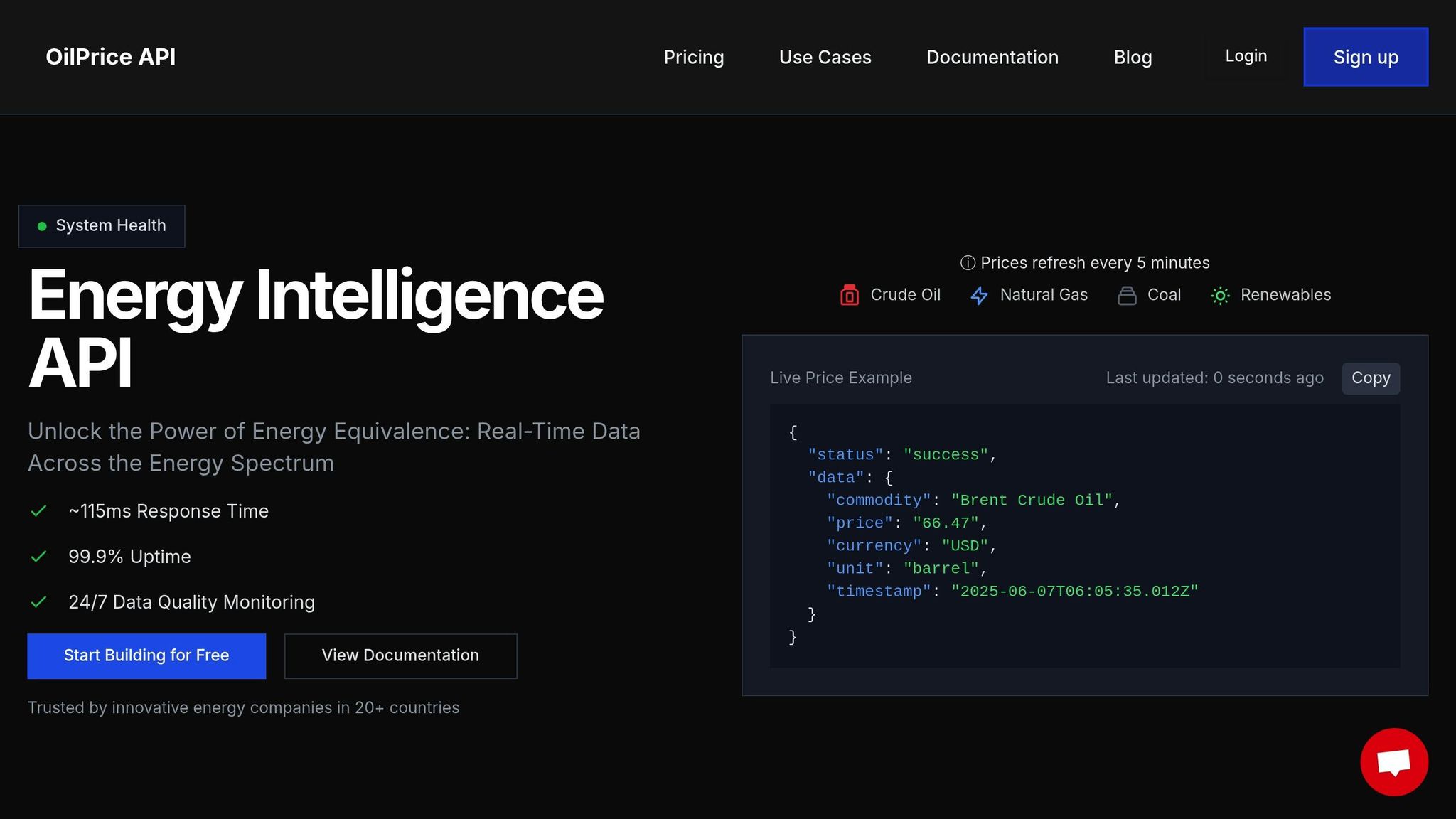
OilpriceAPI provides both real-time and historical pricing data for Brent Crude, WTI, Natural Gas, and Gold through an easy-to-use JSON REST API. This tool simplifies the process of monitoring oil price fluctuations, especially as renewable energy policies continue to shape market dynamics.
Real-time price monitoring is essential for effective analysis. For example, when oil prices averaged $116 per barrel in March 2022, real-time data feeds allowed analysts to quickly assess market conditions. With OilpriceAPI, you can track these price changes as they happen, offering a clear view of market shifts.
Historical data analysis provides a broader perspective by uncovering long-term trends that link oil prices to renewable energy adoption. By studying historical price patterns, you can determine whether recent market changes are short-term fluctuations or part of a larger trend. Combining historical insights with real-time data ensures a well-rounded approach, while customizable alerts and feeds help you stay informed about critical market movements.
Customized data feeds allow you to tailor the information you receive. For instance, you can focus on specific crude grades, regional price variations, or indices that align with renewable energy trends.
Alert systems make it easier to stay on top of significant price changes. You can set up notifications tied to policy events, ensuring you’re always informed without needing to monitor the market constantly.
Adding Data to Market Analysis Systems
Beyond monitoring, integrating real-time data into your analysis systems enhances decision-making during volatile market periods. Scalable systems ensure you can handle continuous updates without missing key insights.
Advanced filtering techniques help prioritize data relevant to renewable energy trends, such as price changes linked to new policies or capacity expansions. This keeps your focus on meaningful updates rather than being overwhelmed by every data point.
Staff training programs are crucial for helping teams interpret real-time data effectively. Training should cover both technical analysis and the strategic implications of how oil prices interact with renewable energy trends.
Flexible analytical strategies ensure your systems can adapt to shifting market conditions. This agility allows you to respond quickly to changes in policy or energy markets.
Machine learning integration takes analysis to the next level by identifying patterns and correlations between renewable energy adoption and oil price trends. These insights can improve the accuracy of your forecasts and reveal hidden connections in large datasets.
Regular system updates keep your tools running smoothly as market conditions and policy frameworks evolve. Staying current ensures your analysis remains effective and aligned with the latest developments.
Integrating real-time data effectively means balancing broad coverage with targeted analysis. This approach highlights the key connections between renewable energy trends and oil price movements, helping you make informed decisions in a fast-changing market.
Summary of Key Indicators and Their Impact
Monitoring key indicators helps uncover how renewable energy policies influence oil prices, offering valuable insights for navigating the intricate energy market where fossil fuels and renewables intersect.
Checklist Review: Indicators to Watch
- Oil Price Volatility: Changes in oil prices directly impact renewable energy adoption. For instance, a 1% rise in oil prices leads to a 0.16% increase in renewable energy consumption.
- Environmental Policy Strength: Strong government incentives and regulations play a critical role in shaping market behavior. Policies that encourage renewable energy investments often limit oil production through climate-focused measures, creating a more predictable investment landscape.
- Renewable Energy Adoption Rates: Tracking how quickly renewables are being integrated into the market is essential. A striking example is the 85% drop in the cost of solar electricity between 2010 and 2020, making renewables increasingly competitive with traditional oil-based energy sources.
"The cost of electricity from solar power fell by 85% between 2010 and 2020".
- Oil Production and Supply-Side Climate Policies: U.S. production levels and policy changes highlight broader trends that influence both oil markets and the renewable sector.
- Economic Growth and Energy Transition Uncertainty: Economic conditions and uncertainty around energy transitions impact renewable energy in complex ways. While some conditions create opportunities, others pose challenges, reflecting broader market sentiment.
Using tools like OilpriceAPI provides real-time data for tracking these indicators. Its JSON REST API offers current pricing for Brent Crude, WTI, Natural Gas, and Gold, allowing professionals to link price movements with renewable energy developments in real time.
These metrics provide a foundation for using real-time data to make strategic decisions.
Using Insights for Better Decisions
By focusing on these key indicators, professionals can derive actionable insights to guide market strategies. For example, the interplay between renewables and oil prices highlights the importance of staying updated with timely data.
"About 80% of the global population lives in countries that are net-importers of fossil fuels".
This underscores the urgency of energy security, which drives investments in renewable energy. Beyond environmental benefits, the economic advantages are clear:
"Every dollar invested in renewables creates three times more jobs than in the fossil fuel industry".
This job creation potential adds a compelling financial incentive to the transition toward renewables. These indicators also help evaluate portfolio diversification opportunities and assess long-term market trends.
Risk management becomes more effective when professionals understand the nuanced relationship between oil and renewables. For instance, while oil supply shocks often have minimal effects on renewables, aggregate demand shocks can reduce renewable investments. Initially, oil demand shocks may dampen renewable appeal, but rising oil prices eventually drive increased renewable consumption.
This intricate relationship calls for ongoing monitoring and analysis to capture both short-term and long-term market dynamics effectively.
FAQs
How do changes in oil prices influence the growth of renewable energy?
When oil prices climb, the appeal of renewable energy sources like solar and wind grows. Why? Because these alternatives often become more cost-effective compared to pricey fossil fuels. This shift frequently sparks greater investments in renewable technologies and motivates both businesses and consumers to adopt cleaner energy options to cut down on expenses.
Rising oil prices can also influence energy policies. Governments and industries may respond by speeding up efforts to transition toward cleaner energy solutions. This relationship underscores how fluctuations in oil prices can directly impact the momentum behind renewable energy adoption.
How do environmental policies impact the connection between renewable energy and oil prices?
Environmental policies play a crucial role in shaping how renewable energy interacts with oil prices. By promoting a move away from fossil fuels toward cleaner energy options, these policies help shield the renewable energy sector from the ups and downs of oil price fluctuations, creating a steadier path for growth.
For instance, when oil prices rise, renewables often become a more appealing alternative, spurring increased investment. On top of that, the expectation of stricter climate regulations can push forward innovation and funding in renewable technologies, strengthening the sector even further. Thoughtfully crafted environmental policies not only encourage the growth of renewable energy but also help stabilize energy markets by reducing their reliance on oil price volatility.
Why is real-time data important for understanding the connection between renewable energy trends and oil prices?
Real-time data plays a crucial role in understanding how renewable energy trends and oil price movements interact. It enables stakeholders to adapt quickly to shifting market conditions, which is vital in a sector where changes can have immediate and far-reaching effects. When oil prices fluctuate, they can directly impact the adoption and use of renewable energy, influencing everything from policy decisions to market strategies.
Access to current data empowers energy producers, policymakers, and investors to track market shifts, anticipate future trends, and make well-informed decisions. This is especially important in today’s rapidly changing energy landscape, where digital tools and instant insights are key to improving efficiency and driving progress. With accurate, real-time information, the energy industry can balance supply and demand more effectively, paving the way for a smoother transition to renewable energy solutions.