Real-Time Alerts for Commodity Price Changes
Real-Time Alerts for Commodity Price Changes
Want to stay ahead in volatile commodity markets? Real-time alerts can give you the edge you need. Businesses relying on manual tracking often miss critical price shifts, leading to lost opportunities and higher costs. Tools like OilpriceAPI deliver instant updates for key commodities, such as Brent Crude and Gold, ensuring faster, more accurate decisions.
Key Takeaways:
- Speed: Automated alerts notify you in seconds, unlike manual tracking, which can take hours.
- Accuracy: OilpriceAPI minimizes errors by cross-referencing trusted data sources.
- Cost: Manual tracking is labor-intensive and expensive, while OilpriceAPI offers a free tier for up to 1,000 requests/month.
- Scalability: Automated tools handle multiple commodities effortlessly, while manual methods struggle to keep up.
For businesses managing fuel costs, hedging prices, or timing purchases, automation saves time, reduces errors, and improves outcomes. While manual methods allow for human judgment, they fall short in speed, scalability, and efficiency. Real-time alerts are the smarter choice for navigating today’s fast-moving markets.
How To Use Price Alerts: Full Walkthrough
1. OilpriceAPI
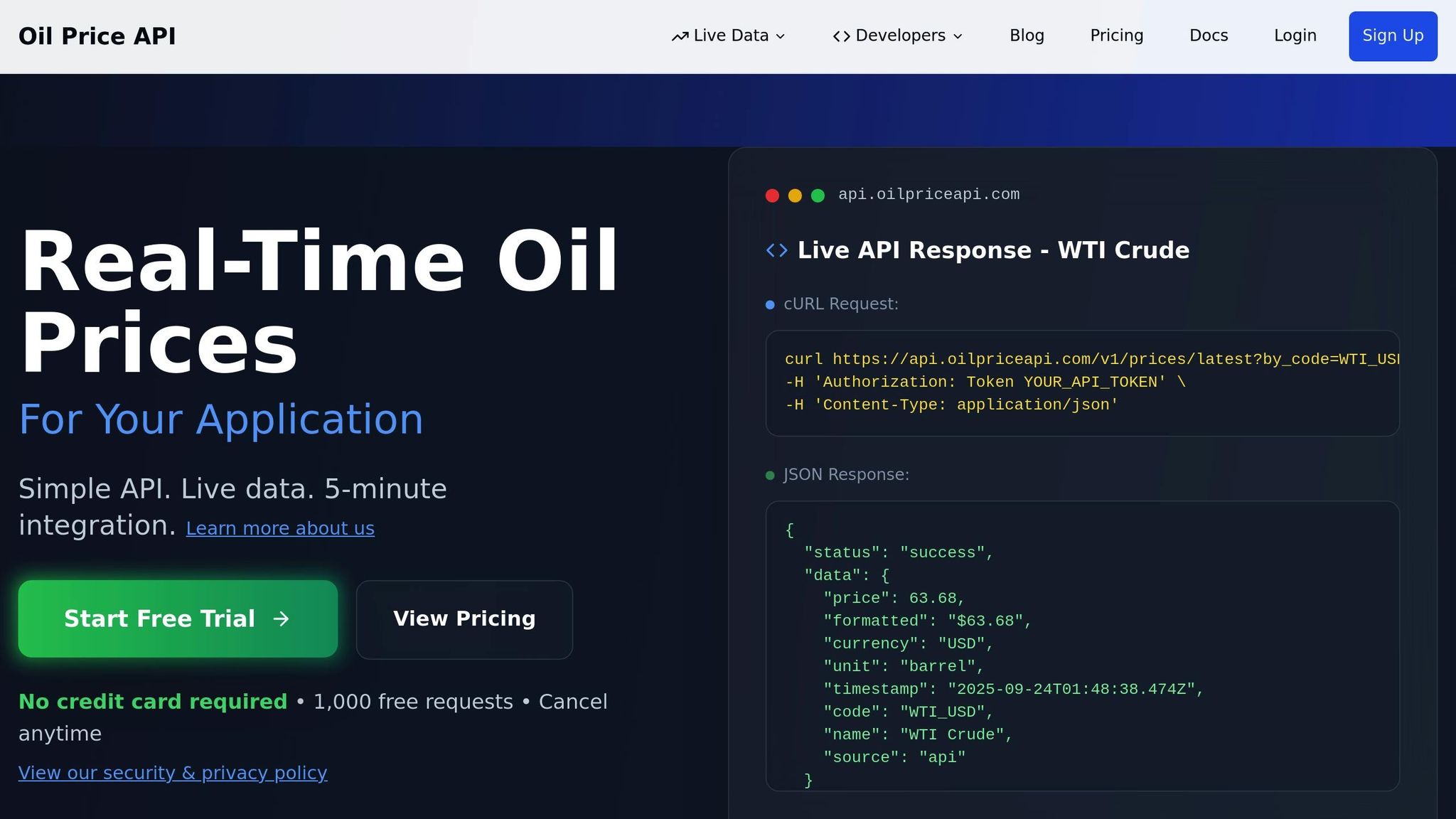
OilpriceAPI delivers real-time alerts for Brent Crude, WTI, Natural Gas, and Gold through its JSON REST API, removing the hassle of manual monitoring. Here's a closer look at what makes it stand out:
Response Time
With OilpriceAPI, price updates reach connected applications in seconds. This speed ensures manufacturers can act quickly - whether it’s managing risks or negotiating contracts - without any delays.
Data Accuracy
OilpriceAPI prioritizes precision by using rigorous data validation methods. It cross-references feeds from trusted market sources and applies real-time checks to catch anomalies. This level of accuracy is critical, especially when even small pricing errors could affect profitability.
Cost Efficiency
For businesses looking to explore real-time monitoring without a big commitment, OilpriceAPI offers a free tier allowing up to 1,000 requests per month - no credit card needed. Compared to traditional market data terminals, which often come with hefty upfront costs and recurring fees, this is a much more accessible option.
Scalability
Whether you’re just starting with basic price tracking or diving into in-depth market analysis, OilpriceAPI’s flexible architecture can grow with your needs. Its simple API endpoints make integration easy, even for teams with limited technical resources.
2. Manual Monitoring Methods
Manual monitoring, unlike automated solutions, struggles to keep up with the fast-paced demands of modern markets. This approach relies on periodic human checks, which often delay critical price updates. Companies typically assign employees to monitor financial websites, review market reports, or contact brokers throughout the day. Let’s break down the challenges manual monitoring faces in terms of response time, accuracy, cost, and scalability.
Response Time
Manual tracking is notoriously slow, often failing to capture rapid price changes. Commodity markets can shift dramatically within minutes, but manual checks may only occur sporadically. For instance, an analyst might check the price of Brent Crude at 9:00 AM and then again around noon, potentially missing a significant price surge in between. These gaps make it nearly impossible to react swiftly to sudden market movements.
Data Accuracy
Human error is a major drawback of manual monitoring. Transcription mistakes and inconsistent timing across various data sources can lead to inaccuracies. These errors can ripple through forecasts and negotiations, undermining decision-making.
Cost Efficiency
Relying on manual tracking can be surprisingly expensive. Each product check costs between $0.50 and $5.00, and teams can lose up to 20 hours a week on this task. For companies monitoring a wide range of commodities across multiple markets, these inefficiencies quickly add up, making the process both time-intensive and costly.
Scalability
Scaling manual monitoring is a logistical nightmare. A small team might handle one or two commodities effectively, but expanding to track multiple commodities or global markets often requires either hiring more staff or reducing the frequency of checks. Neither option is ideal, as both compromise efficiency and effectiveness.
sbb-itb-a92d0a3
Pros and Cons
Real-time alert tools and manual monitoring each come with their own set of strengths and weaknesses when it comes to commodity trading. Tools like OilpriceAPI shine when speed and automation are critical. They deliver notifications in milliseconds, helping traders act on fleeting opportunities that manual methods might miss. For example, a trader using a Brent Crude alert was able to make a timely purchase based on automated insights. These systems also reduce subjective decision-making by relying on real-time, objective data. However, even the best systems can run into issues, such as technical glitches or configuration challenges.
That said, automation isn't without its drawbacks. Poorly set alert parameters can result in notification overload, where excessive alerts make it hard to focus on what truly matters. Over-reliance on these systems may also lead to missed context or false positives, especially if the parameters aren't fine-tuned. On top of that, technical problems or interruptions in data feeds can delay or even block critical alerts during pivotal moments.
On the other hand, manual monitoring has its own advantages. It allows traders to apply human judgment and consider qualitative factors that automated systems might miss. This method can provide more nuanced insights tailored to specific strategies and broader market trends, while also avoiding issues like being overwhelmed by notifications.
However, manual monitoring comes with significant limitations. It’s time-consuming and prone to human error, making it less effective for tracking rapid price changes. It also lacks the scalability of automated tools, making it impractical for monitoring multiple commodities or fast-moving markets. In these situations, even a few minutes’ delay can lead to missed opportunities.
Here’s a quick comparison of the two approaches:
| Criterion | Real-Time Alert Tools (e.g., OilpriceAPI) | Manual Monitoring Methods |
|---|---|---|
| Speed | Instant notifications (milliseconds) | Delayed (minutes to hours) |
| Accuracy | Automated, objective, data-driven | Prone to human error and bias |
| Customization | Highly customizable (thresholds, types) | Limited, manual setup |
| Coverage | Multi-asset, 24/7 monitoring | Limited by human capacity |
| Scalability | Easily scalable to many assets | Not scalable |
| User Effort | Minimal after setup | High, requires constant attention |
| Alert Fatigue | Possible if poorly configured | Not applicable |
| Integration | API/automation ready | Manual only |
| Cost Structure | Subscription/API fees | Labor/time costs |
Ultimately, the choice between these two methods comes down to the scale of operations and the level of risk an organization is willing to take. High-frequency traders and large-scale operations will likely benefit from the speed and automation of tools like OilpriceAPI. Meanwhile, smaller operations with a narrower focus might find manual monitoring sufficient for their needs. Selecting the right approach is key to staying competitive in fast-moving commodity markets.
Conclusion
For U.S. industries that depend on commodity prices, real-time alerts are a game-changer. Chris Griggs, Product Marketing Manager for Enverus Intelligence® | Research (EIR) and Trading & Risk, puts it best:
"Staying on top of sharp price fluctuations can make or break your investments, and the last thing you want is to miss a valuable opportunity because you didn't receive real-time updates. Just a few minutes can make a monumental difference".
Automated price monitoring tools bring measurable benefits - boosting pricing efficiency by 15-20% and improving retail margins by 2-7% through smarter pricing decisions and less manual effort. In the fast-moving U.S. commodity markets, where prices can change several times a day, these improvements are more than just numbers - they're a direct pathway to staying ahead of the competition.
Take OilpriceAPI as an example. It delivers instant alerts for key commodities like Brent Crude, WTI, Natural Gas, and Gold. By automating price monitoring, it not only cuts operational costs but also simplifies decision-making processes. These are critical advantages for businesses navigating volatile markets.
In essence, automated alerts consistently outperform manual methods in speed, accuracy, and cost-effectiveness. For any business aiming to seize market opportunities, real-time alert systems aren't just helpful - they're essential. While manual tracking might work for very small operations, businesses with growth ambitions should prioritize automation to stay competitive.
Ultimately, this isn't just about keeping up with market trends - it's about ensuring your business is ready to act swiftly in a world where timing can make all the difference.
FAQs
How can real-time commodity price alerts improve business decision-making compared to manual tracking?
Real-time commodity price alerts empower businesses to act swiftly and make well-informed decisions by delivering immediate updates on market movements. These alerts enable companies to react promptly to price shifts, minimizing risks and seizing opportunities as they emerge.
Relying on manual tracking often leads to delays and inefficiencies, but real-time alerts eliminate these hurdles by providing the latest market data instantly. This approach helps businesses refine their market timing, streamline operations, and maintain a competitive edge - especially in industries where even minor price changes can lead to major consequences.
What challenges might arise when using automated alert systems like OilpriceAPI, and how can they be addressed?
Automated alert systems, like OilpriceAPI, are incredibly useful but not without their challenges. Technical glitches, delayed updates, or an over-reliance on automation can sometimes result in missed or outdated alerts. This is particularly concerning during periods of high market volatility when prices can shift in the blink of an eye.
To work around these hurdles, it’s a good idea to pair real-time alerts with manual checks to confirm critical details. Incorporating solid risk management strategies - such as financial hedging - can also help cushion potential losses. Keeping the system updated and monitoring its performance regularly ensures it stays accurate and dependable, even in fast-moving markets. Striking a balance between automation and hands-on management can empower users to make smarter, more confident decisions.
How does OilpriceAPI provide accurate and reliable real-time commodity price alerts?
OilpriceAPI provides precise, real-time commodity price alerts by utilizing advanced analytics and powerful data processing. It employs tools such as moving averages and volatility metrics to deliver highly accurate insights. Prices are calculated down to two decimal places using midpoint rate calculations, ensuring precision. With impressive uptime, the platform offers consistent performance, enabling users to confidently base their decisions on the latest data.